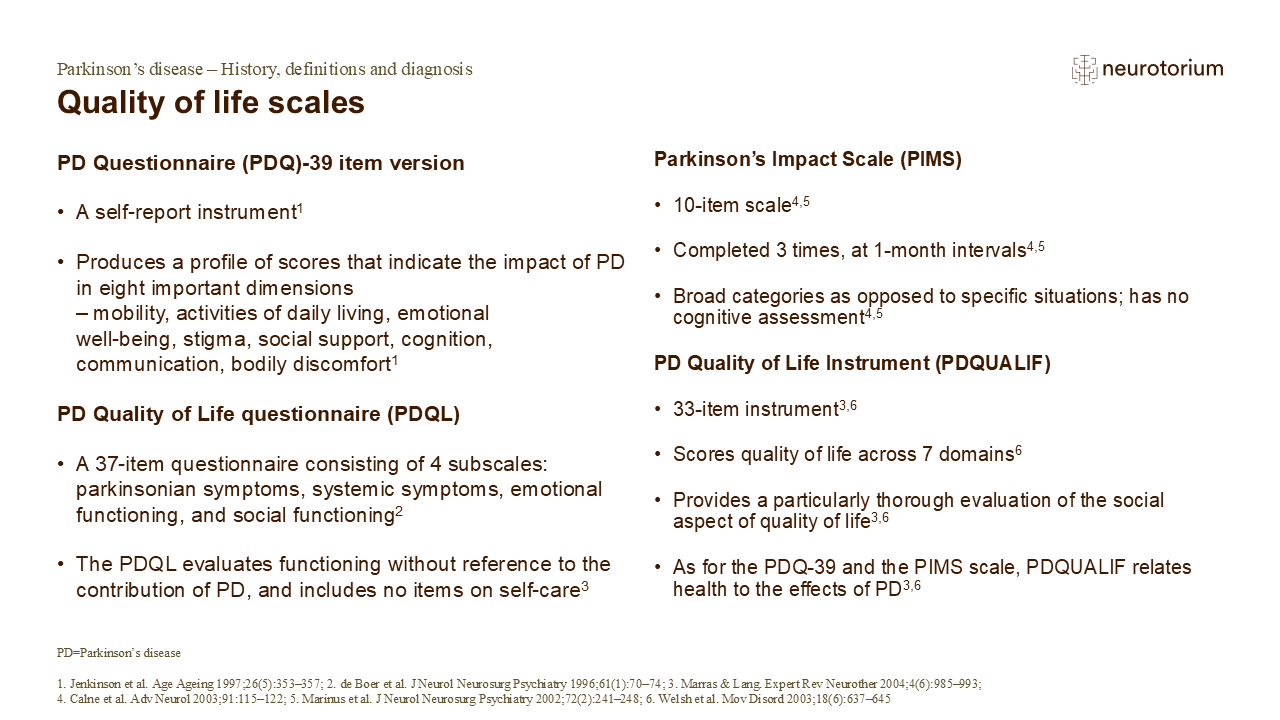
Validated questionnaires that assess quality of life are particularly meaningful as they provide an assessment of health and wellbeing from the perspective of the patient.7
The choice of therapy should always aim to optimise the quality of life over the whole expected lifespan of an individual.8 Assessments should take into account the impact of both motor and non-motor symptoms as, particularly during the advanced stages of PD, non-motor symptoms may have a greater impact on quality of life.7
References:
1. Jenkinson C, Fitzpatrick R, Peto V, et al. The Parkinson’s Disease Questionnaire (PDQ-39): development and validation of a Parkinson’s disease summary index score. Age Ageing 1997; 26 (5): 353–357.
2.de Boer AG, Wijker W, Speelman JD, de Haes JC. Quality of life in patients with Parkinson’s disease: development of a questionnaire. J Neurol Neurosurg Psychiatry 1996; 61 (1): 70–74.
3.Marras C, Lang AE. Outcome measures for clinical trials in Parkinson’s disease: achievements and shortcomings. Expert Rev Neurother 2004; 4 (6): 985–993.
4.Calne SM, Mak E, Hall J, et al. Validating a quality-of-life scale in caregivers of patients with Parkinson’s disease: Parkinson’s Impact Scale (PIMS). Adv Neurol 2003; 91: 115–122.
5.Marinus J, Ramaker C, van Hilten JJ, Stiggelbout AM. Health related quality of life in Parkinson’s disease: a systematic review of disease specific instruments. J Neurol Neurosurg Psychiatry 2002; 72 (2): 241–248.
6.Welsh M, McDermott MP, Holloway RG; Parkinson Study Group. Development and testing of the Parkinson’s disease quality of life scale. Mov Disord 2003; 18 (6): 637–645.
7.Schrag A, Jahanshahi M, Quinn N. What contributes to quality of life in patients with Parkinson’s disease? J Neurol Neurosurg Psychiatry 2000; 69 (3): 308–312.
8.National Collaborating Centre for Chronic Conditions. Parkinson’s disease: national clinical guideline for diagnosis and management in primary and secondary care. London: Royal College of Physicians, 2006.