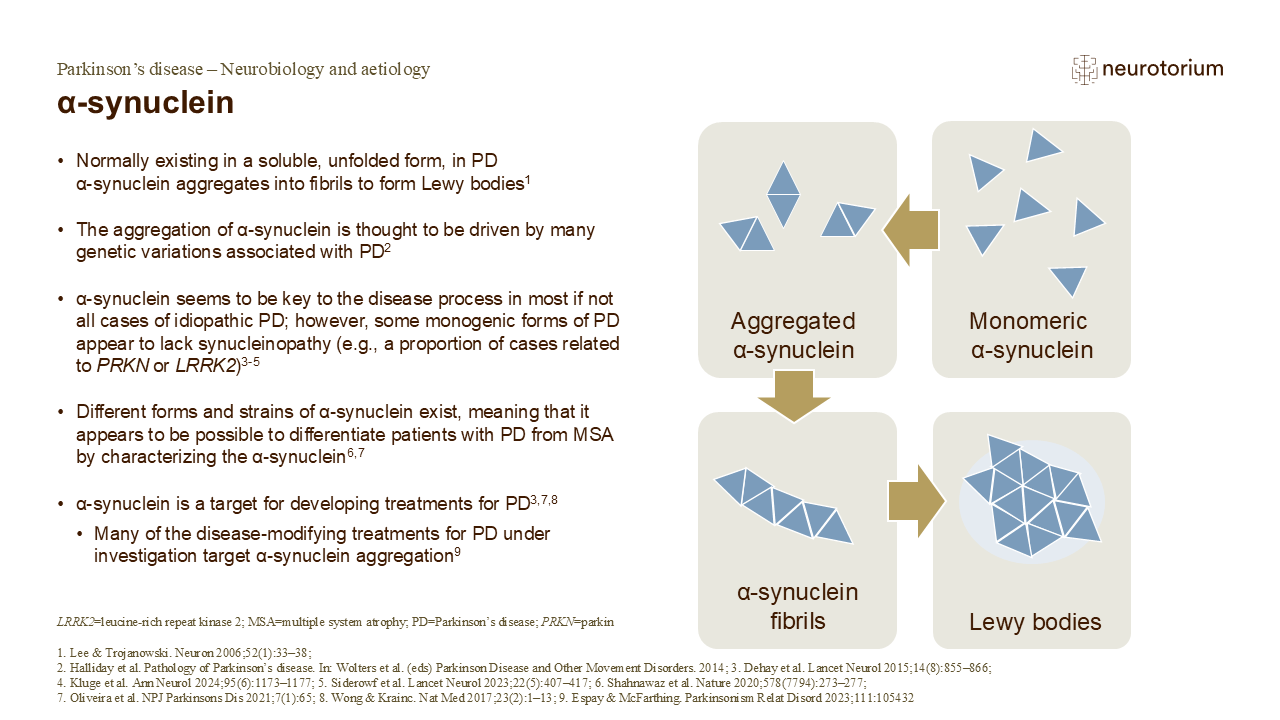
The protein α-synuclein was first isolated from human brain tissue during the early 1990s.10 Its role in PD only became apparent in 1997, when a mutation in the α-synuclein gene was discovered in groups of patients with a rare, autosomal dominant form of familial parkinsonism,11 and the major component of Lewy bodies was identified as α-synuclein.12 While the precise functional mechanisms of α-synuclein are still being elucidated, it appears to interact with and affect various proteins involved with vesicle formation, vesicle pools, and pore opening of the presynaptic terminal.2,10,13
A key feature of PD is the aggregation – or clumping together – of misfolded α-synuclein into small filaments called ‘fibrils’.7 This aggregation continues until Lewy bodies are formed, which can ultimately lead to the destruction of the neuron.7 The accumulation of α-synuclein in the development of PD means that the condition is often referred to as one of the ‘synucleinopathies’, along with several other neurodegenerative disorders (mainly dementia with Lewy bodies, and multiple system atrophy).10 It is hoped that, by limiting the accumulation of α‑synuclein, these disorders can be prevented from developing in the first place.10
References:
1.Lee VM, Trojanowski JQ. Mechanisms of Parkinson’s disease linked to pathological alpha-synuclein: new targets for drug discovery. Neuron 2006; 52 (1): 33–38.
2.Halliday GM, Murphy K, Cartwright H. Pathology of Parkinson’s disease. In: Wolters & Baumann (eds). Parkinson Disease and Other Movement Disorders. VU University Press, 2014.
3.Dehay B, Bourdenx M, Gorry P, et al. Targeting α-synuclein for treatment of Parkinson’s disease: mechanistic and therapeutic considerations. Lancet Neurol 2015; 14 (8): 855–866.
4.Kluge A, Borsche M, Streubel-Gallasch L, et al. α-Synuclein pathology in PRKN-linked Parkinson’s disease: new insights from a blood-based seed amplification assay. Ann Neurol 2024; 95 (6): 1173–1177.
5.Siderowf A, Concha-Marambio L, Lafontant DE, et al.; Parkinson’s Progression Markers Initiative. Assessment of heterogeneity among participants in the Parkinson’s Progression Markers Initiative cohort using α-synuclein seed amplification: a cross-sectional study. Lancet Neurol 2023; 22 (5): 407–417.
6.Shahnawaz M, Mukherjee A, Pritzkow S, et al. Discriminating α-synuclein strains in Parkinson’s disease and multiple system atrophy. Nature 2020; 578 (7794): 273–277.
7.Oliveira LMA, Gasser T, Edwards R, et al. Alpha-synuclein research: defining strategic moves in the battle against Parkinson’s disease. NPJ Parkinsons Dis 2021; 7 (1): 65.
8.Wong YC, Krainc D. α-synuclein toxicity in neurodegeneration: mechanism and therapeutic strategies. Nat Med 2017; 23 (2): 1–13.
9.Espay AJ, McFarthing K. Alpha-synuclein and the Parkinson’s disease drug pipeline. Parkinsonism Relat Disord 2023; 111: 105432.
10.Burré J. The synaptic function of α-synuclein. J Parkinson Dis 2015; 5 (4): 699–713.
11.Polymeropoulos MH, Lavedan C, Leroy E, et al. Mutation in the alpha-synuclein gene identified in families with Parkinson’s disease. Science 1997; 276 (5321): 2045–2047.
12.Spillantini MG, Schmidt ML, Lee VM, et al. Alpha-synuclein in Lewy bodies. Nature 1997; 388 (6645): 839–840.
13.Sharma M, Burré J. α-Synuclein in synaptic function and dysfunction. Trends Neurosci 2023; 46 (2): 153–166.