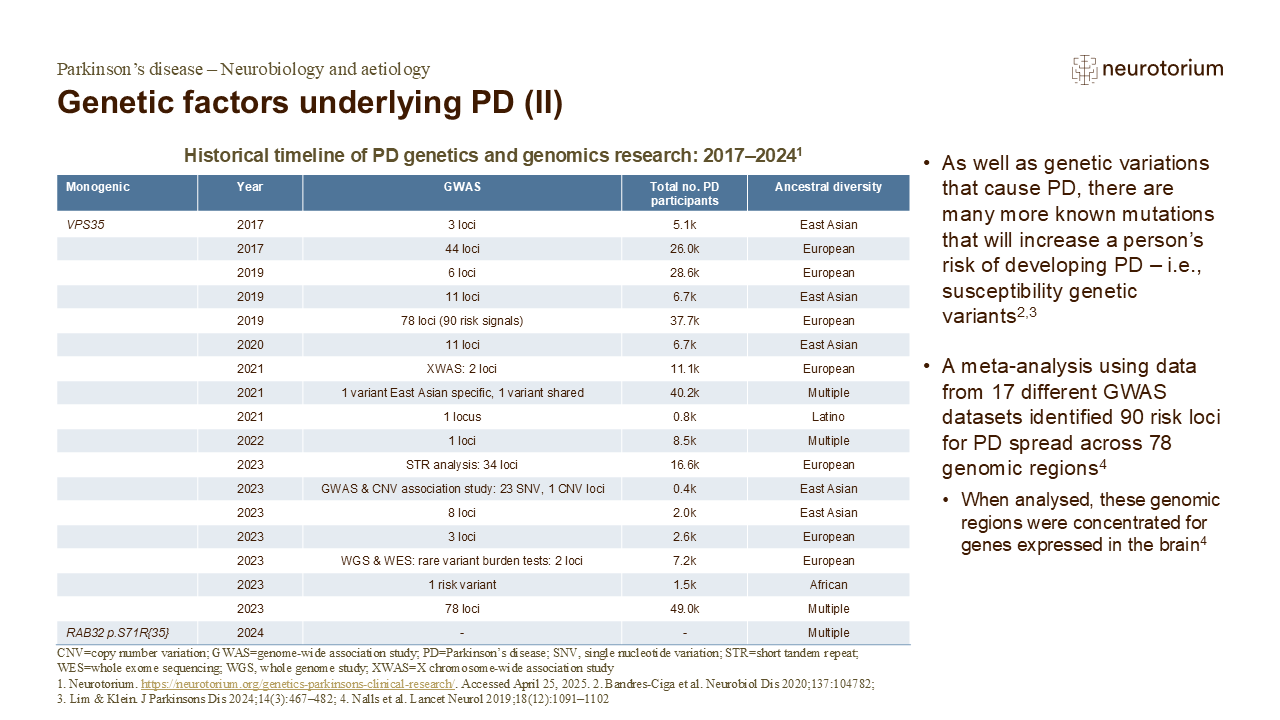
There are many known and hypothesized genes linked with PD, as outlined on the slide.2-5 Indeed, some have argued that PD can be viewed as predominantly a genetic disease, in which all the known environmental factors act within the context of genetic risk.3 This does not ignore the known environmental factors influencing PD risk – and indeed the increase in the prevalence of PD seen in the past decades – but rather argues that these factors are interacting with underlying genetics to produce disease.3
References:
1.Neurotorium. https://neurotorium.org/genetics-parkinsons-clinical-research/. Accessed April 25, 2025.
2.Bandres-Ciga S, Diez-Fairen M, Kim JJ, Singleton AB. Genetics of Parkinson’s disease: an introspection of its journey towards precision medicine. Neurobiol Dis 2020; 137: 104782.
3.Lim SY, Klein C. Parkinson’s disease is predominantly a genetic disease. J Parkinsons Dis 2024; 14 (3): 467–482.
4.Nalls MA, Blauwendraat C, Vallerga CL, et al.; 23andMe Research Team; System Genomics of Parkinson’s Disease Consortium; International Parkinson’s Disease Genomics Consortium. Identification of novel risk loci, causal insights, and heritable risk for Parkinson’s disease: a meta-analysis of genome-wide association studies. Lancet Neurol 2019; 18 (12): 1091–1102.
5.Blauwendraat C, Nalls MA, Singleton AB. The genetic architecture of Parkinson’s disease. Lancet Neurol 2020; 19 (2): 170–178.