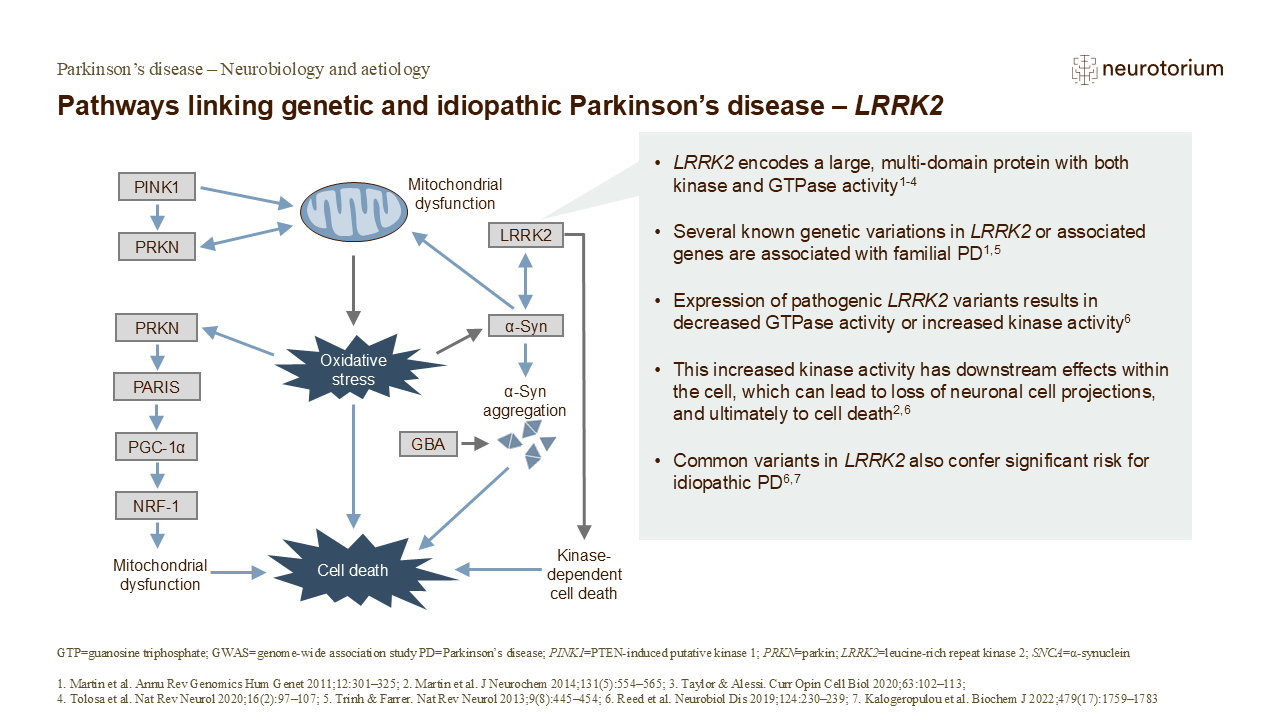
LRRK2 is a large and complex protein with multiple domains and functions, such as GTPase and kinase activity, and protein binding.1-3 Some LRRK2 variants are known to cause monogenic PD, whilst other LRRK2 polymorphisms are associated with an increased risk of PD.1,3
Mutations in LRRK2 are thought to disrupt its cellular functions by increasing the kinase activity.3,6 The upregulation of LRRK2 kinase activity results in phosphorylation of targets within the cell, including a family of proteins known as RAB proteins, which are important mediators of intracellular membrane sorting.6 One such protein is RAB32, variations in which have independently been identified as a suspected susceptibility gene for PD, adding validity to the importance of this pathway in the aetiology of PD.8
Another of the mechanisms by which LRRK2 plays a role in the pathogenesis of PD may be through its interactions with α-synuclein.9 Rats deficient in LRRK2 expression are protected from the degeneration of dopaminergic neurons caused by overexpression of α-synuclein.9 Another mechanism may involve the promotion of neuroinflammation, a process thought to play a key role in the pathogenesis of PD.9
References:
1.Martin I, Dawson VL, Dawson TM. Recent advances in the genetics of Parkinson’s disease. Annu Rev Genomics Hum Genet 2011; 12: 301–325.
2.Martin I, Kim JW, Dawson VL, Dawson TM. LRRK2 pathobiology in Parkinson’s disease. J Neurochem 2014; 131 (5): 554–565.
3.Taylor M, Alessi DR. Advances in elucidating the function of leucine-rich repeat protein kinase-2 in normal cells and Parkinson’s disease. Curr Opin Cell Biol 2020; 63: 102–113.
4.Tolosa E, Vila M, Klein C, Rascol O. LRRK2 in Parkinson disease: challenges of clinical trials. Nat Rev Neurol 2020; 16 (2): 97–107.
5.Trinh J, Farrer M. Advances in the genetics of Parkinson disease. Nat Rev Neurol 2013; 9 (8): 445–454.
6.Reed X, Bandrés-Ciga S, Blauwendraat C, Cookson MR. The role of monogenic genes in idiopathic Parkinson’s disease. Neurobiol Dis 2019; 124: 230–239.
7.Kalogeropulou AF, Purlyte E, Tonelli F, et al. Impact of 100 LRRK2 variants linked to Parkinson’s disease on kinase activity and microtubule binding. Biochem J 2022; 479 (17): 1759–1783.
8.Hop PJ, Lai D, Keagle PJ, et al. Systematic rare variant analyses identify RAB32 as a susceptibility gene for familial Parkinson’s disease. Nat Genet 2024; 56 (7): 1371–1376.
9.Daher JP, Volpicelli-Daley LA, Blackburn JP, et al. Abrogation of α-synuclein-mediated dopaminergic neurodegeneration in LRRK2-deficient rats. Proc Natl Acad Sci USA 2014; 111 (25): 9289–9294.