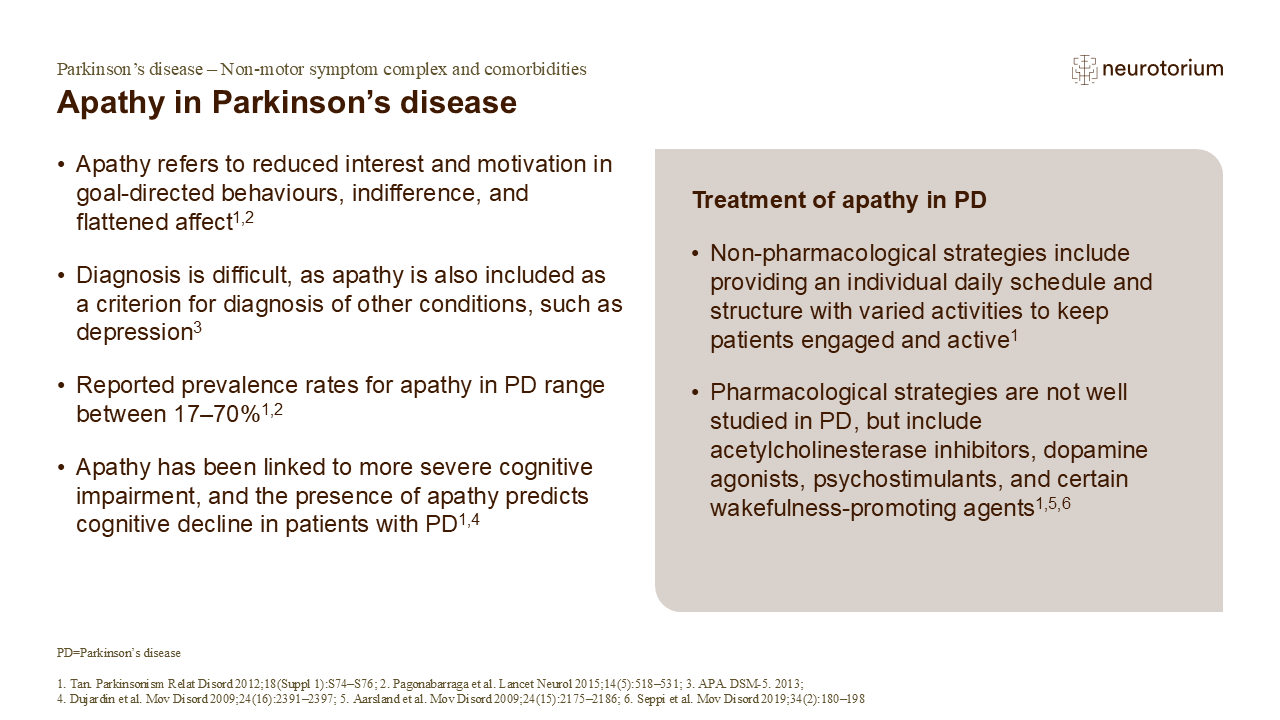
Apathy refers to a set of behavioural, emotional and cognitive features that involve reduced interest and motivation in goal-directed behaviours, indifference, and flattened mood.1,2 Essentially, the individual lacks motivation and they appear to be emotionally numb.1,2 Apathy in patients with PD is associated with poor quality of life, impaired daily functioning, medication non-compliance, and increased mortality.7,8
Apathy can be a component of depression, but it is not uncommon to find apathy in patients who do not suffer from depression.3 Apathy may also be one of the more frequent and distressing neuropsychiatric symptoms of PD for caregivers and next of kin.8
There is emerging evidence from clinical studies for pharmacological treatments including medications that enhance cholinergic and/or dopaminergic neurotransmission.2,6 Some studies have reported that motivation is greater during ‘ON’ states when levodopa levels are at their most effective, suggesting that optimising dopaminergic medication may prove beneficial.8
References:
1. Tan LC. Mood disorders in Parkinson’s disease. Parkinsonism Relat Disord 2012; 18 (Suppl 1): S74–S76.
2. Pagonabarraga J, Kulisevsky J, Strafella AP, Krack P. Apathy in Parkinson’s disease: clinical features, neural substrates, diagnosis, and treatment. Lancet Neurol 2015; 14 (5): 518–531.
3. American Psychiatric Association. Diagnostic and statistical manual of mental disorders, 5th edition text revision. Arlington, VA: American Psychiatric Publishing, 2022.
4. Dujardin K, Sockeel P, Delliaux M, et al. Apathy may herald cognitive decline and dementia in Parkinson’s disease. Mov Disord 2009; 24 (16): 2391–2397.
5. Aarsland D, Marsh L, Schrag A. Neuropsychiatric symptoms in Parkinson’s disease. Mov Disord 2009; 24 (15): 2175–2186.
6. Seppi K, Ray Chaudhuri K, Coelho M, et al. Update on treatments for nonmotor symptoms of Parkinson’s disease – an evidence-based medicine review. Mov Disord 2019; 34 (2): 180–198.
7. Barone P, Antonini A, Colosimo C, et al. The PRIAMO study: a multicenter assessment of nonmotor symptoms and their impact on quality of life in Parkinson’s disease. Mov Disord 2009; 24 (11): 1641–1649.
8. Connolly B, Fox SH. Treatment of cognitive, psychiatric, and affective disorders associated with Parkinson’s disease. Neurotherapeutics 2014; 11 (1): 78–91.