

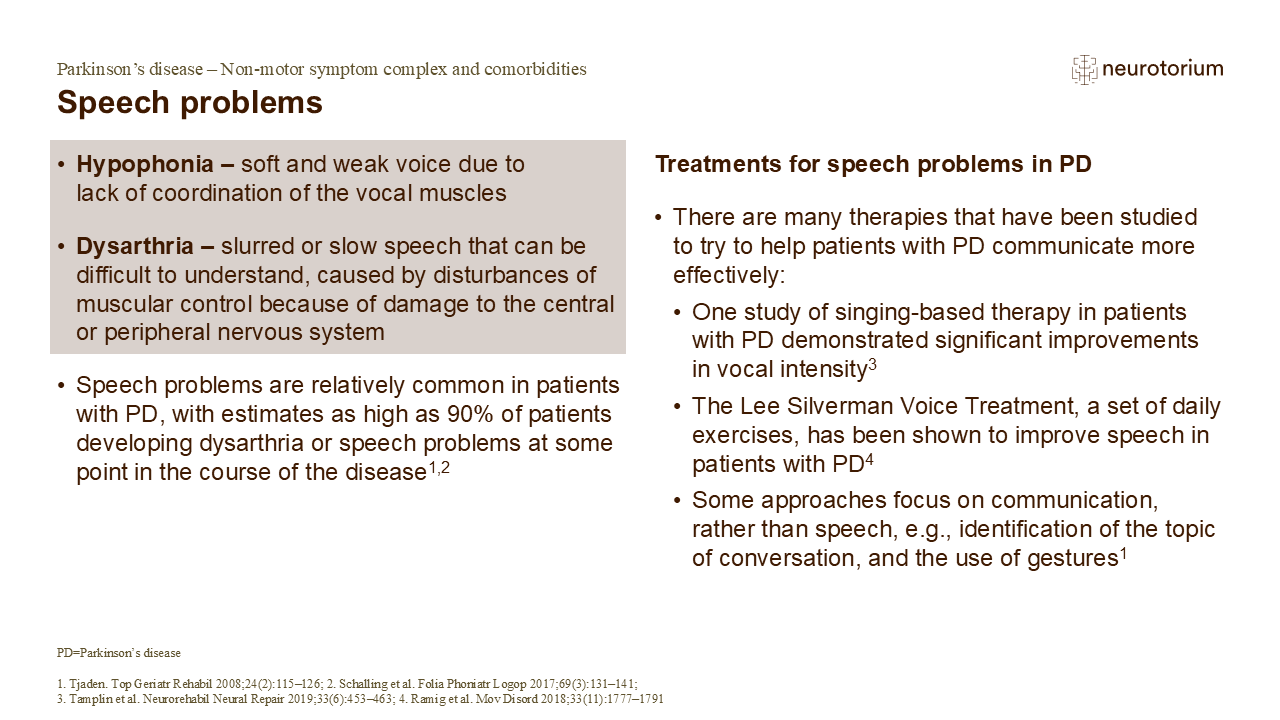
At first, problems with speech may not be noticeable to the affected individual but, as the disease progresses, they may become more difficult to understand as their words become slurred or slow.1 The pitch and loudness of the voice become more monotonous, and generally quieter than usual (hypophonia).1 Sentences may be cut short by inappropriate silences, and the pace of words is either too rushed or too slow, compared to normal speech.1 Occasionally, the tone of the voice itself may change, becoming more nasal, harsh, or breathy.1
The communication problems faced by patients with PD often run deeper than speech; patients can also experience problems with word retrieval.5 One qualitative analysis highlighted the multifaceted nature of the communication problems that patients with PD face in everyday conversations.5 Examples include patients failing to communicate the essential information of a sentence, mixing up words, and using atypical words or phrases.5
References:
1. Tjaden K. Speech and swallowing in Parkinson’s disease. Top Geriatr Rehabil 2008; 24 (2): 115–126.