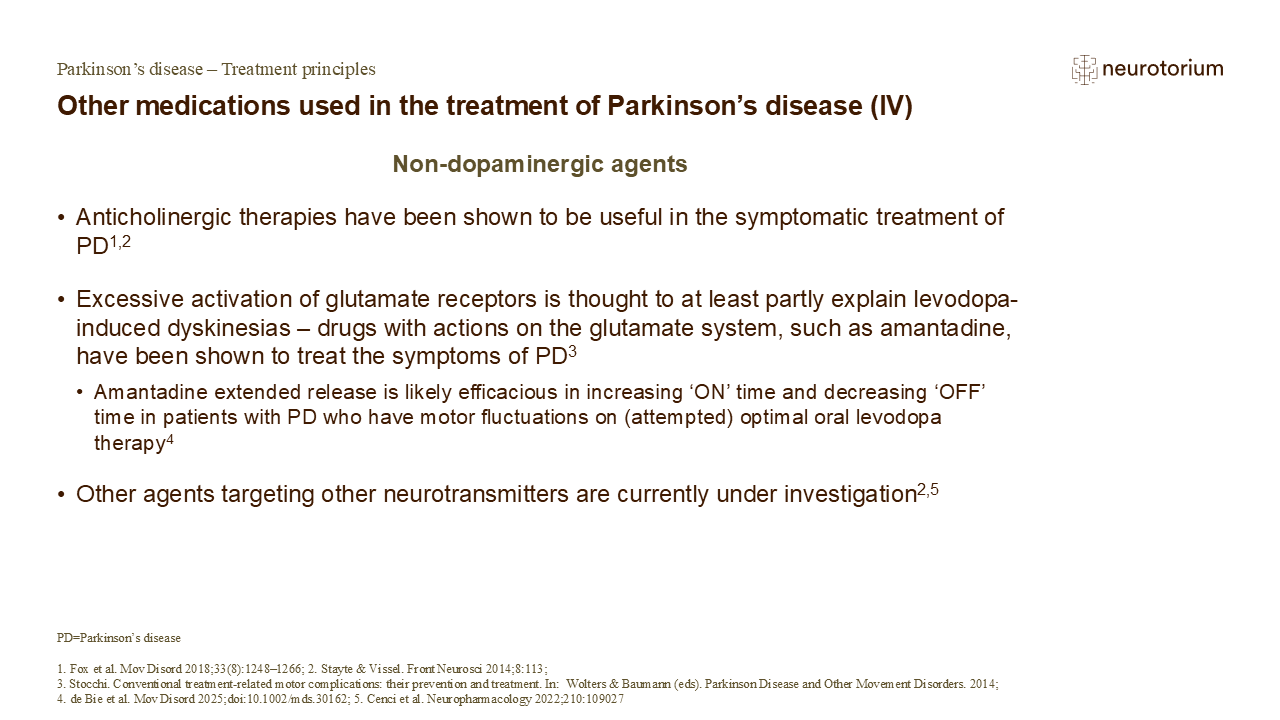
Certain non-dopaminergic agents help to reduce dyskinesias,6 but have the limitation of worsening side effects, such as hallucinations and psychosis, in some individuals.7 Non-dopaminergic agents have also been licensed for patients with moderate to advanced PD experiencing motor fluctuations.8
References:
1. Fox SH, Katzenschlager R, Lim S-Y, et al. International Parkinson and Movement Disorder Society evidence-based medicine review: update on treatments for the motor symptoms of Parkinson’s disease. Mov Disord 2018; 33 (8): 1248–1266.
2. Stayte S, Vissel B. Advances in non-dopaminergic treatments for Parkinson’s disease. Front Neurosci 2014; 8: 113.
3. Stocchi F. Conventional treatment-related motor complications: their prevention and treatment. In: Wolters & Baumann (eds). Parkinson Disease and Other Movement Disorders. VU University Press, 2014.
4. de Bie RMA, Katzenschlager R, Swinnen BEKS, et al. Update on treatments for Parkinson’s disease motor fluctuations – An International Parkinson and Movement Disorder society evidence-based medicine review. Mov Disord 2025; doi: 10.1002/mds.30162.
5. Cenci MA, Skovgård K, Odin P. Non-dopaminergic approaches to the treatment of motor complications in Parkinson’s disease. Neuropharmacology 2022; 210: 109027.
6. Factor SA. Current status of symptomatic medical therapy in Parkinson’s disease. Neurotherapeutics 2008; 5 (2): 164–180.
7. Müller T. Drug therapy in patients with Parkinson’s disease. Transl Neurodegener 2012; 1 (1): 10.
8. Jing X-Z, Yuan X-Z, Luo X, et al. An update on nondopaminergic treatments for motor and non-motor symptoms of Parkinson’s disease. Curr Neuropharmacol 2023; 21 (8): 1806–1826.