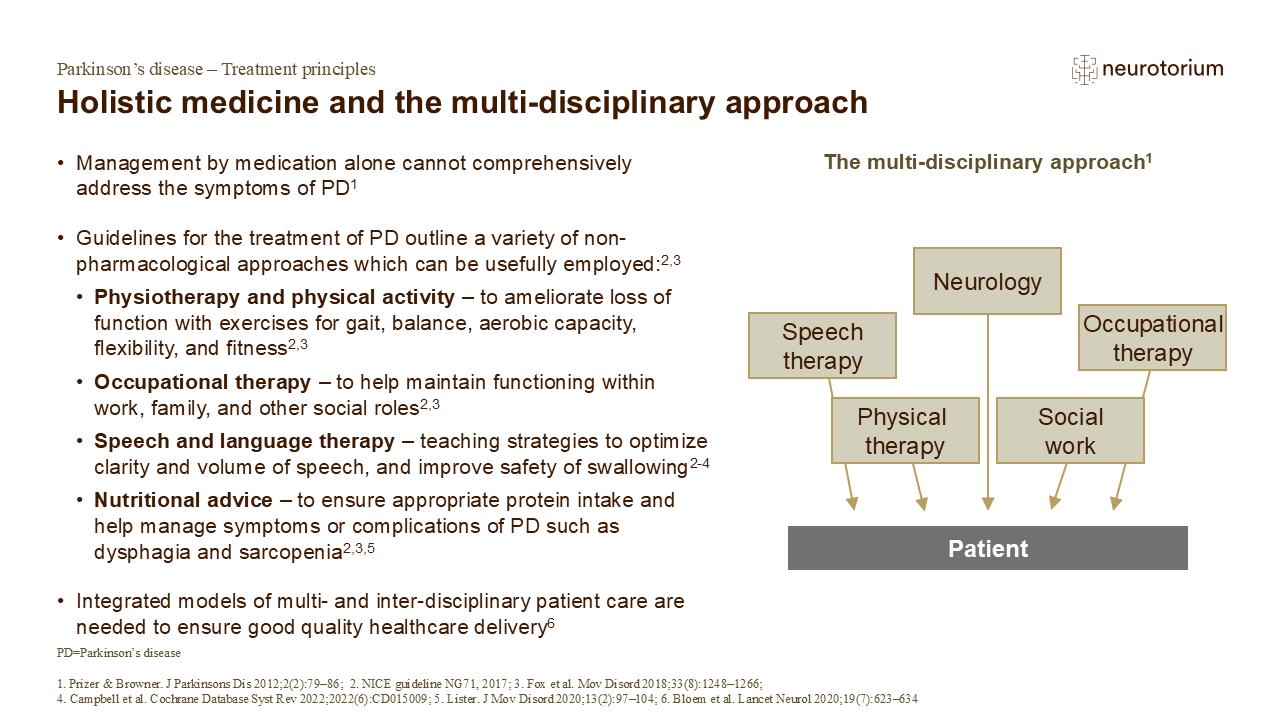
The primary emphasis of the care of patients with PD should focus on maximising their quality of life and reducing disability.1 Conventional medical and surgical therapies are still limited to providing only partial relief.1 Research has shown that the incorporation of allied healthcare clinicians, such as specialist nurses, physiotherapists and speech therapists, is essential to provide the best quality of care for patients with PD.1,7,8 Ideally, this should be organised using an integrative and interdisciplinary model, which promotes open and continuing communication between the patient and all of the clinicians and other practitioners involved in care.1,6,7 The integrated, holistic approach allows patient preferences and goals to be incorporated into treatment.1,7
References:
1. Prizer LP, Browner N. The integrative care of Parkinson’s disease: a systematic review. J Parkinsons Dis 2012; 2 (2): 79–86.
2. National Institute for Health and Care Excellence. Parkinson’s disease in adults. Guideline 71. July 2017.
3. Fox SH, Katzenschlager R, Lim S-Y, et al. International Parkinson and Movement Disorder Society evidence-based medicine review: update on treatments for the motor symptoms of Parkinson’s disease. Mov Disord 2018; 33 (8): 1248–1266.
4. Campbell P, Rooney S, Nicoll A, et al. Speech and language therapy interventions for speech problems in Parkinson’s disease. Cochrane Database Syst Rev 2022; 2022 (6): CD015009.
5. Lister T. Nutrition and lifestyle interventions for managing Parkinson’s disease: a narrative review. 13 (2): 97–104.
6. Bloem BR, Henderson EJ, Dorsey ER, et al. Integrated and patient-centred management of Parkinson’s disease: a network model for reshaping chronic neurological care. Lancet Neurol 2020; 19 (7): 623–634.
7. Lim S-Y, Tan AH, Fox SH, et al. Integrating patient concerns into Parkinson’s disease management. Curr Neurol Neurosci Rep 2017; 17 (1): 3.
8. Ypinga JHL, de Vries NM, Boonen LHHM, et al. Effectiveness and costs of specialised physiotherapy given via ParkinsonNet: a retrospective analysis of medical claims data. Lancet Neurol 2018; 17 (2): 153–161.