

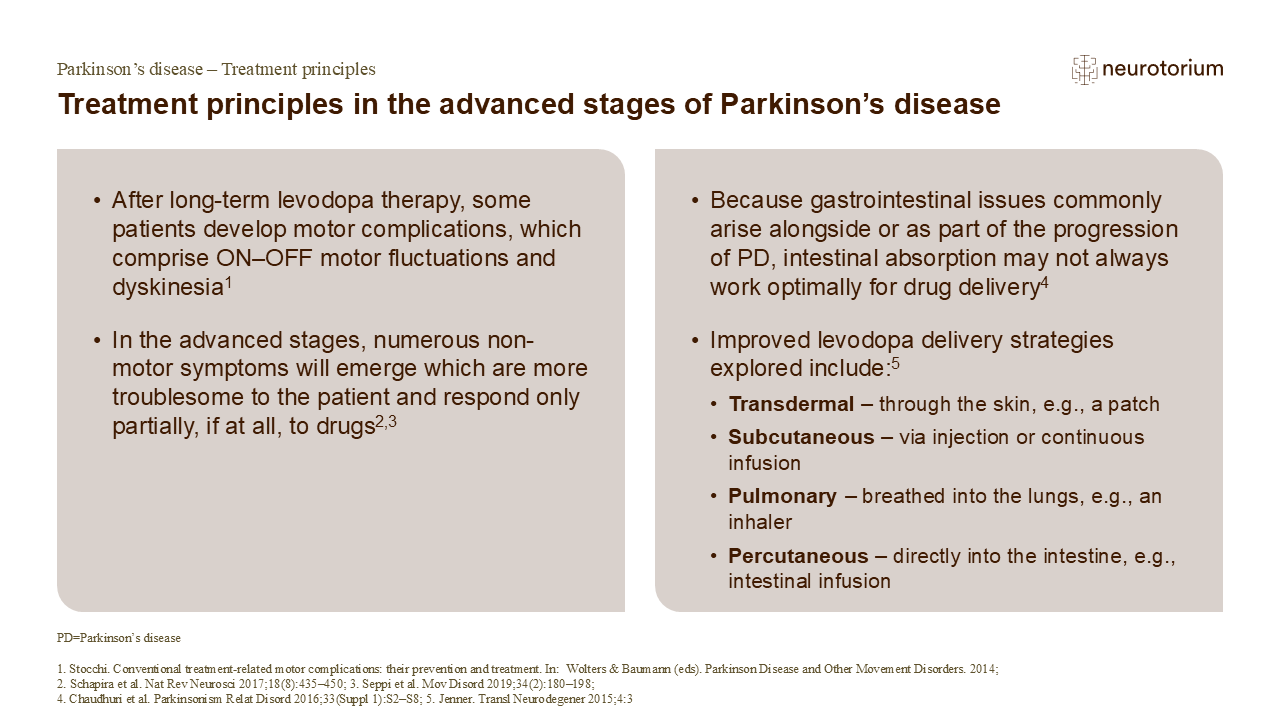
Although levodopa and dopamine agonists are initially able to control motor symptoms effectively, eventually most patients will start to develop motor complications, which comprise ON– OFF motor fluctuations and dyskinesia.1
‘Wearing-off’ is one of the more troublesome problems associated with long-term dopaminergic therapy.5 It is characterised by an increasingly short duration of effect of individual doses of levodopa or dopamine agonists, which results in a faster reversion to uncontrolled motor symptoms.5
Current treatment of ‘wearing-off’ attempts to provide a more sustained and continuous delivery of dopaminergic medication by (a) increasing the frequency or dosage of medication, (b) splitting a single, large dose over several, smaller administrations (‘fractionation’), or (c) using a modified release form of medication, which remains effective over a longer duration.5
During late-stage PD, oral administration of dopaminergic medication becomes less effective as patients experience more fluctuations and motor complications,5 and may also have difficulty swallowing.6 Several non-oral alternatives have been developed, including transdermal (e.g., patches), pulmonary (e.g., inhalers or nebulisers), nasal (e.g., intranasal sprays), buccal (e.g., absorbed under the tongue), and intraduodenal (intestinal infusion) medications.5