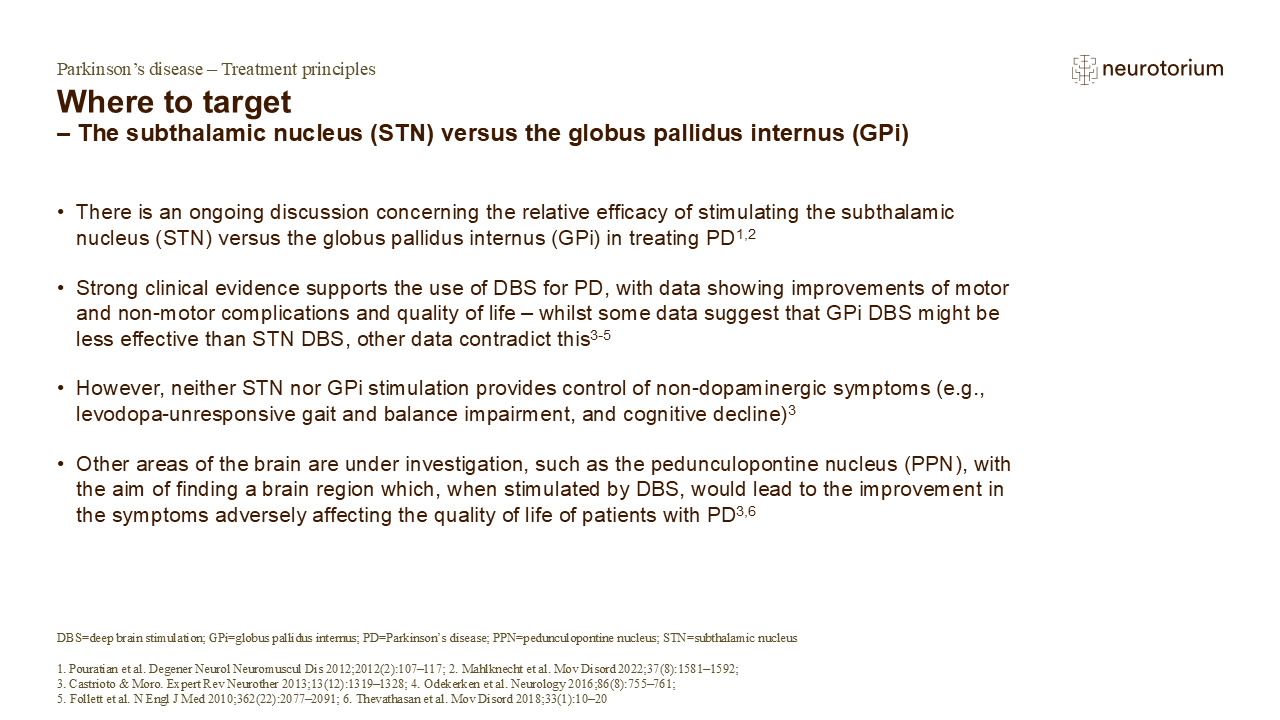
The most common targets for DBS are the subthalamic nucleus (STN) and the globus pallidus internus (GPi).1 However, the optimal choice of target is still unclear since, when looking at the evidence, there do not appear to be unequivocal, clinically significant differences that make one target obviously superior to the other.7
Some researchers have expressed concerns that STN DBS may have more significant adverse effects on cognition, as compared with GPi DBS.8 However, a high-quality trial showed no difference between the two methods in a combined score of cognition, mood, and behaviour.4
References:
1. Pouratian N, Thakkar S, Kim W, Bronstein JM. Deep brain stimulation for the treatment of Parkinson’s disease: efficacy and safety. Degener Neurol Neuromuscul Dis 2012; 2012 (2): 107–117.
2. Mahlknecht P, Foltynie T, Limousin P, Poewe W. How does deep brain stimulation change the course of Parkinson’s disease? Mov Disord 2022; 37 (8): 1581–1592.
3. Castrioto A, Moro E. New targets for deep brain stimulation treatment of Parkinson’s disease. Expert Rev Neurother 2013; 13 (12): 1319–1328.
4. Odekerken VJJ, Boel JA, Schmand BA, et al. GPi vs STN deep brain stimulation for Parkinson disease: three-year follow-up. Neurology 2016; 86 (8): 755–761.
5. Follett KA, Weaver FM, Stern M, et al. Pallidal versus subthalamic deep-brain stimulation for Parkinson’s disease. N Engl J Med 2010; 362 (22): 2077–2091.
6. Thevathasan W, Debu B, Aziz T, et al. Pedunculopontine nucleus deep brain stimulation in Parkinson’s disease: a clinical review. Mov Disord 2018; 33 (1): 10–20.
7. Tan Z-G, Zhou Q, Huang T, Jiang Y. Efficacies of globus pallidus stimulation and subthalamic nucleus stimulation for advanced Parkinson’s disease: a meta-analysis of randomized controlled trials. Clin Interv Aging 2016; 11: 777–786.
8. Tagliati M. Turning tables: should GPi become the preferred DBS target for Parkinson disease? Neurology 2012; 79 (1): 19–20.