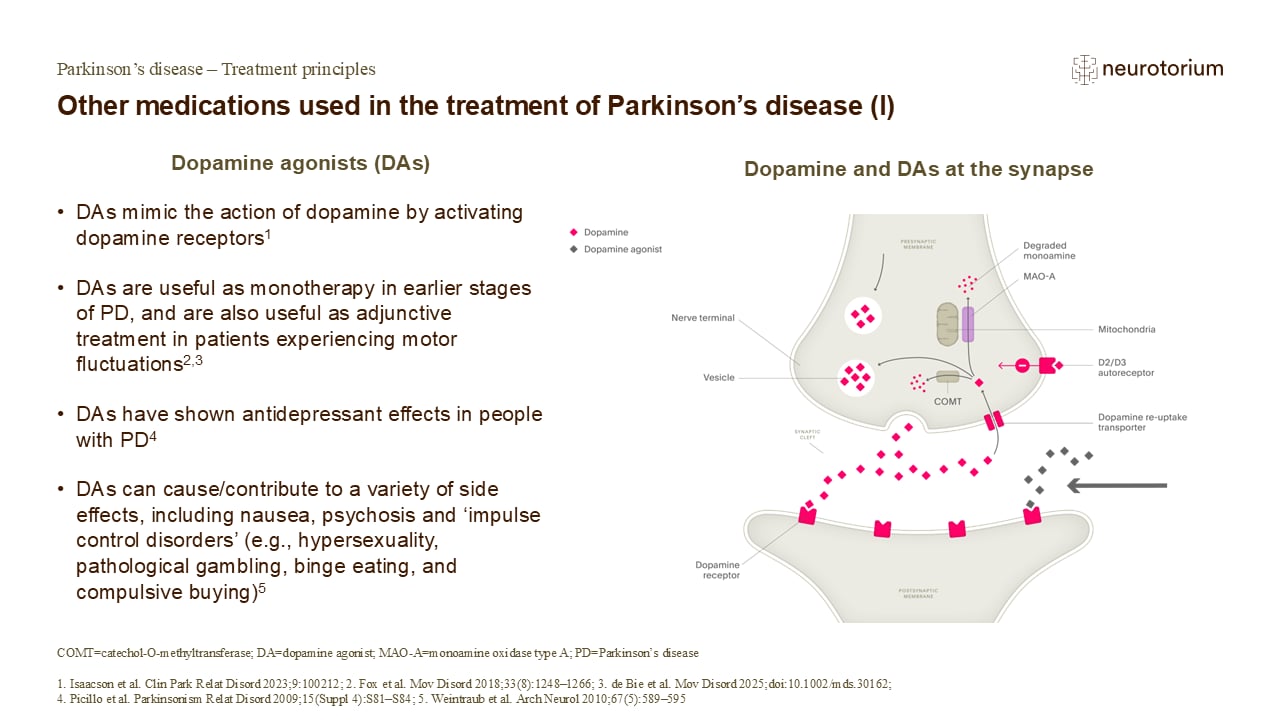
Dopamine agonists play a major role in the treatment of PD.6 They act by directly stimulating intact postsynaptic receptors in the brain linked to motor control.6 Although they tend to be less potent than levodopa in reducing parkinsonian motor symptoms, dopamine agonists are much less likely to cause dyskinesias.6 This characteristic can make dopamine agonists a useful tool for the management of early and fluctuating PD.6
Dopamine agonists have several key advantages over levodopa: they tend to have a longer half-life, which allows for a more prolonged action; their absorption in the gut is not inhibited by dietary protein; and they are easily absorbed across the blood–brain barrier.6 Dopamine agonists may therefore allow the patient to reduce their levodopa usage without worsening their parkinsonian symptoms.7
References:
1. Isaacson SH, Hauser RA, Pahwa R, et al. Dopamine agonists in Parkinson’s disease: Impact of D1-like or D2-like dopamine receptor subtype selectivity and avenues for future treatment. Clin Park Relat Disord 2023; 9: 100212.
2. Fox SH, Katzenschlager R, Lim S-Y, et al. International Parkinson and Movement Disorder Society evidence-based medicine review: update on treatments for the motor symptoms of Parkinson’s disease. Mov Disord 2018; 33 (8): 1248–1266.
3. de Bie RMA, Katzenschlager R, Swinnen BEKS, et al. Update on treatments for Parkinson’s disease motor fluctuations – An International Parkinson and Movement Disorder Society evidence-based medicine review. Mov Disord 2025; doi: 10.1002/mds.30162.
4. Picillo M, Rocco M, Barone P. Dopamine receptor agonists and depression in Parkinson’s disease. Parkinsonism Relat Disord 2009; 15 (Suppl 4): S81–S84.
5. Weintraub D, Koester J, Potenza MN. Impulse control disorders in Parkinson disease: A cross-sectional study of 3090 patients. Arch Neurol 2010; 67 (5): 589–595.
6. Factor SA. Current status of symptomatic medical therapy in Parkinson’s disease. Neurotherapeutics 2008; 5 (2): 164–180.
7. Stocchi F. Conventional treatment-related motor complications: their prevention and treatment. In: Wolters & Baumann (eds). Parkinson Disease and Other Movement Disorders. VU University Press, 2014.