

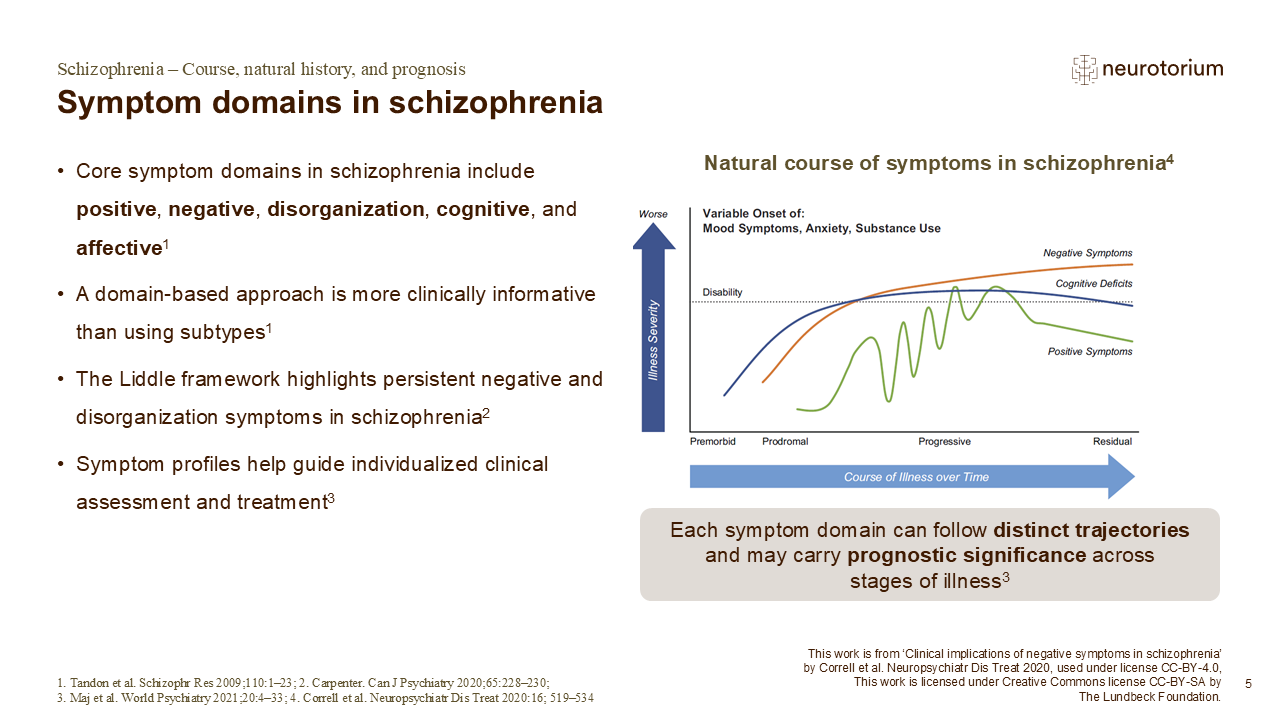
The Liddle framework identifies psychomotor poverty (e.g., reduced speech and movement), disorganization (e.g., thought disorder and inappropriate affect), and reality distortion (e.g., delusions and hallucinations) as distinct but related syndromes.2 This model expanded the earlier positive–negative symptom distinction by suggesting that schizophrenia symptoms group into three underlying syndromes rather than two.2
References:
1. Tandon R, Nasrallah HA, Keshavan MS. Schizophrenia, “just the facts” 4. Clinical features and conceptualization. Schizophr Res 2009; 110: 1–23.
2. Carpenter. Classical schizophrenia: Liddle and the core of schizophrenia. Can J Psychiatry 2020; 65: 228–230.
3. Maj M, van Os J, De Hert M, Wolfgang G, et al. The clinical characterization of the patient with primary psychosis aimed at personalization of management. World Psychiatry 2021; 20: 4–33.
4. Correll CU, Schooler NR & Kane JM, et al. Clinical implications of negative symptoms in schizophrenia. Neuropsychiatr Dis Treat 2020; 16: 519–534.