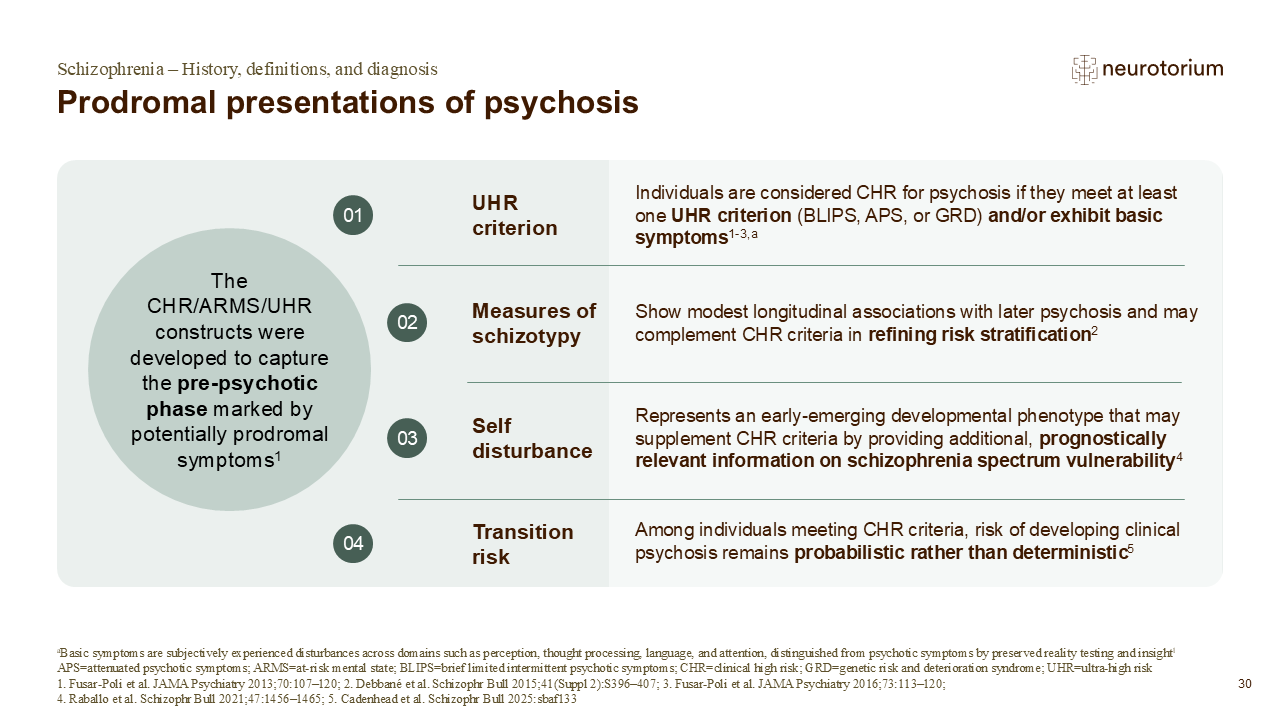
A meta‑analysis of 33 longitudinal studies showed that BLIPS represents a distinct, higher‑risk subgroup compared with APS, while GRD is uncommon and does not confer increased psychosis risk.3
In long‑term follow‑up (≥5 years), only 16.7% (84/504) of individuals classified as CHR transitioned to psychosis, and approximately one‑third (32.1%) of those were subsequently diagnosed with schizophrenia.5
Abbreviations: APS=attenuated psychotic symptoms; BLIPS=brief limited intermittent psychotic symptoms; CHR=clinical high risk; GRD=genetic risk and deterioration syndrome
References:
1.Fusar-Poli P, Borgwardt S, Bechdolf A et al. The psychosis high-risk state: a comprehensive state-of-the-art review. JAMA Psychiatry 2013; 70: 107–120.
2.Debbané M, Eliez S, Badoud D et al. Developing psychosis and its risk states through the lens of schizotypy. Schizophr Bull 2015; 41 (Suppl 2): S396–407.
3.Fusar-Poli P, Cappucciati M, Borgwardt S et al. Heterogeneity of psychosis risk within individuals at clinical high risk: a meta-analytical stratification. JAMA Psychiatry 2016; 73: 113–120.
4.Raballo A, Poletti M, Preti A, Parnas J. The Self in the spectrum: a meta-analysis of the evidence linking basic self-disorders and schizophrenia. Schizophr Bull 2021; 47: 1007–1017.
5.Cadenhead KS, Kennedy L, Mirzakhanian H et al. Predictors and moderators of long-term outcome of persons at clinical high risk for psychosis: methods and preliminary data. Schizophr Bull 2025: sbaf133.