

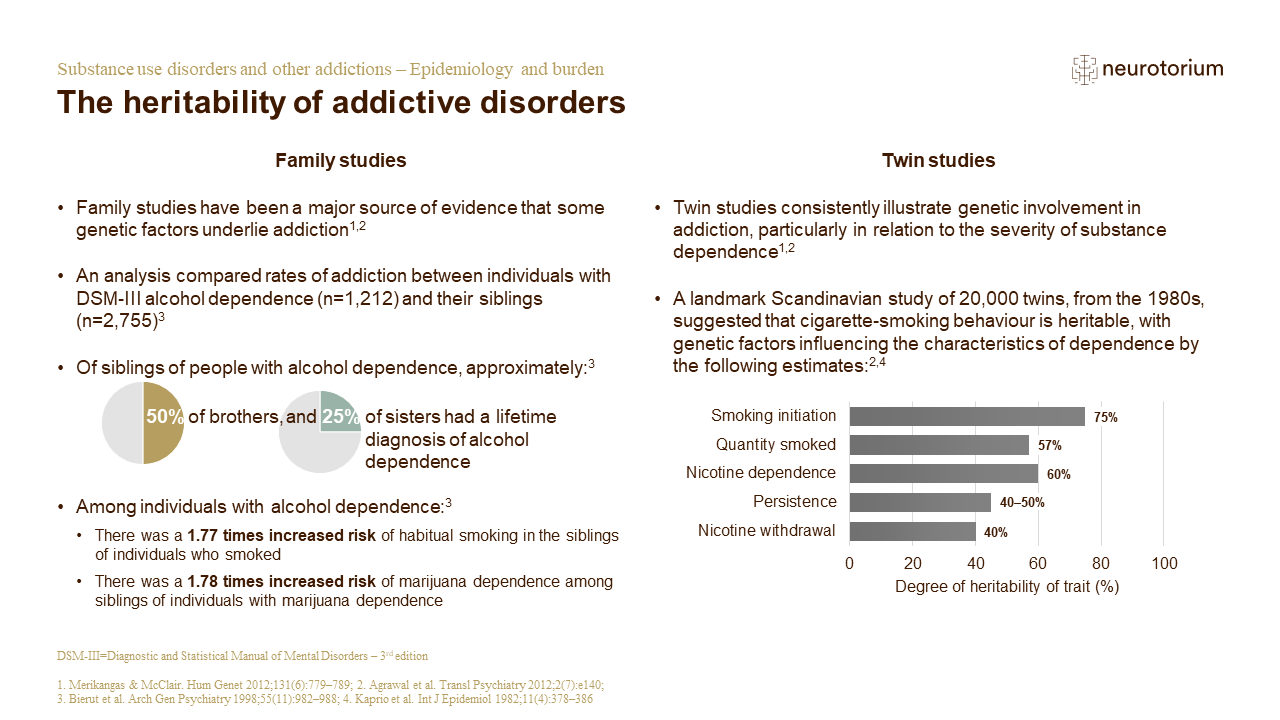
Early convincing evidence that addictive disorders are at least partly heritable came from studies of the families, and sometimes twins, of individuals with substance-use disorders.[1,2] Indeed, after decades of research, a wealth of studies show that the risk of addiction is greater among the relatives of individuals with substance-use disorders.[2] Whilst this all points to there being some genetic component to addiction, familial studies do not allow researchers to identify the exact genes involved – this requires gene-finding studies, linkage analysis, and more recently genome-wide association studies.[2]
References:
[1] Merikangas KR, McClair VL. Epidemiology of substance use disorders. Hum Genet 2012; 131 (6): 779–789.
[2] Agrawal A, Verweij KJH, Gillespie NA, et al. The genetics of addiction – a translational perspective. Transl Psychiatry 2012; 2 (7): e140.
[3] Bierut LJ, Dinwiddie SH, Begleiter H, et al. Familial transmission of substance dependence: alcohol, marijuana, cocaine, and habitual smoking: a report from the Collaborative Study on the Genetics of Alcoholism. Arch Gen Psychiatry 1998; 55 (11): 982–988.