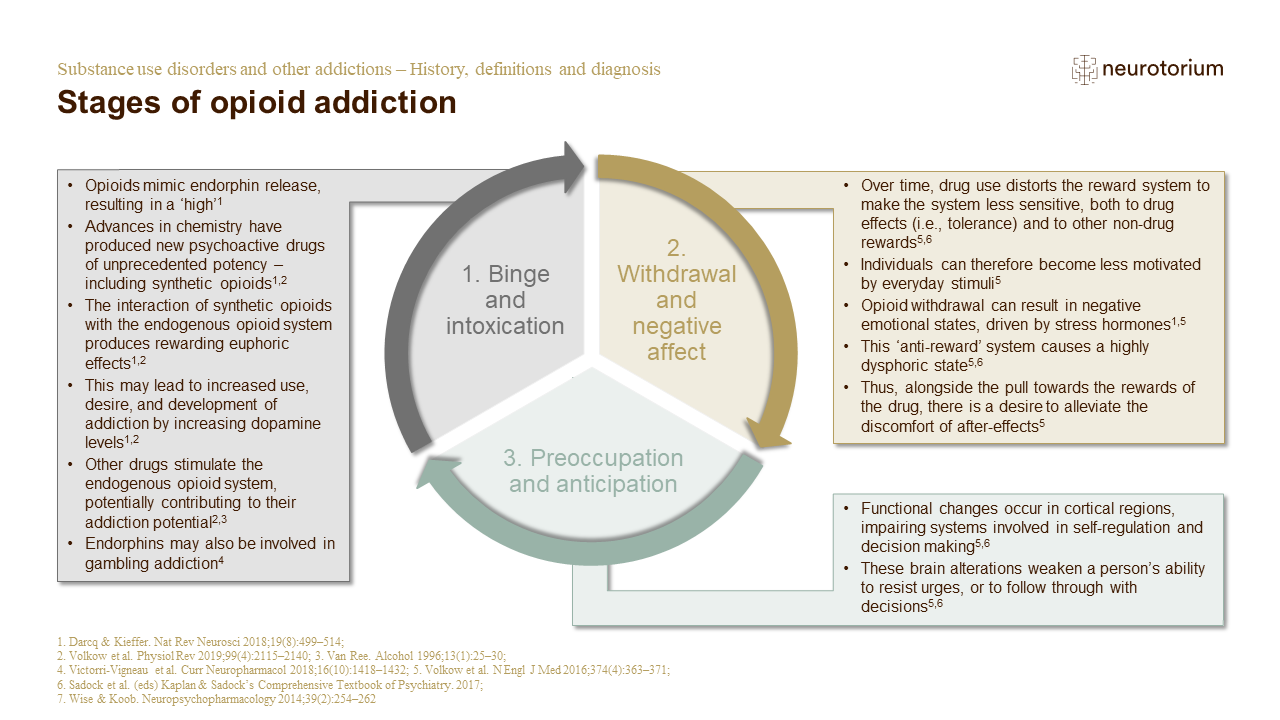
As with addiction to stimulants or alcohol, over time a person with addiction who starts taking opioid drugs for pleasure experiences brain changes that result in that person needing to take drugs in order to relieve dysphoria.[5,6,7]
References:
[1] Darcq E, Kieffer BL. Opioid receptors: drivers to addiction? Nat Rev Neurosci 2018; 19 (8): 499–514.
[2] Volkow ND, Michaelides M, Baler R. The neuroscience of drug reward and addiction. Physiol Rev 2019; 99 (4): 2115–2140.
[3] Van Ree JM. Endorphins and experimental addiction. Alcohol 1996; 13 (1): 25–30.
[4] Victorri-Vigneau C, Spiers A, Caillet P, et al. Opioid antagonists for pharmacological treatment of gambling disorder: are they relevant? Curr Neuropharmacol 2018; 16 (10): 1418–1432.
[5] Volkow ND, Koob GF, McLellan AT. Neurobiologic advances from the brain disease model of addiction. N Engl J Med 2016; 374 (4): 363–371.
[6] Sadock BJ, Sadock VA, Ruiz P (eds). Kaplan & Sadock’s Comprehensive Textbook of Psychiatry, 10th edition. Wolters Kluwer, 2017.
[7] Wise RA, Koob GF. The development and maintenance of drug addiction. Neuropsychopharmacology 2014; 39 (2): 254–262.