

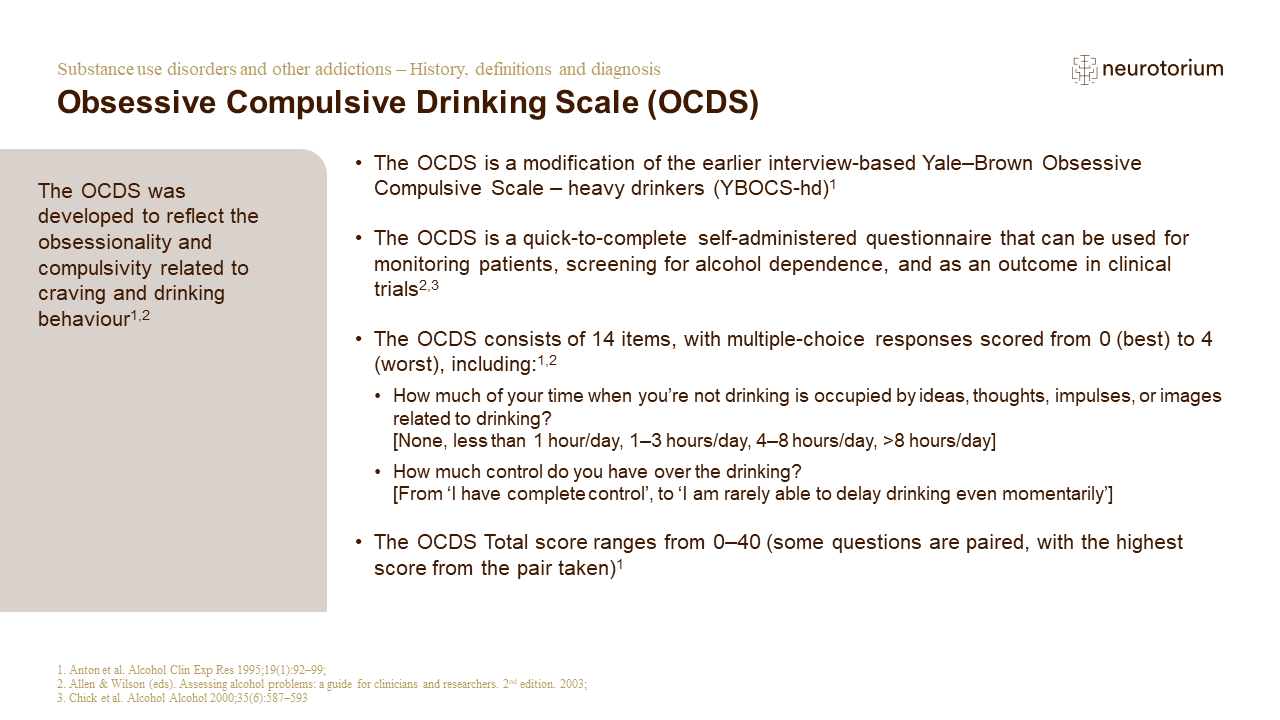
Obsessive thoughts about alcohol use and compulsive behaviours toward drinking, as assessed by the Obsessive Compulsive Drinking Scale (OCDS), are proposed to be important in the craving of alcohol.[1] The OCDS can be split into two subscales:[1]
- obsessive thoughts of drinking (items 1–6; score range 0–20)
- compulsive drinking (items 7–14; score range 0–20).
The OCDS has excellent test–retest correlation, and high internal consistency.[1] In general, when drinking is present, there is an elevation of the OCDS score.[1]
Reference:
[1] Anton RF, Moak DH, Latham P. The Obsessive Compulsive Drinking Scale: a self-rated instrument for the quantification of thoughts about alcohol and drinking behavior. Alcohol Clin Exp Res 1995; 19 (1): 92–99.
[2] Allen JP, Wilson VB (eds). Assessing alcohol problems: a guide for clinicians and researchers. 2nd edition. NIH Publication No. 03-3745. Revised 2003.