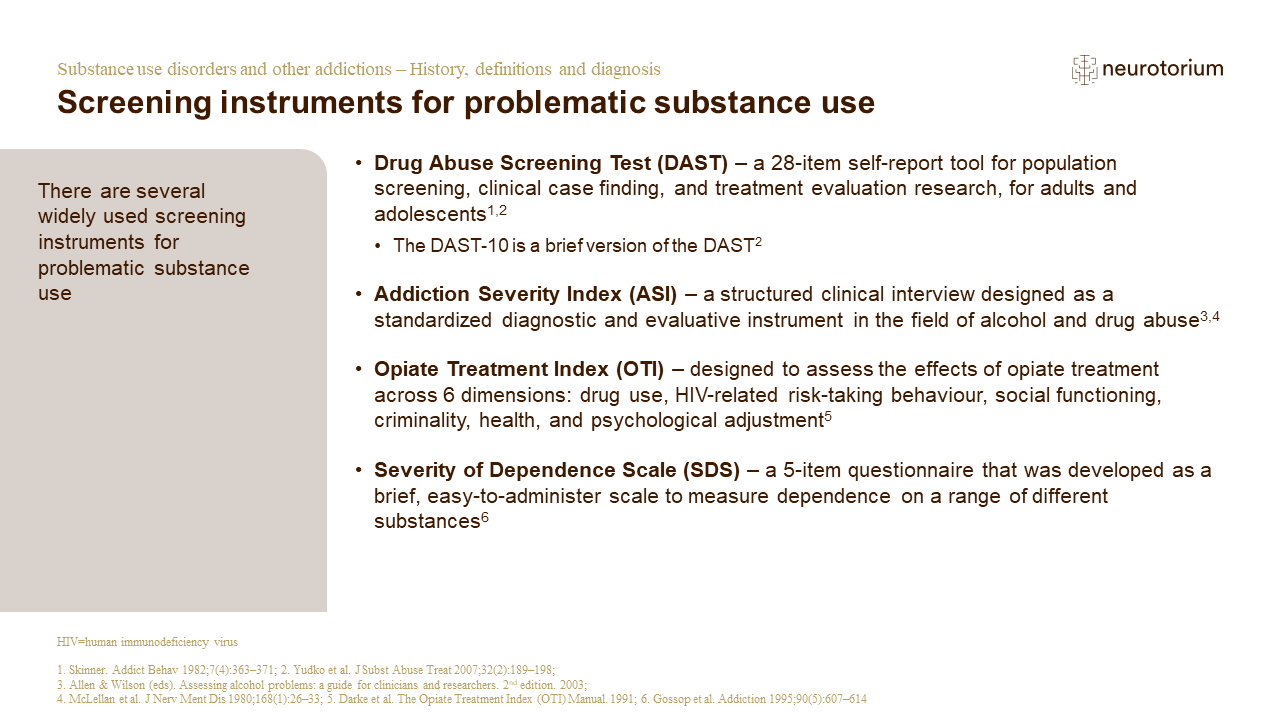
A systematic review aimed to identify scales that would be useful in identifying illicit drug use in a hospital setting.[7] Although the review identified 13 instruments that could be useful, there was a wide variation in the degree of validation each had undergone and the evidence base behind each scale.[7] The authors concluded that, given the paucity of head-to-head evidence, clinicians do not have enough information to be able to choose between the various measures available.[7]
A similar review, investigating scales to identify illegal drug use that would be useful in psychiatric settings, concluded that there was no scale or instrument that was suited to routine drug screening of psychiatric patients.[8]
References:
[1] Skinner HA. The Drug Abuse Screening Test. Addict Behav 1982; 7 (4): 363–371.
[2] Yudko E, Lozhkina O, Fouts A. A comprehensive review of the psychometric properties of the Drug Abuse Screening Test. J Subst Abuse Treat 2007; 32 (2): 189–198.
[3] Allen JP, Wilson VB (eds). Assessing alcohol problems: a guide for clinicians and researchers. 2nd edition. NIH Publication No. 03-3745. Revised 2003.
[4] McLellan AT, Luborsky L, Woody GE, O’Brien CP. An improved diagnostic evaluation instrument for substance abuse patients. The Addiction Severity Index. J Nerv Ment Dis 1980; 168 (1): 26–33.
[5] Darke S, Ward J, Hall W, et al. The Opiate Treatment Index (OTI) Manual. National Drug and Alcohol Research Centre, 1991.
[6] Gossop M, Darke S, Griffiths P, et al. The Severity of Dependence Scale (SDS): psychometric properties of the SDS in English and Australian samples of heroin, cocaine and amphetamine users. Addiction 1995; 90 (5): 607–614.
[7] Mdege ND, Lang J. Screening instruments for detecting illicit drug use/abuse that could be useful in general hospital wards: a systematic review. Addict Behav 2011; 36 (12): 1111–1119.
[8] Tiet QQ, Finney JW, Moos RH. Screening psychiatric patients for illicit drug use disorders and problems. Clin Psychol Rev 2008; 28 (4): 578–591.