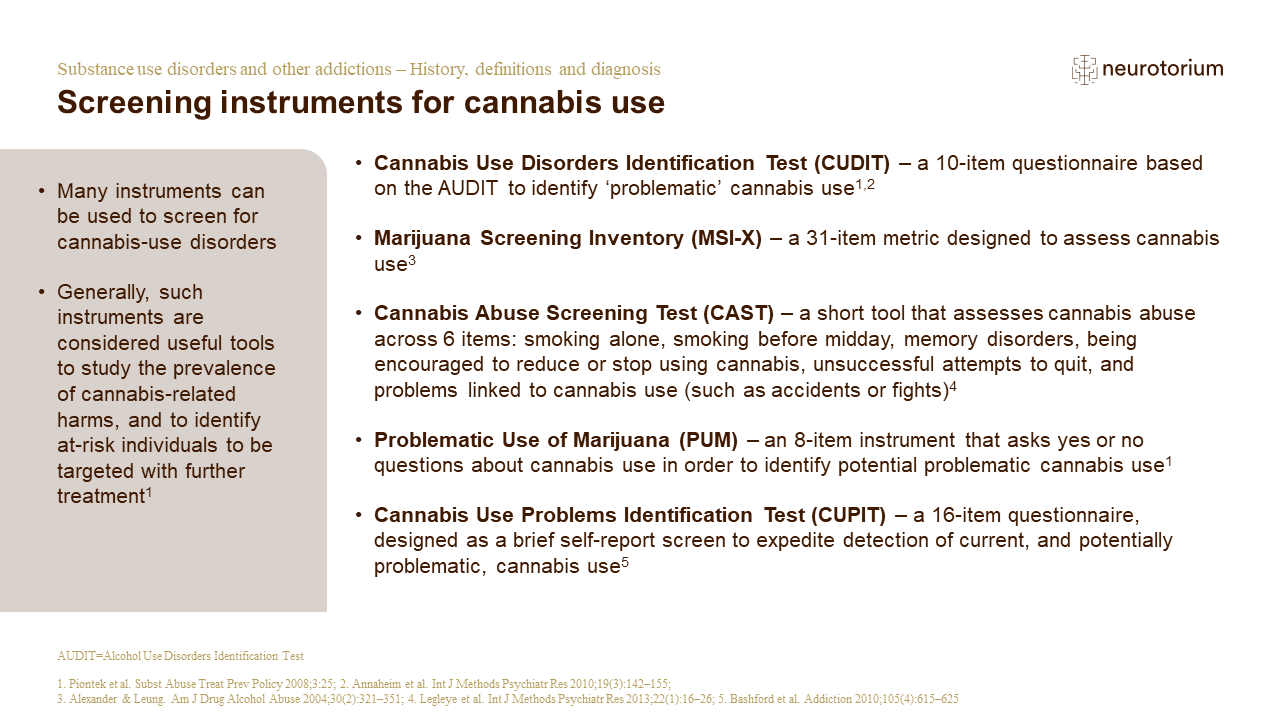
Several short instruments have been developed that assess an individual’s cannabis use, and can be useful in detecting cannabis dependence or cannabis-related harms.[1] Such questionnaires are of great value to society, because cannabis use has been associated with a range of acute and chronic harms to the individual and to society.[6] Acute and chronic use of cannabis has been linked to changes in mood states, negative effects on an individual’s neurocognition, and dangers related to driving and road traffic accidents.[6] Given the addictive nature of cannabis, these negative outcomes have implications for public safety and healthcare expenditure – making screening and identification of problematic cannabis use a good use of resources.[1,6]
References:
[1] Piontek D, Kraus L, Klempova D. Short scales to assess cannabis-related problems: a review of psychometric properties. Subst Abuse Treat Prev Policy 2008; 3: 25.
[2] Annaheim B, Scotto TJ, Gmel G. Revising the Cannabis Use Disorders Identification Test (CUDIT) by means of item response theory. Int J Methods Psychiatr Res 2010; 19 (3): 142–155.
[3] Alexander DE, Leung P. The Marijuana Screening Inventory (MSI-X): reliability, factor structure, and scoring criteria with a clinical sample. Am J Drug Alcohol Abuse 2004; 30 (2): 321–351.
[4] Legleye S, Piontek D, Kraus L, et al. A validation of the Cannabis Abuse Screening Test (CAST) using a latent class analysis of the DSM-IV among adolescents. Int J Methods Psychiatr Res 2013; 22 (1): 16–26.
[5] Bashford J, Flett R, Copeland J. The Cannabis Use Problems Identification Test (CUPIT): development, reliability, concurrent and predictive validity among adolescents and adults. Addiction 2010; 105 (4): 615–625.
[6] Ford TC, Hayley AC, Downey LA, Parrott AC. Cannabis: an overview of its adverse acute and chronic effects and its implications. Curr Drug Abuse Rev 2017; 10 (1): 6–18.