

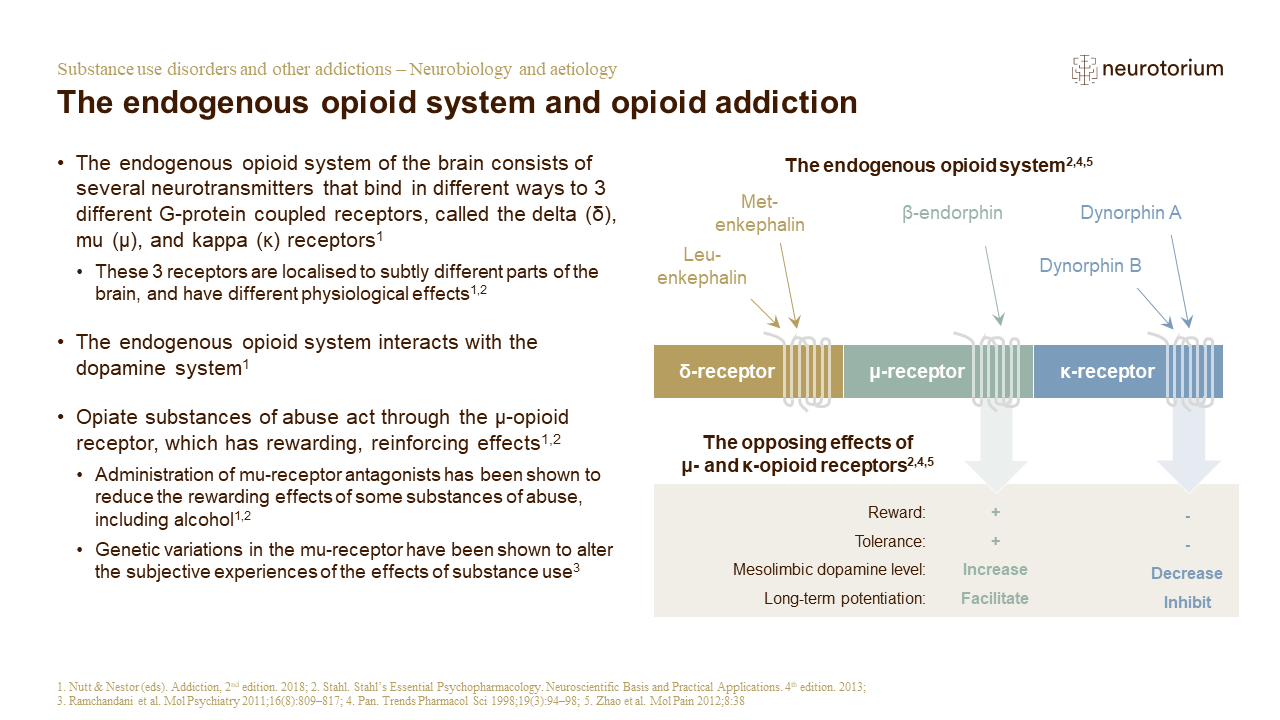
As shown on the slide, the endogenous opioid system exists in balance, with the three receptors mediating opposing components of the affective system of the brain.[1,6] Of course, the view that the mu- and kappa- opioid receptor systems are mutually antagonistic is overly simplistic; there is some evidence that in some regions of the brain these systems can work synergistically.[6] The endogenous opioid system can be seen – rather than as a balance of kappa versus mu activation – as a complex counter-balanced interacting system determined by genetics, by the expression, localisation, and regulation of opioid receptors, and by their interaction with different neurochemical systems.[6] When considered in its full intricacy, correcting an imbalance in the opioid system is far more complicated than adjusting one side or the other.[6]
References:
[1] Nutt DJ, Nestor LJ. The Opioid System and Addiction. In: Nutt DJ, Nestor LJ (eds). Addiction, 2nd edition. Oxford University Press, 2018.
[4] Pan ZZ. mu-Opposing actions of the kappa-opioid receptor. Trends Pharmacol Sci 1998; 19 (3): 94–98.