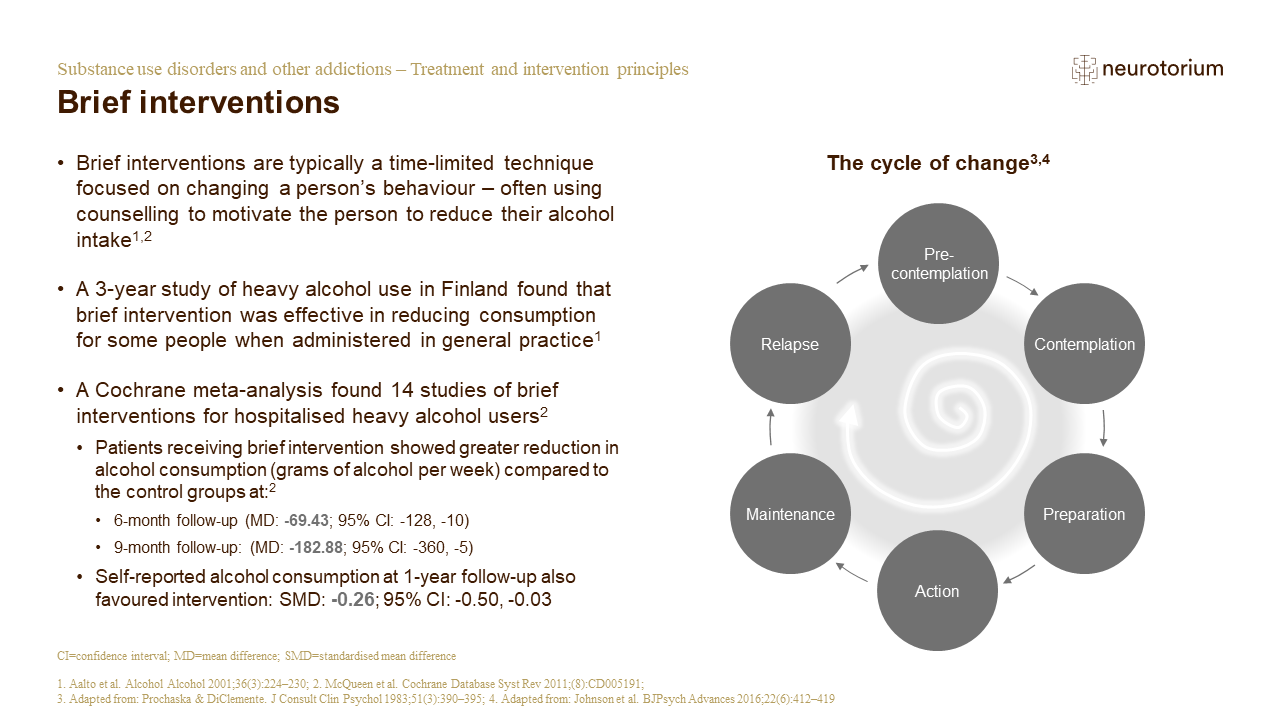
There is some good evidence for the effectiveness of brief interventions for alcohol-use disorder in general care as well as in emergency settings.2,5,6
The Finnish study outlined on the slide was part of a multi-component collaborative community action project of the World Health Organization Regional Office for Europe.1 After the screening process, 296 participants were randomised into three groups:1
A – given brief intervention at baseline, 2, 6, 12, 18, 24 and 30 months
B – given brief intervention at baseline, 12 and 24 months
C – a control group who were simply advised to reduce their drinking.
Although the results showed that many participants reduced their consumption, and generally more reduction was observed in group A than group B, and more in group B than in group C, the differences did not reach statistical significance, perhaps because of the small sample size.1 Nevertheless a clinically significant reduction of drinking was found in 25–53% of heavy drinkers in the study.1
References:
[1] Aalto M, Seppä K, Mattila P, et al. Brief intervention for male heavy drinkers in routine general practice: a three-year randomized controlled study. Alcohol Alcohol 2001; 36 (3): 224–230.
[2] McQueen J, Howe TE, Allan L, et al. Brief interventions for heavy alcohol users admitted to general hospital wards. Cochrane Database Syst Rev 2011; (8): CD005191.
[3] Prochaska JO, DiClemente CC. Stages and processes of self-change of smoking: toward an integrative model of change. J Consult Clin Psychol 1983; 51 (3): 390–395.
[4] Johnson D, Mullen D, Smith ID, Wilson A. Mindfulness in addictions. BJPsych Advances 2016; 22 (6): 412–419.
[5] Kaner EFS, Beyer FR, Muirhead C, et al. Effectiveness of brief alcohol interventions in primary care populations. Cochrane Database Syst Rev 2018; 2 (2): CD004148.
[6] Vasilaki EI, Hosier SG, Cox WM. The efficacy of motivational interviewing as a brief intervention for excessive drinking: a meta-analytic review. Alcohol Alcohol 2006; 41 (3): 328–335.