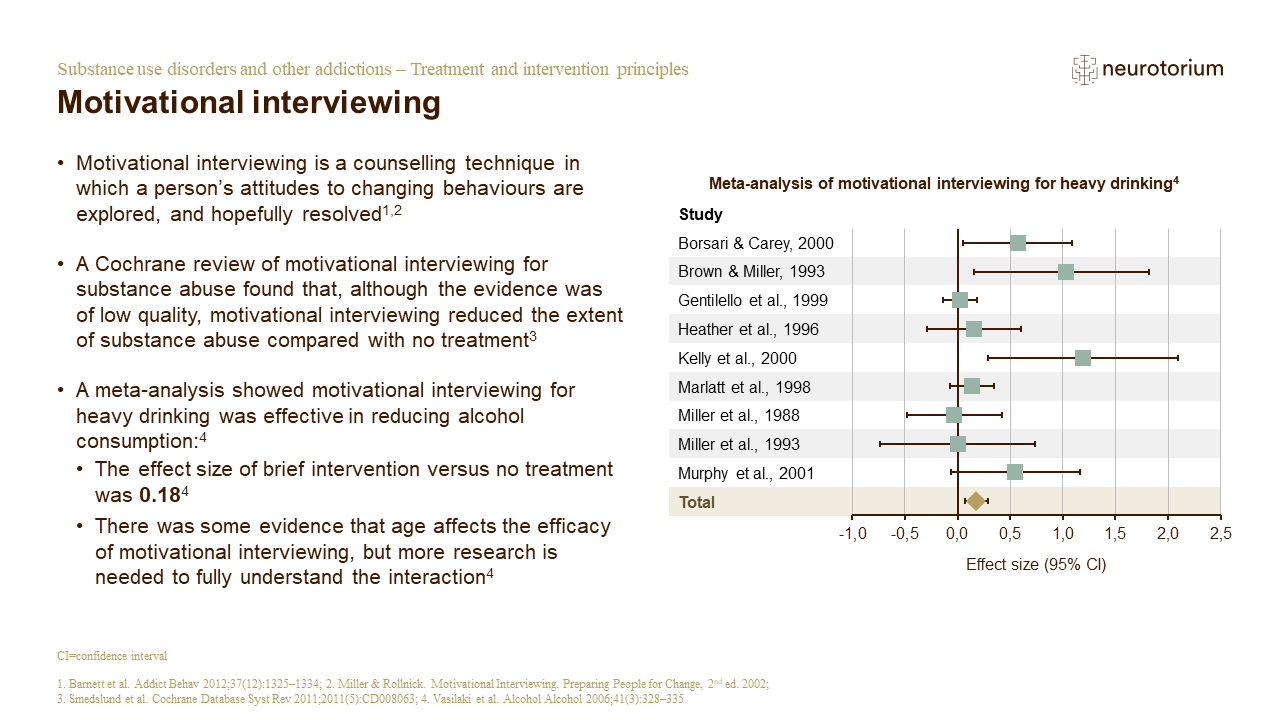
Motivational interviewing can be effective for reducing substance use across a range of addictions and substance-use disorders.1,3,4 Furthermore, motivational interviewing has become widely used for tackling substance use in adolescents, although with relatively small treatment effect sizes.1 The theoretical basis of the technique remains poorly understood – more research is needed to understand the mechanisms of change that motivational interviewing can encourage, and how best the technique can be operationalised.1
References:
[1] Barnett E, Sussman S, Smith C, et al. Motivational Interviewing for adolescent substance use: a review of the literature. Addict Behav 2012; 37 (12): 1325–1334.
[2] Miller WR, Rollnick S. Motivational Interviewing. Preparing People for Change, Second edition. The Guilford Press, 2002.
[3] Smedslund G, Berg RC, Hammerstrøm KT, et al. Motivational interviewing for substance abuse. Cochrane Database Syst Rev 2011; 2011 (5): CD008063.
[4] Vasilaki EI, Hosier SG, Cox WM. The efficacy of motivational interviewing as a brief intervention for excessive drinking: a meta-analytic review. Alcohol Alcohol 2006; 41 (3): 328–335.