

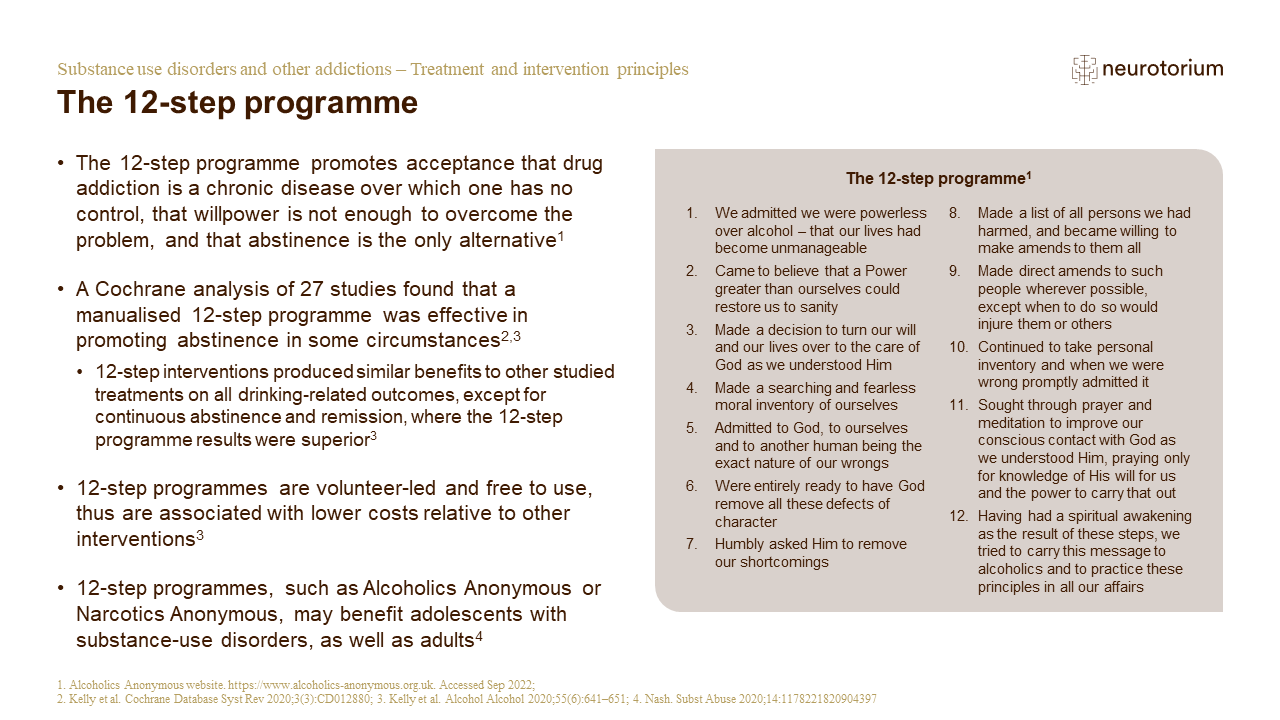
Alcoholics Anonymous was founded in 1935, in the United States of America, when one of the founding members (Dr. Robert Smith) resolved to abstain from alcohol, and another of the founding members (William G. Wilson) wrote a book about the experiences of abstaining.5 The book is titled ‘Alcoholics Anonymous: The Story of How Many Thousands of Men and Women Have Recovered From Alcoholism’, and has passed through several editions.5 At its heart, Alcoholics Anonymous is a spiritual movement, with an emphasis placed on turning over one’s will and life to a higher power.1,5 However, modern iterations of the Alcoholics Anonymous 12-step programme make it clear that newcomers to the programme are not expected to accept or follow all the steps if they are unwilling to do so.1
References:
[1] Alcoholics Anonymous website. Available at: https://www.alcoholics-anonymous.org.uk. Accessed September 2022.