

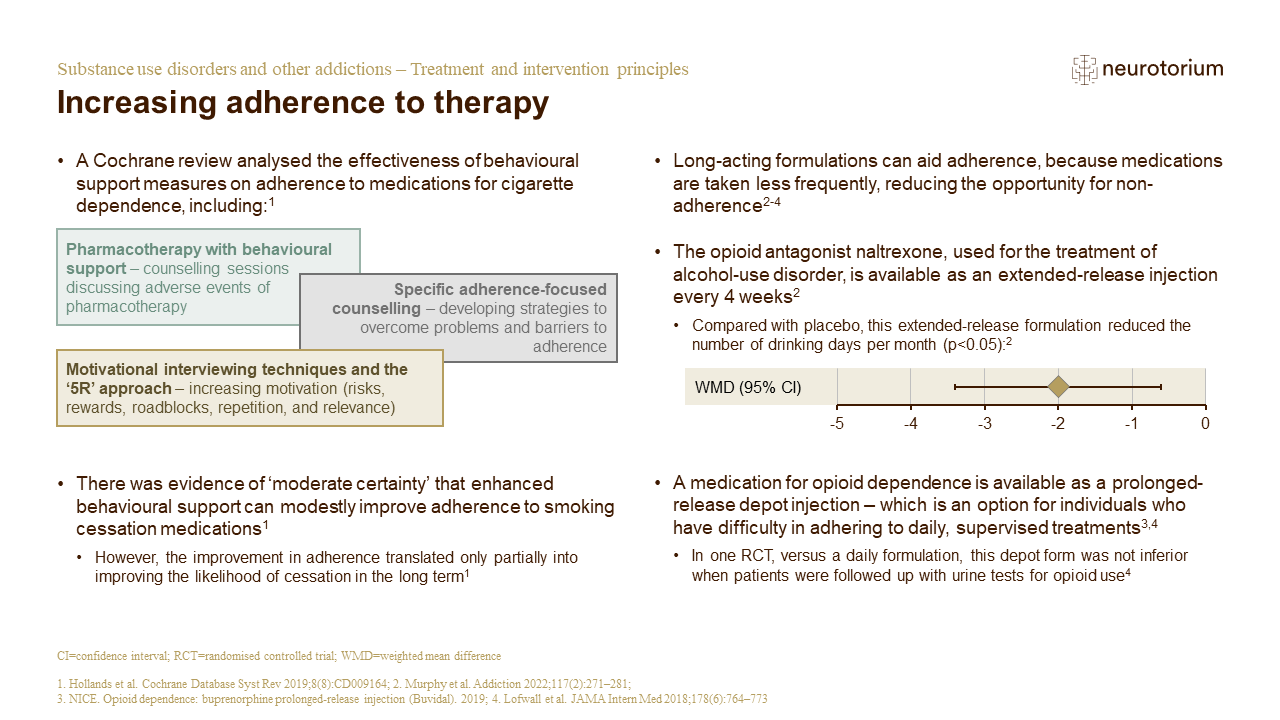
“Drugs don’t work in patients who don’t take them”, as famously stated by C. Everett Koop, the former Surgeon General.5 Therefore it is important, when considering medication for substance-use disorders, to consider adherence to that medication. As outlined on the slide, there are some behavioural counselling techniques, and some approaches to drug formulation, that can aid patient adherence.1,2,3,4
[3] NICE. Opioid dependence: buprenorphine prolonged-release injection (Buvidal), 14 February 2019. Available at: https://www.nice.org.uk/advice/es19/resources/opioid-dependence-buprenorphine-prolongedrelease-injection-buvidal-pdf-1158123740101. Accessed September 2022.
[5] Osterberg L, Blaschke T. Adherence to medication. N Engl J Med 2005; 353 (5): 487–497.