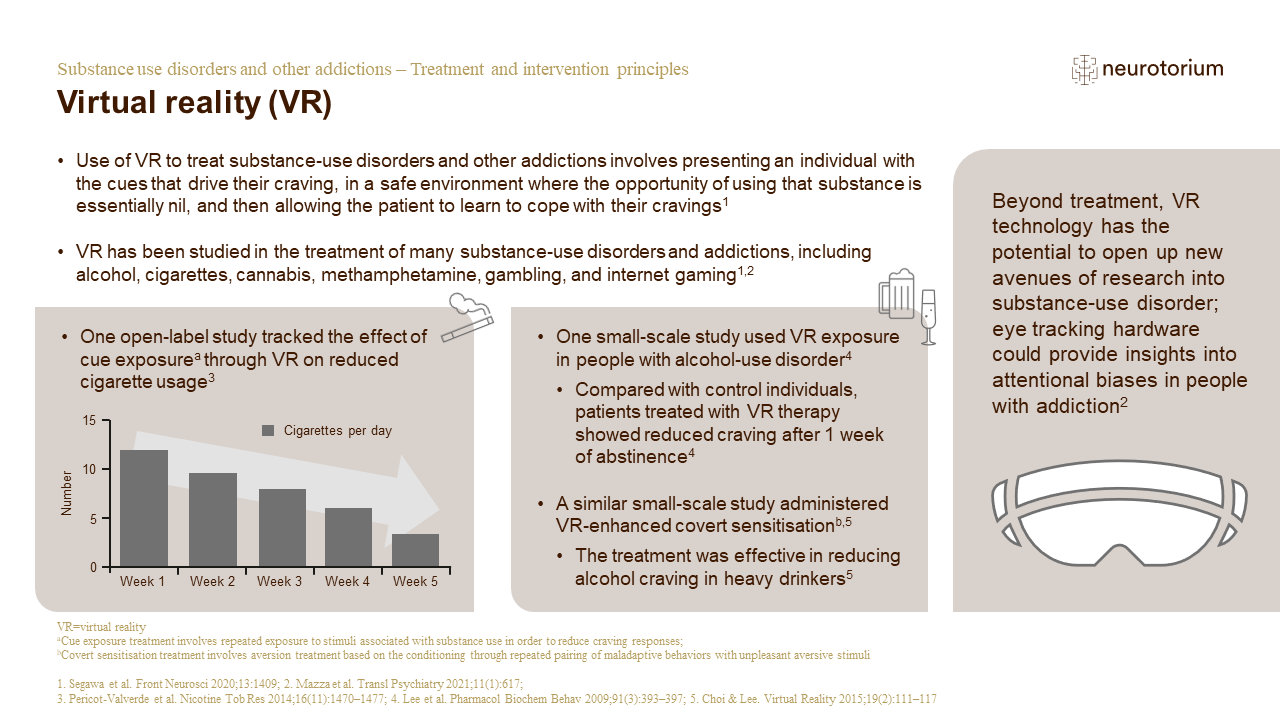
The potential of virtual reality (VR) in the treatment of substance-use disorders and other addictions is introduced on the slide. There is some evidence that VR can be used to reduce cravings, although much of the evidence comes from small-scale studies.1 In order to be more certain of the possible benefits of VR in treating addiction, more studies with more rigorous methods are needed.1
Reference:
[1] Segawa T, Baudry T, Bourla A, et al. Virtual reality (VR) in assessment and treatment of addictive disorders: a systematic review. Front Neurosci 2020; 13: 1409.
[2] Mazza M, Kammler-Sücker K, Leménager T, et al. Virtual reality: a powerful technology to provide novel insight into treatment mechanisms of addiction. Transl Psychiatry 2021; 11 (1): 617.
[3] Pericot-Valverde I, Secades-Villa R, Gutiérrez-Maldonado J, García-Rodríguez O. Effects of systematic cue exposure through virtual reality on cigarette craving. Nicotine Tob Res 2014; 16 (11): 1470–1477.
[4] Lee SH, Han DH, Oh S, et al. Quantitative electroencephalographic (qEEG) correlates of craving during virtual reality therapy in alcohol-dependent patients. Pharmacol Biochem Behav 2009; 91 (3): 393–397.
[5] Choi YJ, Lee JH. The effect of virtual covert sensitization on reducing alcohol craving in heavy social drinkers. Virtual Reality 2015; 19 (2): 111–117.