

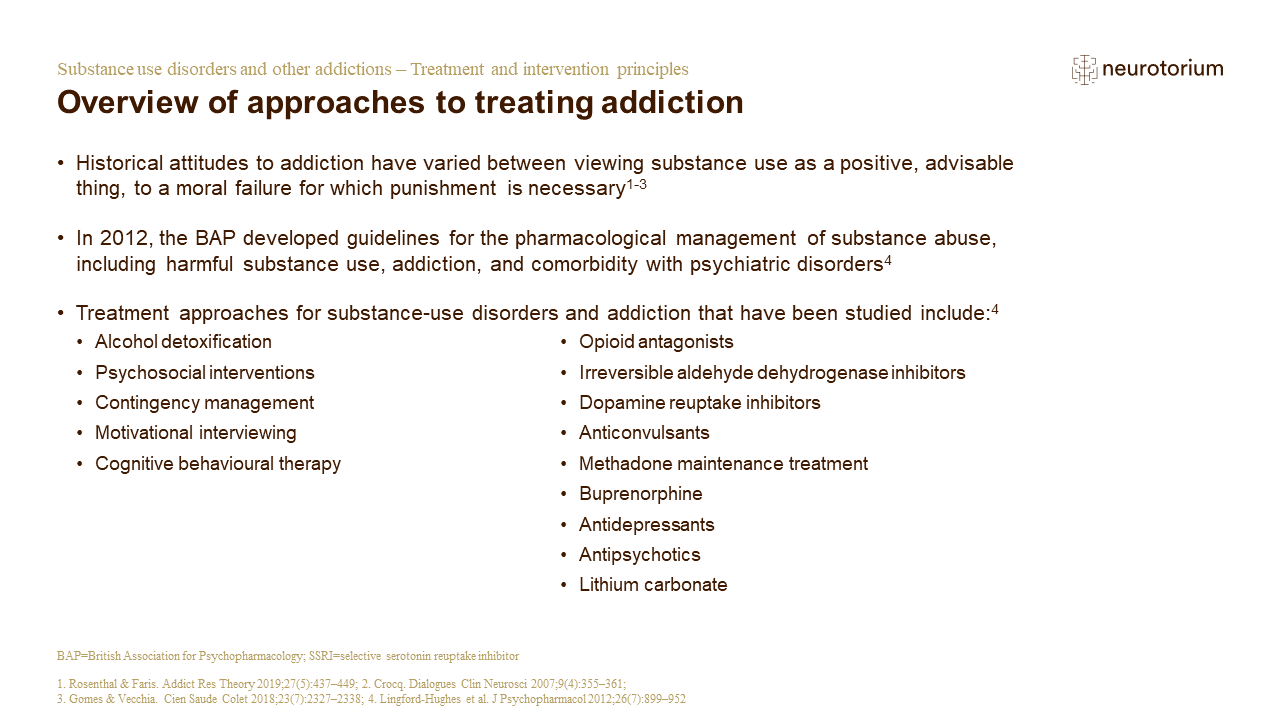
Historically, approaches to illicit substances have encompassed a spectrum ranging from open use to prohibition.3 The 20th century is full of examples of national, and international, attempts to control the use and trade of substances of abuse, including opium and alcohol.3 More recently, the focus of many policy makers and healthcare providers across the world has been to move to a harm-reduction model.3,4 The British Association for Psychopharmacology (BAP) has developed evidence-based consensus guidelines for the pharmacological management of substance-use disorders and other addictions, which are outlined on the slide.4
References:
[1] Rosenthal RJ, Faris SB. The etymology and early history of ‘addiction’. Addict Res Theory 2019; 27 (5): 437–449.