




Motor Neuron Disease and Frontotemporal Dementia
Motor neuron disease (MND) and frontotemporal dementia (FTD) rank among neurology’s most formidable diseases, and both are set to become more common as populations age. Worldwide, MND affects roughly 1.7 people per 100,000 each year, with a prevalence of around 5.1 per 100,000. FTD is the leading cause of dementia under age 60, with an incidence of ~2.3 and a prevalence of 9.2 per 100,000.1
Amyotrophic lateral sclerosis (ALS) is the most common MND subtype, though the term is often used interchangeably with MND to denote the entire syndrome. ALS is rapidly progressive and fatal within 2–5 years;2 with current therapies extending survival by only ~6 months.3,4 FTD is also universally fatal, with no disease-modifying treatment.5 Drugs for Alzheimer’s disease show no benefit, or in some cases have been reported to worsen neuropsychiatric symptoms of FTD.5
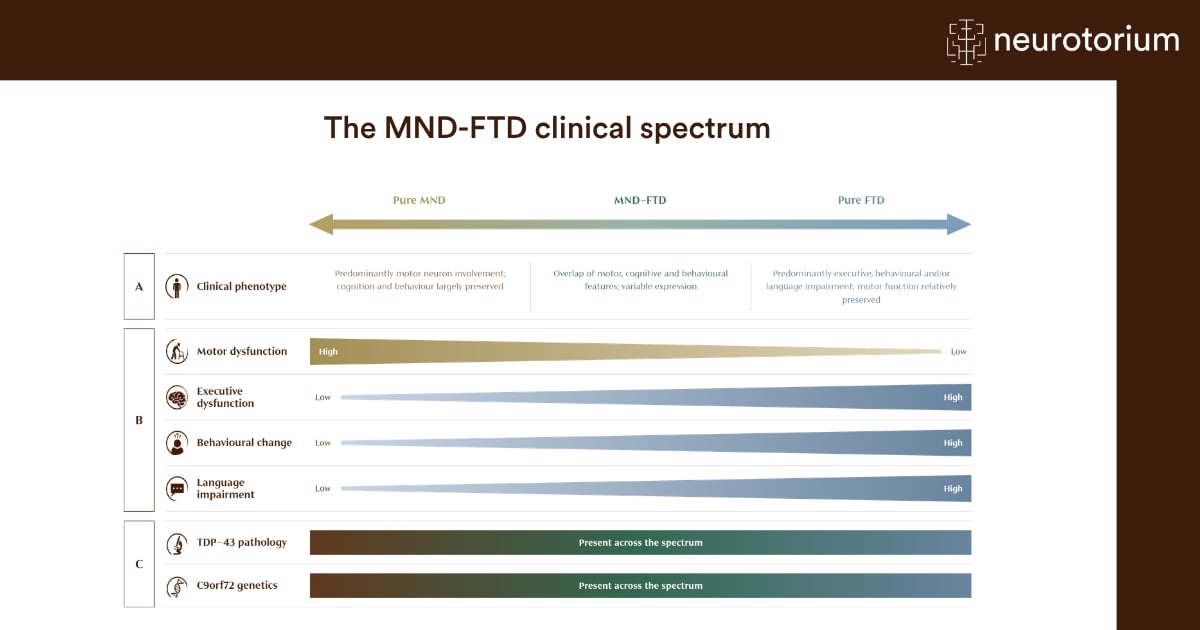
Though MND is generally characterised by progressive motor decline and FTD cognitive and behavioural changes, MND and FTD are increasingly understood to be part of the same disease spectrum, with clinical, genetic and pathological overlap (Fig.1).
Cognitive and behavioural abnormalities occur in 50–75% of MND patients, with 15–25% meeting formal criteria for FTD, most commonly the behavioural variant (bvFTD).6,7 When observing patients with FTD, ~15% have a clinical diagnosis of definite MND.8 Cognitive involvement in MND and motor dysfunction in FTD are both frequently under-recognised, risking incomplete phenotyping on either side of the spectrum.
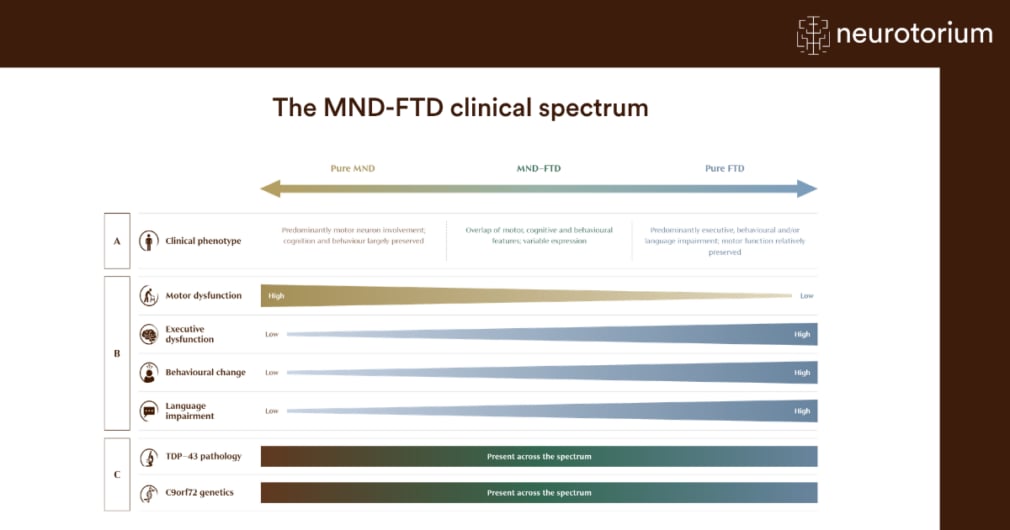
The MND-FTD clinical spectrum
Although MND is generally characterised by progressive motor decline and FTD cognitive and behavioural changes, MND and FTD are increasingly understood to be part of the same disease spectrum, with clinical, genetic and pathological overlap.
Clinical Overlap
Executive impairment is the most common cognitive change in MND, seen in about 20–25% of cases, while non-executive deficits — language or memory problems — affect around 5–10%.9,10 Behavioural change is even more widespread: using the Motor Neuron Disease Behavioural Instrument, disturbances have been identified in around 75% of patients.11 In some cases, these behavioural symptoms don’t follow motor decline — they precede it, appearing roughly 12 months before motor dysfunction sets in.12
Apathy is the most common of these behavioural changes, being moderate-to-severe in at least half of the cases, independent of any underlying mood or anxiety disorder.13 Disinhibition, a blunted sense of empathy, aggression, and agitation have all been reported too, in both MND and combined FTD-MND.14
The overlap between the two diseases runs in both directions and shows up early. Population and clinic-based cohort studies find that 10–15% of MND patients already meet criteria for FTD at baseline, while 15% of patients who present with FTD go on to develop MND — and a further 30–40% show subtle clinical or neurophysiological signs of motor system involvement even without a formal MND diagnosis.15 Progression is more rapid in patients with combined FTD-MND than in those with MND alone, with bulbar onset and low educational status being identified as potential risk factors for cognitive decline.9
The overlap between the two diseases runs in both directions and shows up early. Population and clinic-based cohort studies find that 10–15% of MND patients already meet criteria for FTD at baseline, while 15% of patients who present with FTD go on to develop MND.
Genetic and Pathological Overlap
In MND, 10-15% of cases are classified as familial,16 with up to 60% of FTD patients reporting a family history of dementia.17 Both figures are probably underestimates, with apparently sporadic cases carrying pathogenic variants likely representing unrecognised familial cases, missed through incomplete family history rather than genuinely arising de novo mutations.16
The C9orf72 hexanucleotide repeat expansion is the most common cause of both familial MND and familial FTD, and is the strongest single piece of genetic evidence for overlap between the two diseases.18 It is present in ~40% of familial MND and ~25% of familial FTD.19
Penetrance of the expansion has not been definitively established, and clinical presentation and prognosis vary widely among carriers.20 Whether an asymptomatic carrier will develop FTD, MND, or a combination cannot currently be predicted. However, brain imaging may help: early studies suggest scans showing damage in specific brain regions could be developed into risk biomarkers.21 Patients with C9orf72 mutations who have a predominant MND syndrome can still exhibit pathological features consistent with FTD, and those with a predominant FTD syndrome can show pathology in the motor system.22
Whether an asymptomatic carrier will develop FTD, MND, or a combination cannot currently be predicted. However, brain imaging may help: early studies suggest scans showing damage in specific brain regions could be developed into risk biomarkers.21
Three mechanisms have been proposed for how the C9orf72 expansion drives disease — haploinsufficiency, toxic RNA foci, and dipeptide repeat toxicity.23 Evidence supports all three, but none conclusively enough to stand alone, suggesting several mechanisms may act together to drive the pathophysiology of MND/FTD.24
C9orf72 mutations are associated with TDP-43 inclusions; cytoplasmic and nuclear TDP-43 inclusions are characteristic of both MND and FTD, and TDP-43 pathology is consistently identified as the shared hallmark linking the two diseases.25,5 This pathology is present in over 90% of MND patients, and in around half of all FTD cases.24,26
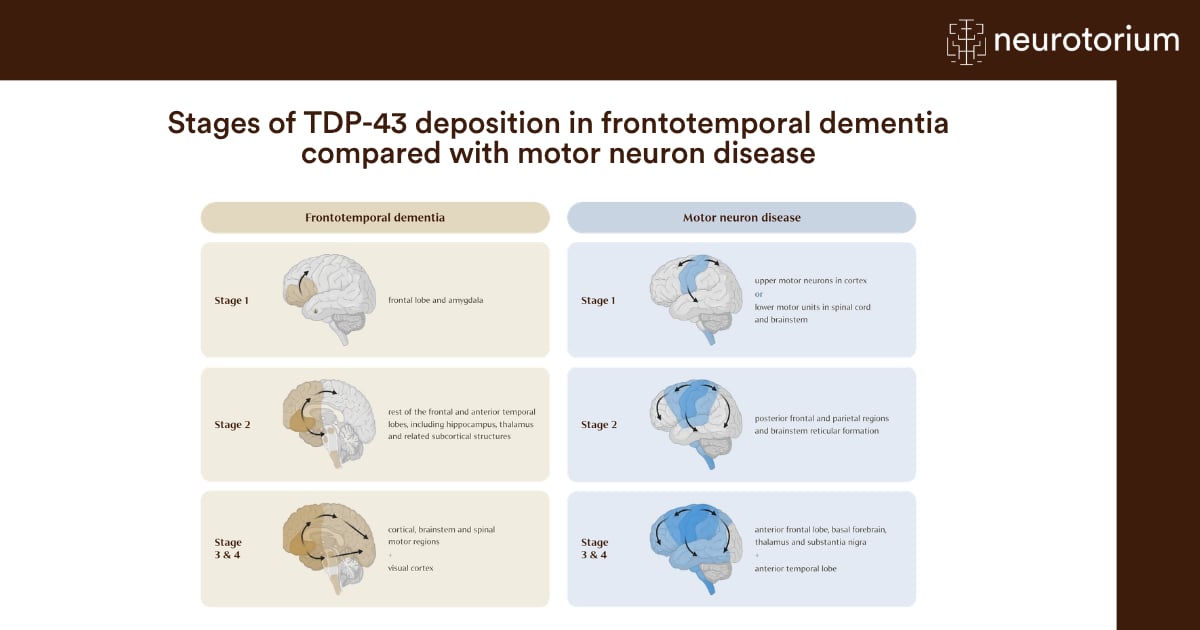
TDP-43 deposition follows a different, but converging anatomical path in FTD and MND (Fig. 2). In bvFTD, pathology begins in the frontal lobe and amygdala (stage 1), then spreads through the rest of the frontal and anterior temporal lobes — including the hippocampus, thalamus, and related subcortical structures (stage 2) — before reaching cortical, brainstem, and spinal motor regions at stage 3, and finally the visual cortex at stage 4. In MND, the sequence runs in roughly the opposite direction. Deposition starts in upper motor neurons in the cortex or lower motor neurons in the spinal cord and lower brainstem (stage 1), then extends to posterior frontal and parietal regions and the brainstem reticular formation (stage 2), to the anterior frontal lobe, basal forebrain, thalamus, and substantia nigra (stage 3), and finally to the anterior temporal lobe, including the hippocampus, at stage 4.27,28
Overlap in deposition of TDP-43 in MND and FTD is greatest for type B TDP-43 pathology, which occurs in most patients with MND but only a fraction of those with FTD, and may account for the overlap in clinical phenotypes.20
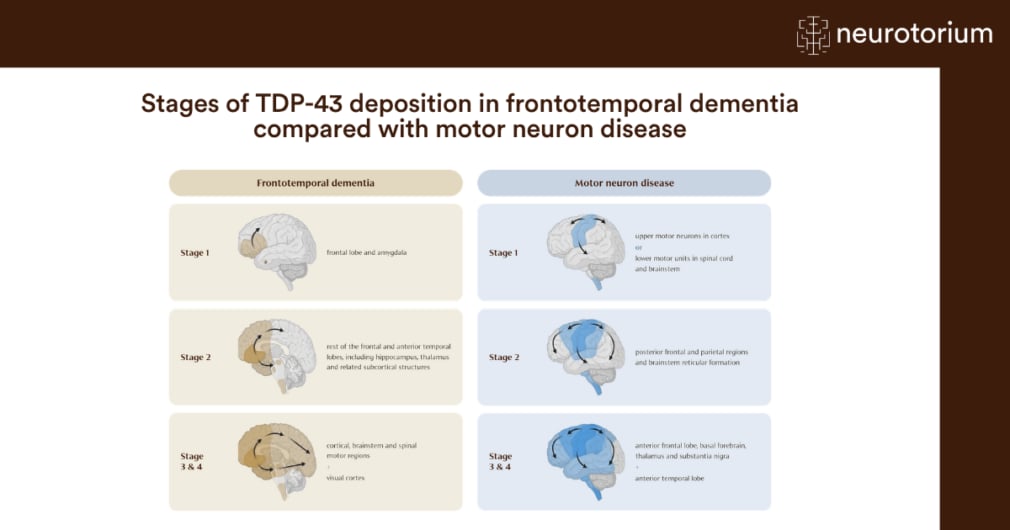
Figure 2. Stages of TDP-43 deposition in frontotemporal dementia compared with motor neuron disease
TDP-43 deposition follows a different, but converging anatomical path in FTD and MND.
Overlap in deposition of TDP-43 in MND and FTD is greatest for type B TDP-43 pathology, which occurs in most patients with MND but only a fraction of those with FTD, and may account for the overlap in clinical phenotypes.20
Clinical and Therapeutic Implications
The international consensus criteria for possible bvFTD require three of six clinically discriminating features: disinhibition, apathy or inertia, loss of sympathy or empathy, perseverative or compulsive behaviours, hyperorality, and a dysexecutive neuropsychological profile.29 These criteria make no reference to motor features, but the Gold Coast Criteria — the more recently established diagnostic criteria for ALS — acknowledge the overlap directly: ALS may include cognitive, behavioural, and/or psychiatric abnormalities, though these are not essential for diagnosis.30 Separate consensus criteria have also been developed specifically for diagnosing frontotemporal cognitive and behavioural syndromes in MND. These span four axes: clinical diagnosis of MND (axis I), behavioural and cognitive deficits (axis II), non-motor manifestations (axis III), and disease modifiers (axis IV) (Table 1).31
| Criteria | Diagnostic category | Key required features | ||||||
| Gold Coast ALS diagnosis criteria30 | Single diagnostic entity (replaces definite / probable / possible) | • Progressive motor impairment, preceded by normal motor function
• UMN + LMN dysfunction in ≥1 body region, OR LMN dysfunction alone in ≥2 regions • Investigations exclude other disease processes |
||||||
| Consensus criteria for the diagnosis of frontotemporal cognitive and behavioural syndromes in ALS29 |
|
|||||||
| FTDC bvFTD criteria31 |
|
|||||||
Table 1. Key diagnostic criteria for ALS and the ALS-FTD spectrum
Abbreviations: UMN = upper motor neuron; LMN = lower motor neuron; bvFTD = behavioural variant frontotemporal dementia; PNFA = progressive non-fluent aphasia; SD = semantic dementia; ALSbi = ALS with behavioural impairment; ALSci = ALS with cognitive impairment; FTLD = frontotemporal lobar degeneration; FTDC = International Behavioural Variant FTD Criteria Consortium.
Two cognitive screening tools have been developed specifically for MND. The ALS Cognitive Behavioural Screen (ALS-CBS) measures executive dysfunction while accounting for motor deficits32 and the Edinburgh Cognitive and Behavioural ALS Screen (ECAS), which assesses executive function, verbal fluency, language, and visuospatial function.33
The FDA-approved MND drugs each produce only modest slowing of progression.3,4 FTD management remains symptomatic relying on selective serotonin reuptake inhibitors (SSRIs) and atypical antipsychotics for behavioural symptoms.5 Antisense oligonucleotide (ASO) technologies to reduce mutant gene expression including C9orf72 have been evaluated in clinical trials34, along with trials indirectly targeting C9orf72 through other pathways.35
No therapies have been specifically studied for abnormal behaviours in this combined syndrome, though symptomatic antipsychotic treatment may be used for agitation, aggression, or sexualised behaviours.20 Recently, the FDA has approved the first medication targeting pseudobulbar affect (PBA), characterised by sudden bouts of uncontrollable crying or laughter, which is frequently seen in FTD-MND.5
The well-established multidisciplinary care model for MND36 offers a natural starting point for FTD-MND, and extending it to the combined syndrome is already common practice. Confirming which elements translate directly is a clear opportunity for future work: Riluzole’s specific role in FTD-MND has not yet been directly studied, and interventions known to help in MND — non-invasive ventilation and enteral feeding — remain to be evaluated in this group, where compliance may need particular attention.2 Better characterising the link between respiratory insufficiency, quality of life, and cognitive decline is a further avenue worth pursuing. Earlier recognition of carer burden as the disease progresses, supported by counselling and, later, regular respite and psychological support, is an area where FTD-MND care stands to build meaningfully on what’s already established for MND.
Conclusion
MND and FTD are now widely recognised as part of a single disease spectrum, rather than as separate conditions. This is supported by their shared genetic driver (C9orf72), a common pathological substrate (TDP-43), and overlapping patterns of disease spread. It is also reflected in current clinical practice: diagnostic criteria on both sides increasingly account for features of the other domain, screening tools have been developed specifically for MND-associated cognitive change, and clinical trials are now testing therapies that target the shared C9orf72 mutation. Recognising MND and FTD as points on one spectrum, rather than through separate diagnostic pathways, supports earlier diagnosis and better coordinated care.
MND and FTD are now widely recognised as part of a single disease spectrum, rather than as separate conditions. This is supported by their shared genetic driver (C9orf72), a common pathological substrate (TDP-43), and overlapping patterns of disease spread.
Related content
Motor neuron disease (MND) and frontotemporal dementia (FTD) were once seen as separate conditions, one affecting movement and the other cognition and behaviour. Growing evidence now places them on the same disease spectrum, linked by shared clinical features, genetic causes, and underlying pathology.
ALS and FTD were historically regarded as distinct diseases but are now recognised as overlapping disorders within a broader neurodegenerative spectrum. This slide deck introduces their defining clinical features, the development of the ALS–FTD concept, and the approaches used to diagnose ALS, FTD and mixed presentations.
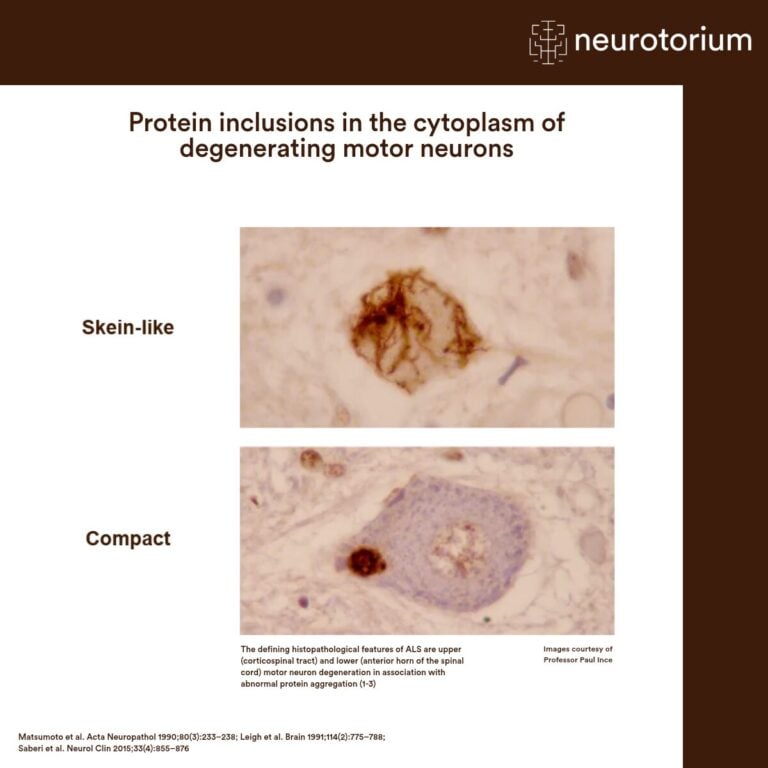
Motor neuron degeneration in ALS is associated with abnormal protein aggregation, including characteristic skein-like and compact cytoplasmic inclusions.