

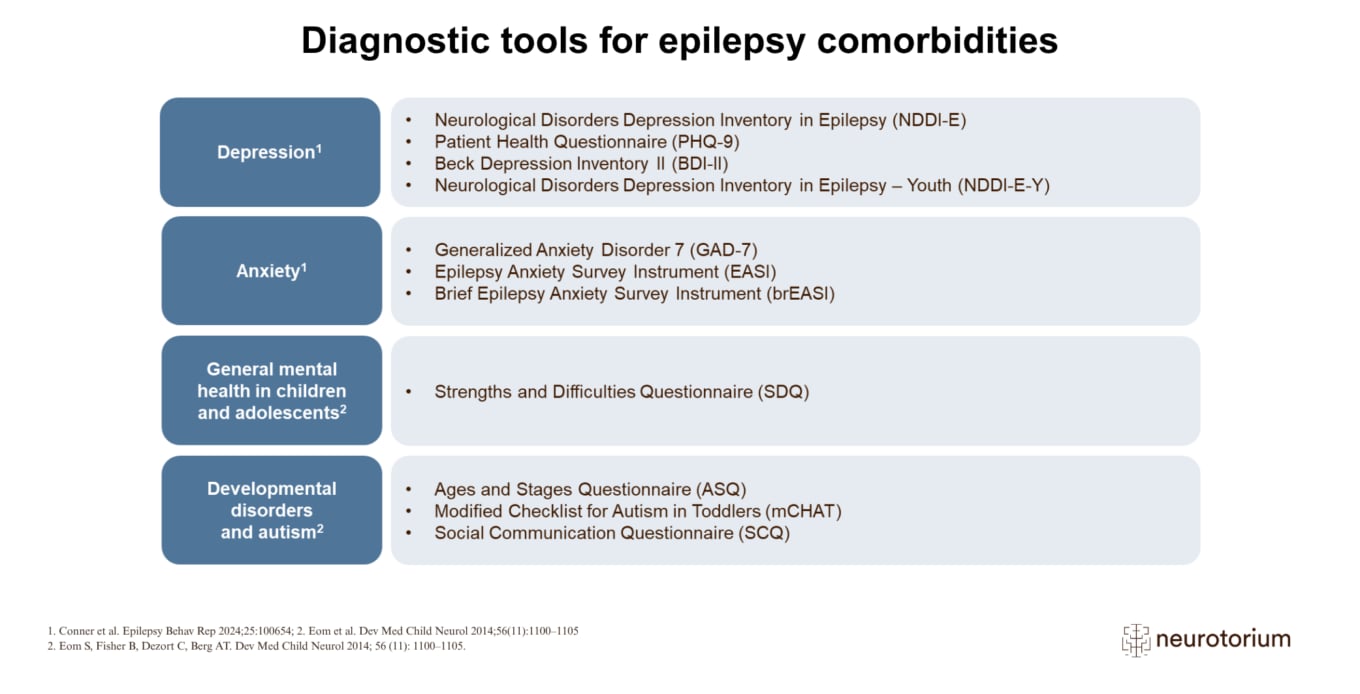
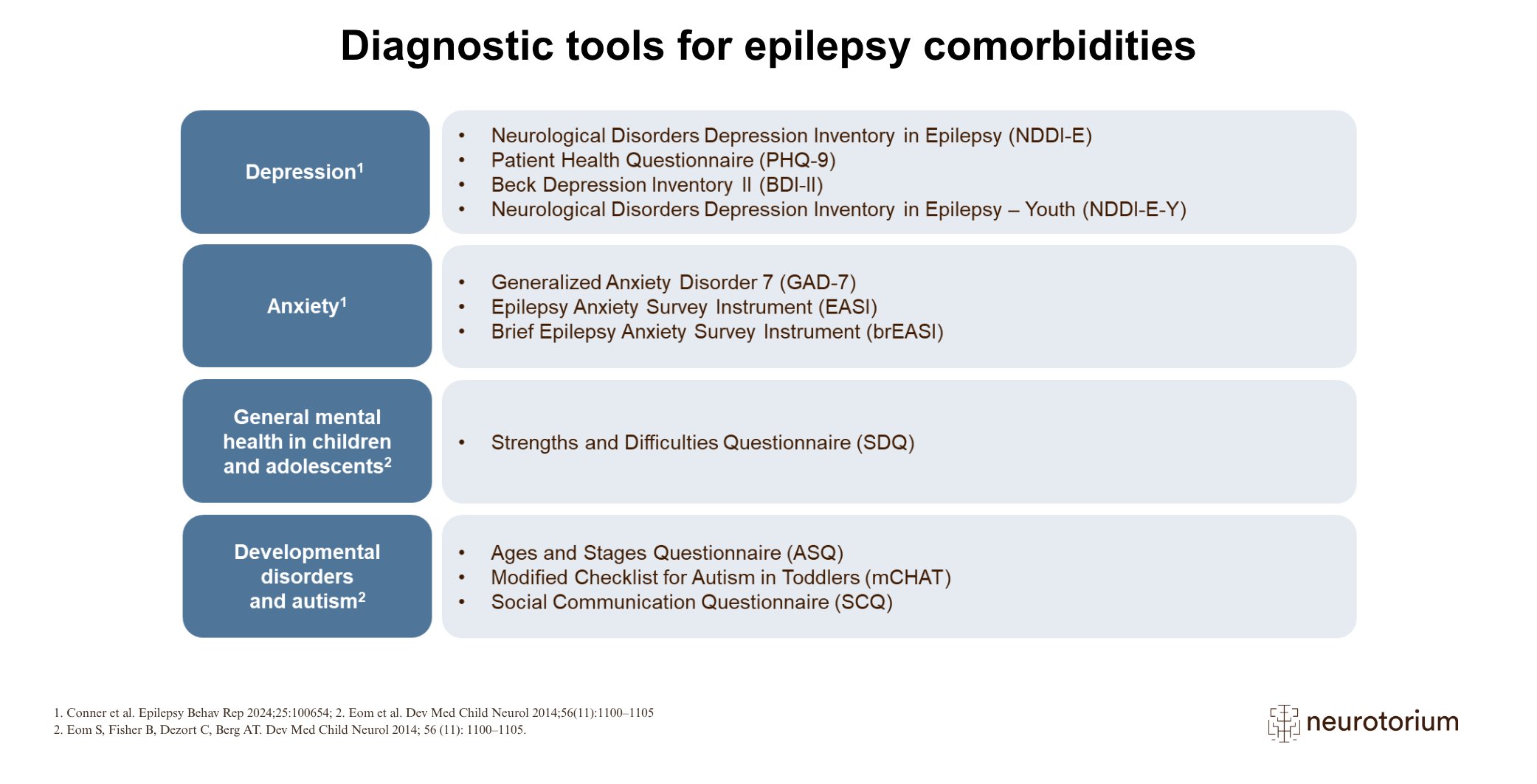
The figure presents key diagnostic tools used to assess common comorbidities in people with epilepsy. For depression, recommended instruments include the NDDI-E, PHQ-9, BDI-II, and NDDI-E-Y. Anxiety can be evaluated using the GAD-7, EASI, and brEASI. General mental health in children and adolescents is assessed with the SDQ. Developmental disorders and autism may be screened using the ASQ, mCHAT, and SCQ.
The NDDI-E-Y is validated for use in children and adolescents with epilepsy.1 Also the GAD-7 is validated for use in people with epilepsy and is based on the DSM-5 diagnostic criteria for generalized anxiety disorder1 and is recommended by the American Academy of Neurology as a screening tool.1
NDDI-E=Neurological Disorders Depression Inventory in Epilepsy, PHQ-9=Patient Health Questionnaire, BDI-II=Beck Depression Inventory II, NDDI-E-Y=Neurological Disorders Depression Inventory in Epilepsy Youth, GAD-7=Generalized Anxiety Disorder 7, EASI=Epilepsy Anxiety Survey Instrument, brEASI=Brief Epilepsy Anxiety Survey Instrument, SDQ=Strenghts and Difficulties Questionnaire, ASQ=Ages and Stages Questionnarie, mCHAT=Modified Checklist for Autism in Toddlers, SCQ=Social Communication Questionnaire
Related content

In this video, Professor Dr. Nathalie Jetté reviews depression as a common yet often under-recognized comorbidity in epilepsy.

In this video, Professor Dr. Gretchen Birbeck examines epilepsy-associated stigma as a global public-health challenge

In this video, Professor Dr. Jacqueline French reviews practical, first-line decision-making for anti-seizure medication selection