


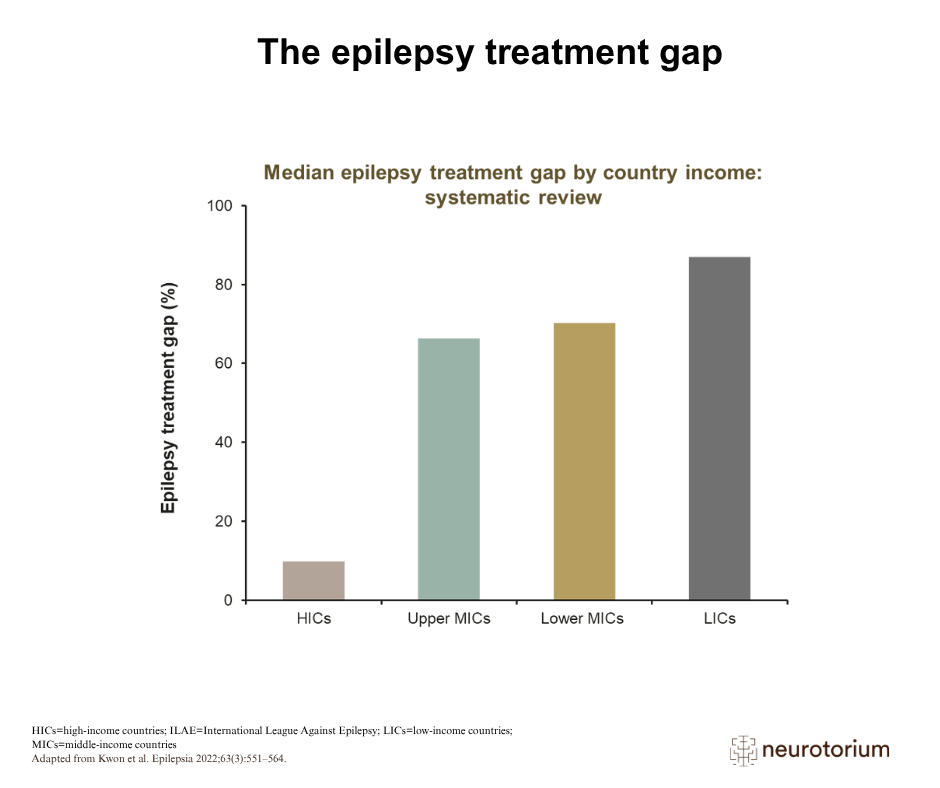
The ILAE Commission on the Developing World has defined the epilepsy treatment gap as the difference between the number of people with epilepsy and those with epilepsy who receive antiseizure medication.1 This figure summarizes findings from a systematic review of 45 epidemiological studies, in which treatment gaps were calculated as the proportion of people with epilepsy who were either not receiving antiseizure medication or receiving inadequate treatment. The estimated epilepsy treatment gap ranged from 9.8% in high-income countries to 86.9% in low-income countries.1
Related content
In this video, Professor Dr. Nathalie Jetté reviews depression as a common yet often under-recognized comorbidity in epilepsy.

In this video, Professor Dr. Gretchen Birbeck examines epilepsy-associated stigma as a global public-health challenge
In this video, Professor Dr. Jacqueline French reviews practical, first-line decision-making for anti-seizure medication selection