

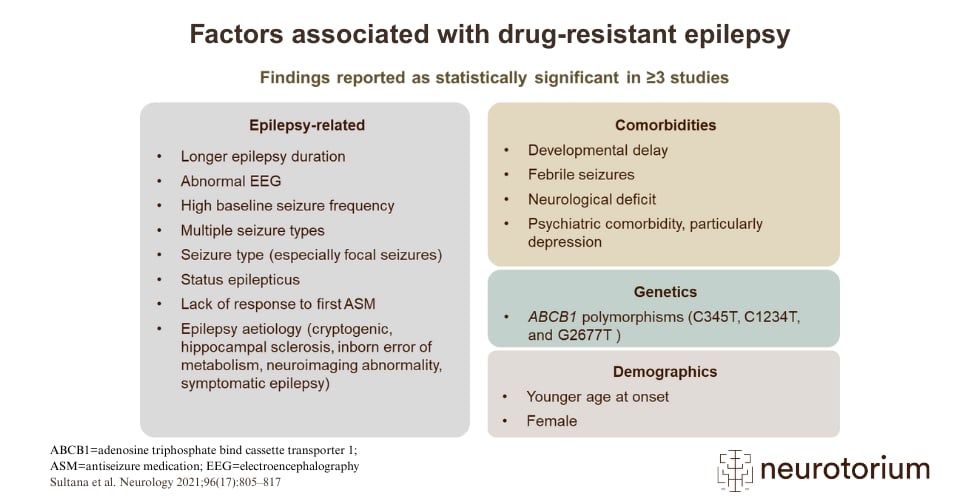
The figure summarizes factors associated with drug-resistant epilepsy reported as statistically significant in multiple studies. The most commonly reported predictors and correlates of drug-resistant epilepsy (DRE), reported by ≥10 of the studies included in the systematic review, were younger age at onset, a neurological or electroencephalographic (EEG) abnormality, high baseline seizure frequency, and symptomatic epilepsy.1 DRE predictors and correlates reported as statistically significant by ≤3 studies included for example male sex, drug or alcohol abuse, changes in seizure type with treatment, long latency between epilepsy onset and first antiseizure medication treatment, or epileptic encephalopathy.1
The authors were careful to emphasize that counting the number of studies reporting a factor as statistically significant is an imperfect method of analyzing DRE predictors and correlates, as it may not only reflect the biological importance of a factor but also the number of studies conducted in the epilepsy subfield, and the collection of some of the variables may be inherent to study design (e.g., the association of longer disease duration with DRE).1 Nonetheless, neurological or EEG abnormalities and symptomatic epilepsy being the most frequently reported factors suggests that underlying structural, immune, infectious, or metabolic aetiology of epilepsy, especially when they lead to neurological or EEG abnormalities, are predictive of a more severe course of epilepsy.1
Related content

In this video, Professor Dr. Nathalie Jetté reviews depression as a common yet often under-recognized comorbidity in epilepsy.

In this video, Professor Dr. Gretchen Birbeck examines epilepsy-associated stigma as a global public-health challenge

In this video, Professor Dr. Jacqueline French reviews practical, first-line decision-making for anti-seizure medication selection