


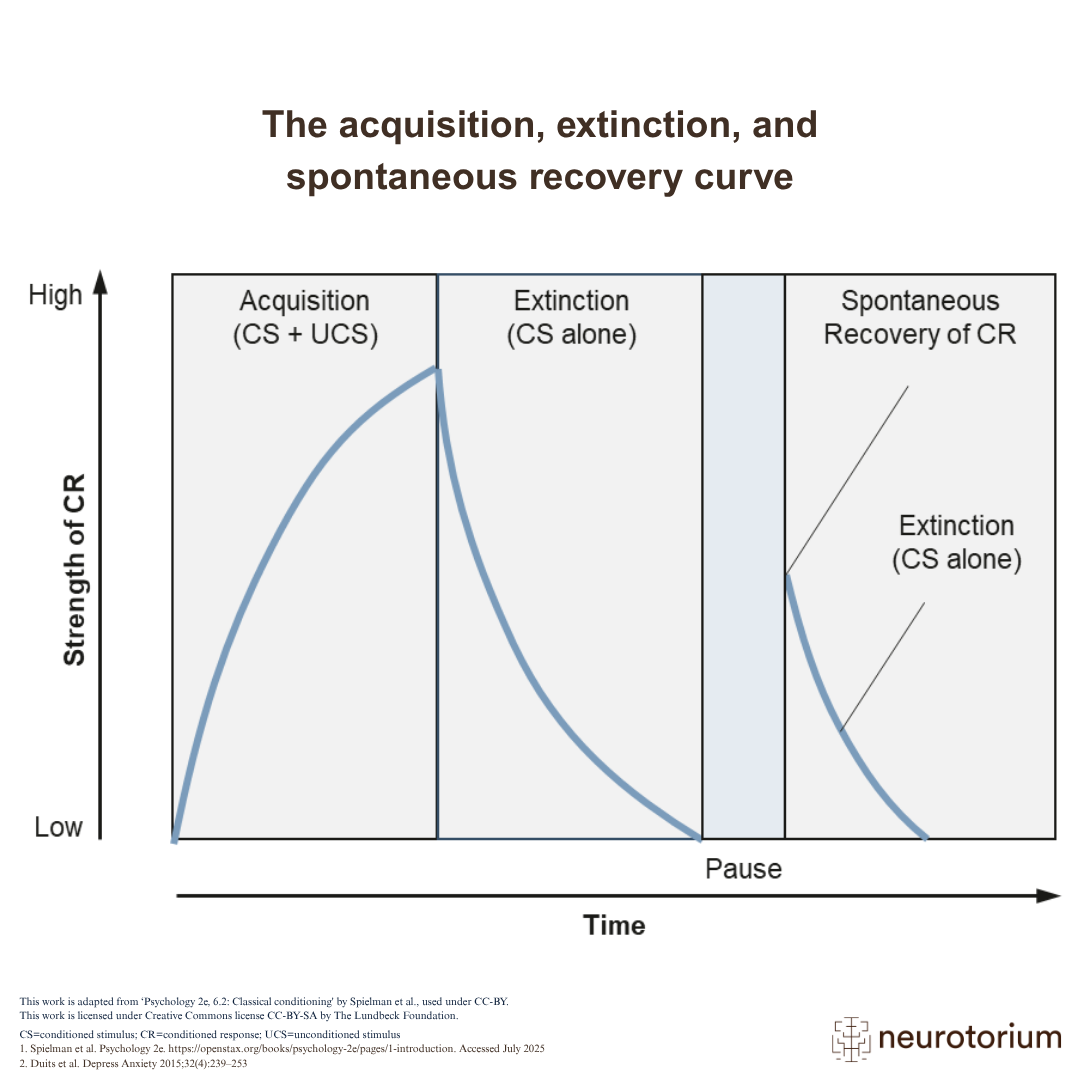
The rising curve in the graph represents the conditioned response becoming stronger through repeated association of the conditioned stimulus and the unconditioned stimulus, after which the strength weakens during the extinction phase when only the conditioned stimulus is presented.1 The spontaneous recovery describes how, after a pain in time, the conditioned response may reappear.1
Human studies of threat conditioning and fear learning2:
- A positive conditioned stimulus (CS+) is paired with an aversive unconditioned stimulus.
- A negative conditioned stimulus (CS-) is not paired with the aversive cue, and acts as a safety cue.
- Eventually, a conditioned response occurs where the positive conditioned stimulus evokes the same fear response as the aversive stimulus.The extinction of this response occurs over time on exposure to the newly conditioned stimulus in the absence of the aversive stimulus.
- However, the association between the CS+ and the aversive stimulus is not removed during extinction, but is replaced with a newly learned association that is now dependent on context.
CS=conditioned stimulus; CR=conditioned response; UCS=unconditioned stimulus
Related content
In the video, Professor Dr. Brenda Penninx highlights a significant increase in the prevalence of anxiety disorders, with a 50% rise over the last decade, affecting about 10% of the population.

In this video, Professor Dr. Dan Stein highlights the dynamic nature of anxiety disorders, emphasizing the need to re-conceptualize them from a course perspective.
In this video, Professor Dr. Milan Latas highlights the high prevalence of comorbidity in anxiety disorders, with 50% or more of patients having additional psychiatric conditions