

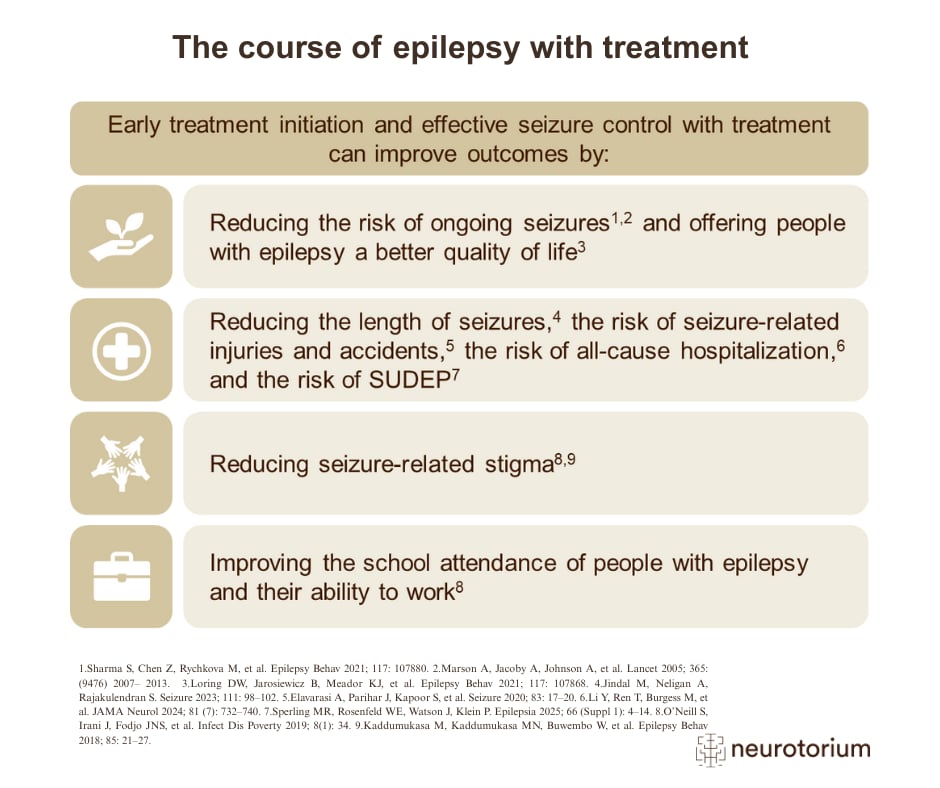
Approximately two-thirds of people with newly diagnosed epilepsy can enter prolonged remission with currently available antiseizure medication.1,2
The more seizures occur, the less likely they are to be controlled.1,3 Immediate treatment is associated with lower rates of seizure recurrence and longer time to seizure recurrence than deferred treatment in patients with epilepsy, especially in those who had experienced two or more unprovoked seizures at diagnosis.4,5 However, once treatment commenced, the differences in the rates of patients achieving seizure remission following immediate vs deferred treatment diminish over time.4,5
Apart from treatment timing, correct dosing is also crucial for optimizing outcomes in epilepsy.7
A retrospective observational study evaluating the management and outcomes of status epilepticus in 252 patients at University College Hospital London found the median time to seizure cessation to be 25 minutes, with a positive correlation between time to first benzodiazepine treatment administration and seizure cessation (p<0.05).7 The median time to seizure cessation was 18 minutes in patients who received a correct dose of benzodiazepine treatment, compared with 39 minutes in patients who received either lower or higher doses than recommended by the National Institute for Health and Care Excellence.7 In addition, patients who received benzodiazepine treatment within 15 minutes of status epilepticus onset had a much lower likelihood of requiring second- and third-line treatment, and of experiencing respiratory complications, than patients receiving benzodiazepine treatment after 15 minutes of status epilepticus onset (p<0.05).7 Longer duration of seizures (>30 minutes) was associated with a significantly higher likelihood of respiratory complications than shorter duration of seizures.7
Related content
In this video, Professor Dr. Nathalie Jetté reviews depression as a common yet often under-recognized comorbidity in epilepsy.

In this video, Professor Dr. Gretchen Birbeck examines epilepsy-associated stigma as a global public-health challenge
In this video, Professor Dr. Jacqueline French reviews practical, first-line decision-making for anti-seizure medication selection