

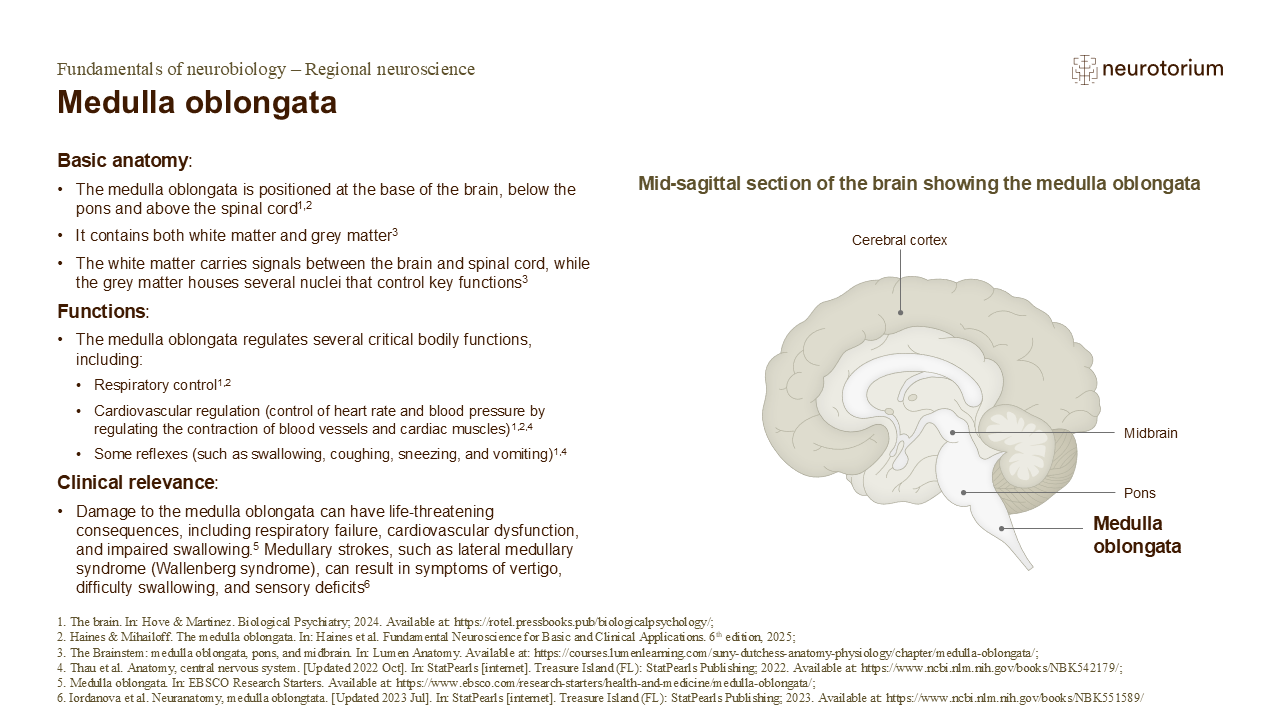
The medulla oblongata is part of the brainstem, located just above the spinal cord. It plays a crucial role in controlling autonomic functions, such as breathing, heart rate, and blood pressure.1,2,4
Several cranial nerves emerge from or pass through the medulla, governing functions like taste, swallowing, and movements of the neck and tongue:6
- Glossopharyngeal (IX, mixed) – taste, swallowing and monitoring of blood pressure
- Vagus (X, mixed) – regulation of heart, lungs, digestive tract, speech, swallowing
- Accessory (XI, motor)
- Hypoglossal (XII, motor) – controls movement of tongue needed for speech and swallowing
References:
1. The brain. In: Hove & Martinez. Biological Psychiatry; 2024. Available at: https://rotel.pressbooks.pub/biologicalpsychology/.
2. Haines DE, Mihailoff GA. The medulla oblongata. In: Haines DE, Mihailoff GA, Willis MA. Fundamental Neuroscience for Basic and Clinical Applications. 6th edition, 2025. Philadelphia: Elsevier.
3. The Brainstem: medulla oblongata, pons, and midbrain. In: Lumen Anatomy. Available at: https://courses.lumenlearning.com/suny-dutchess-anatomy-physiology/chapter/medulla-oblongata/.
4. Thau et al. Anatomy, central nervous system. [Updated 2022 Oct]. In: StatPearls [internet]. Treasure Island (FL): StatPearls Publishing; 2022. Available at: https://www.ncbi.nlm.nih.gov/books/NBK542179/.
5. Medulla oblongata. In: EBSCO Research Starters. Available at: https://www.ebsco.com/research-starters/health-and-medicine/medulla-oblongata/.
6. Lordanova R, Reddivari AKR. Neuronatomy, medulla oblongtata. [Updated 2023 Jul]. In: StatPearls [internet]. Treasure Island (FL): StatPearls Publishing; 2023. Available at: https://www.ncbi.nlm.nih.gov/books/NBK551589/.