

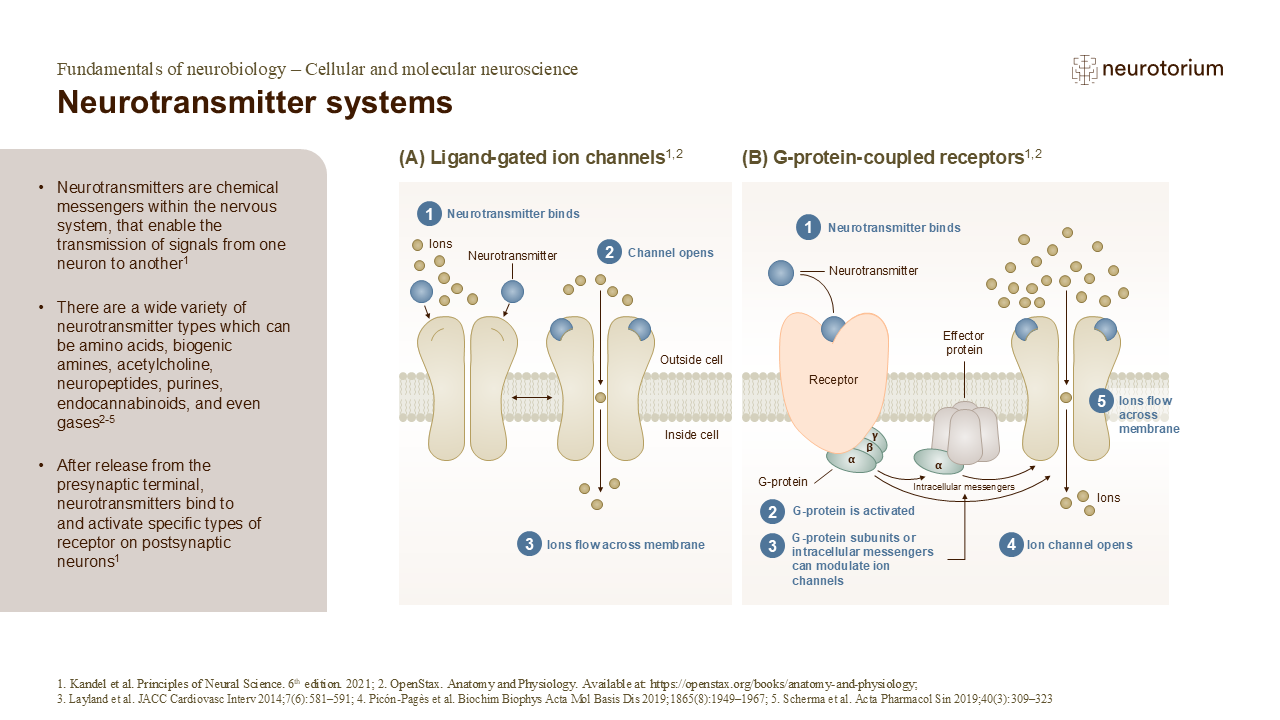
Ionotropic receptors are ligand-gated ion channels.1 When a neurotransmitter binds, the receptor undergoes a conformational change that directly opens or closes an ion channel, allowing specific ions (Na⁺, K⁺, Cl⁻, Ca²⁺) to pass through.1,2,6 They are very fast acting (milliseconds), because the effect is direct.1,2 Ionotropic receptors can be excitatory (e.g., Na⁺ influx leading to depolarization) or inhibitory (e.g., Cl⁻ influx leading to hyperpolarization).6,7 Examples of ionotropic receptors include those that bind glutamate (N-methyl-D-aspartate, α-amino-3-hydroxy-5-methyl-4-isoxazole, and kainate receptors), nicotinic acetylcholine receptors, and GABAA receptors.6,8
Metabotropic receptors are G-protein-coupled receptors.1 Neurotransmitter binding activates a G-protein, which then triggers second messenger cascades (e.g., cyclic adenosine monophosphate, inositol triphosphate, diacylglycerol).1,8 These messengers then have a downstream effect in the cell.8,9 They act more slowly than ionotropic receptors but their effects can be long-lasting.1,10 Examples include: metabotropic glutamate receptors, muscarinic acetylcholine receptors, and dopamine, serotonin, and noradrenaline receptors.1,11,12
References:
1. Overview of synaptic transmission. In: Kandel ER, Koester JD, Mack SH, Siegelbaum SA (eds). Principles of Neural Science. 6th edition. McGraw-Hill, 2021.
2. The action potential. In: OpenStax. Anatomy and Physiology. Available at: https://openstax.org/books/anatomy-and-physiology.
3. Layland J, Carrick D, Lee M, et al. Adenosine: Physiology, pharmacology, and clinical applications. JACC Cardiovasc Interv 2014; 7 (6): 581–591.
4. Picón-Pagès P, Garcia-Buendia J, Munoz FJ. Functions and dysfunctions of nitric oxide in the brain. Biochim Biophys Acta Mol Basis Dis 2019; 1865 (8): 1949–1967.
5. Scherma M, Masia P, Satta V, et al. Brain activity of anandamide: a rewarding bliss? Acta Pharmacol Sin 2019; 40 (3): 309–323.
6. Chen RJ, Sharma S. GABA receptor. StatPearls [internet]. 2025.
7. Synaptic transmission. In: Augustine GJ, Groh J, Huettel S, et al. (eds). Neuroscience. 7th edition. Oxford University Press, 2023.
8. Hassel B, Dingledine R. Glutamate and glutamate receptors. In: Brady ST, Siegel CJ, Albers RW, Price DL (eds). Basic Neurochemistry: Principles of Molecular, Cellular and Medical Neurobiology. 8th edition. Academic Press, 2012.
9. Fernández de Sevilla D, Nuñez A, Araque A, Buño W. Metabotropic regulation of synaptic plasticity. Neuroscience 2021; 456: 1–3.
10. Caire MJ, Reddy V, Varacallo MA. Physiology, synapse. StatPearls [internet]. 2023.
11. Picciotto MR, Higley MJ, Mineur YS. Acetylcholine as a neuromodulator: Cholinergic signaling shapes nervous system function and behavior. Neuron 2012; 76 (1): 116–129.
12. Millan MJ, Marin P, Bockaert J, Mannoury la Cour C. Signaling at G-protein-coupled serotonin receptors: recent advances and future directions. Trends Pharmacol Sci 2008; 29 (9): 454–464.