

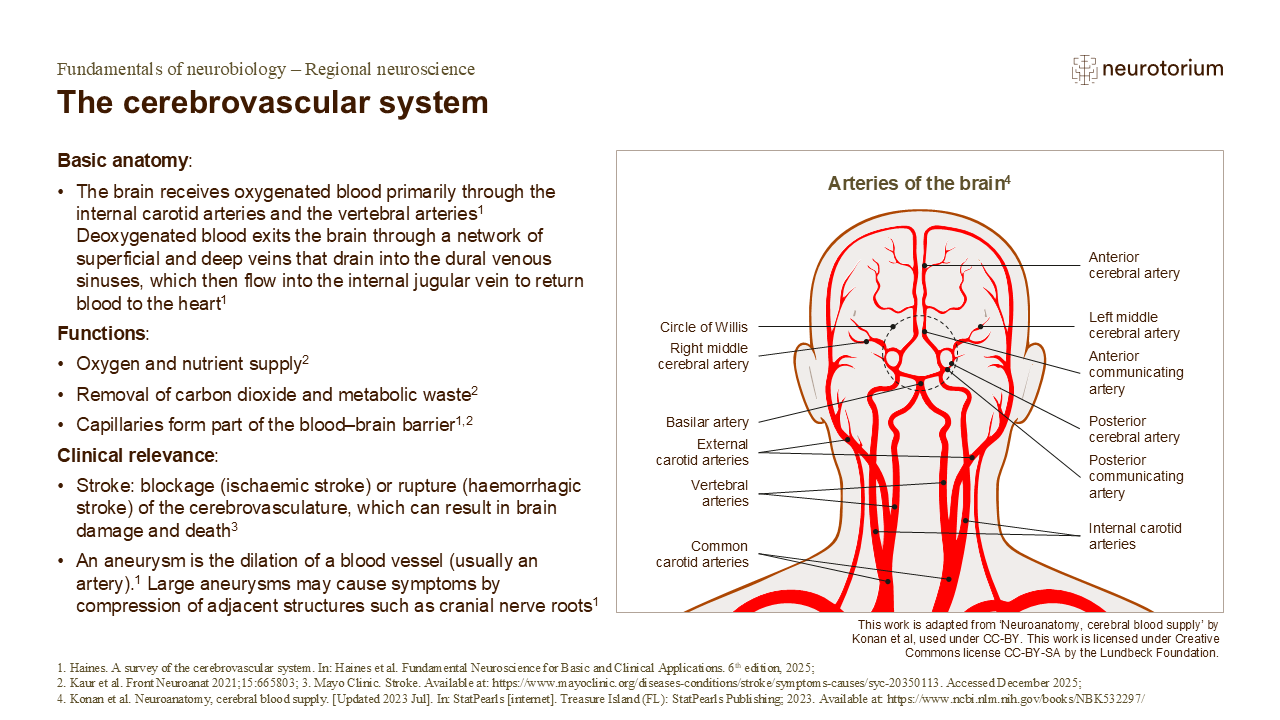
The brain makes up approximately 2% of total body weight but consumes about 20% of the oxygen used.1 Oxygenated blood is supplied by the internal carotid and vertebral arteries.1 The internal carotid arteries enter the skull and branch into the anterior and middle cerebral arteries, supplying the front (anterior) portion of the brain.1 The vertebral arteries converge to form the basilar artery, which itself divides into the left and right posterior cerebral arteries, supplying the back (posterior) portion of the brain.1 These arteries are interconnected at the base of the brain in a roughly circular formation called the circle of Willis, which helps ensure blood supply continuity.1 A network of capillaries (the smallest blood vessels) distributes blood throughout the brain, enabling nutrient and gas exchange at a cellular level.5
A continuous flow of oxygenated blood is essential for brain function.1 Loss of consciousness will occur if the brain is deprived of oxygen for 10–12 seconds.1 After 3 to 5 minutes irreparable brain damage or death may result.1 About 50% of problems that occur inside the cranial cavity and result in neurologic deficits are vascular in origin.1
References:
1. Haines DE. A survey of the cerebrovascular system. In: Haines DE, Mihailoff GA, Willis MA. Fundamental Neuroscience for Basic and Clinical Applications. 6th edition, 2025. Philadelphia: Elsevier.
2. Kaur J, Fahmy LM, Davoodi-Bojd, et al. Waste clearance in the brain. Front Neuroanat 2021; 15: 665803.
3. Mayo Clinic. Stroke. Available at: https://www.mayoclinic.org/diseases-conditions/stroke/symptoms-causes/syc-20350113. Accessed December 2025.
4. Konan LM, Reddy V, Mesfin FB. Neuroanatomy, cerebral blood supply. [Updated 2023 Jul 24]. In: StatPearls [Internet]. Treasure Island (FL): StatPearls Publishing; 2023. Available at: https://www.ncbi.nlm.nih.gov/books/NBK532297/.
5. Bracko O, Harraz OF. Editorial: small and mighty: Brain capillaries in health and disease. Front Mol Neurosci 2022; 15: 1108978.