

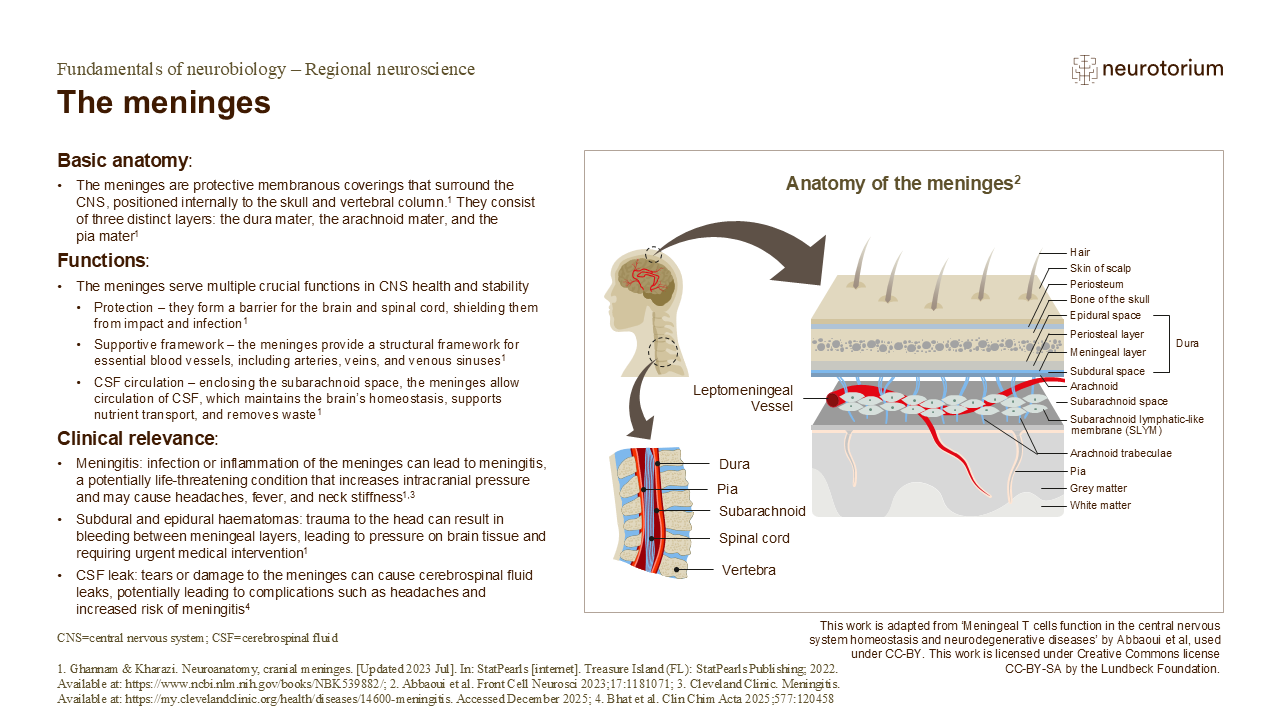
The dura mater is a tough, thick layer composed of two sublayers, the periosteal dura (attached to the skull) and the meningeal dura (closer to the brain).1,2 The dura mater provides a protective layer for the brain and spinal cord.1,2
The arachnoid mater has a spider’s web appearance and is thinner and more delicate than the dura mater.1,2,5 The subarachnoid space, filled with CSF, is beneath this layer.1,2
The pia mater is the very thin innermost layer which is closely adhered to the surface of the brain and spinal cord.1,2 It contains many blood vessels which supply oxygen and nutrients to the brain.2
References:
1. Ghannam JY, Al Kharazi KA. Neuroanatomy, cranial meninges. [Updated 2023 Jul]. In: StatPearls [internet]. Treasure Island (FL): StatPearls Publishing; 2022. Available at: https://www.ncbi.nlm.nih.gov/books/NBK539882/.
2. Abbaoui A, Fatoba O, Yamashita T. Meningeal T cells function in the central nervous system homeostasis and neurodegenerative diseases. Front Cell Neurosci 2023; 17: 1181071.
3. Cleveland Clinic. Meningitis. Available at: https://my.clevelandclinic.org/health/diseases/14600-meningitis. Accessed December 2025.
4. Bhat SN, Thunga G, Kamath A, et al. CSF biomarkers and leak detection: A systematic review and meta-analysis of diagnostic test accuracy (DTA) studies. Clin Chim Acta 2025; 577: 120458.
5. Adeeb N, Deep A, Griessenauer CJ, et al. The intracranial arachnoid mater: A comprehensive review of its history, anatomy, imaging, and pathology. Childs Nerv Syst 2013; 29 (1): 17–33.