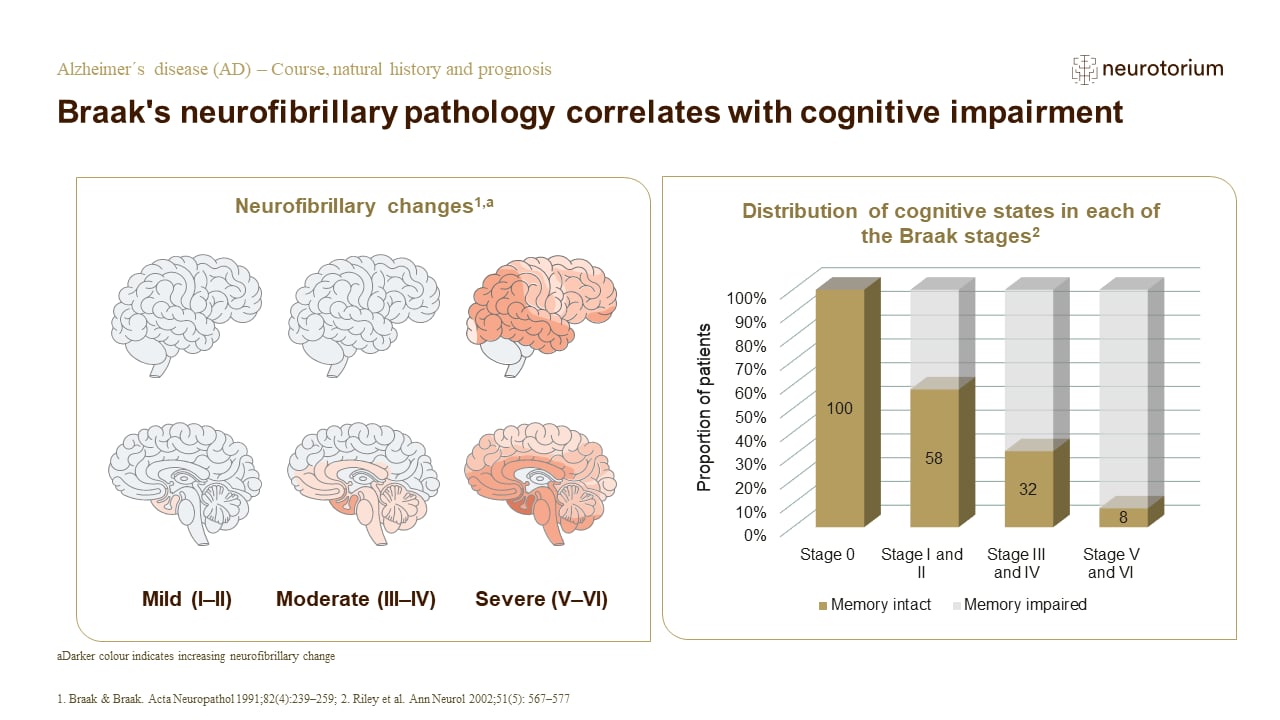
The staging method developed by Braak and Braak suggests that the neurofibrillary pathology of AD progresses in a relatively predictable sequence across the medial temporal lobe structures, subcortical nuclei, and neocortical areas of the brain in seven stages, with the final stage representing the absence of cortical neurofibrillary changes.1 Stages I and II denote the transentorhinal stage, in which the neurofibrillary pathology is limited to the transentorhinal and entorhinal cortex with mild involvement of the CA1/CA2 sections of the hippocampus.1 Stages III and IV denote the limbic stage, in which there is severe involvement of the entorhinal areas, moderate tangles in the hippocampus, and spread to the amygdala, thalamus, hypothalamus, and basal forebrain.1 Stages V and VI denote the neocortical stage, in which there is abundant neurofibrillary pathology in the neocortex.1 Classification of patients into the six cognitive states was significantly linked to Braak stages of AD neurofibrillary pathology, providing further support for the relationship between cognitive impairment and the progression of AD pathology from its earliest stages.1,2 Overall, clinical decline and progression of AD appear to be more closely correlated with tau neuropathology compared with Aβ neuropathology3,4
Braak's neurofibrillary pathology correlates with cognitive impairment