

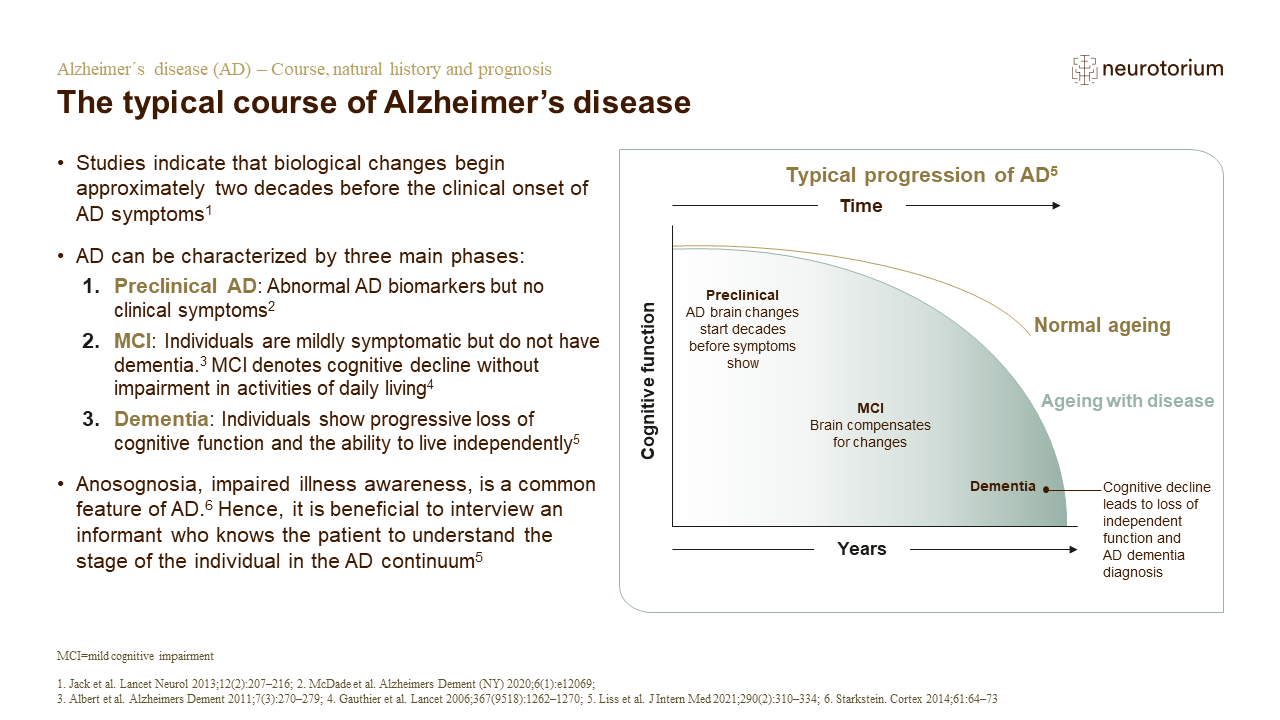
The ‘preclinical’ stage precedes mild cognitive impairment (MCI) and includes individuals who have evidence of early AD pathological changes, but do not meet clinical criteria for MCI or dementia.7 Three stages of preclinical AD were first defined in 2011.7 In Stage 1, individuals are not cognitively impaired but present with amyloidß- (Aß) pathology.7 Stage 2 is characterized by the presence of Ab pathology and neurodegeneration, without cognitive impairment, and Stage 3 is also characterized by the presence of Aß pathology and neurodegeneration, but with subtle cognitive impairment.7
MCI stage describes the presence of noticeable cognitive decline which is relative to age and does not interfere with daily activities.4 The heterogeneity of MCI presents a challenge to the timely diagnosis of MCI due to AD.4 Cognitive impairments of different aetiologies may be more correctable than MCI due to AD (e.g polypharmacy, sleep disorders, major depressive disorder), will require different treatments, and will be associated with differing prognoses.8 Therefore, characterizing the nature of and accurately diagnosing the aetiology of observed impairment is important.4
The dementia stage is the stage most associated with AD and is characterized by substantial cognitive impairment which affects more than one cognitive domain.9 Dementia due to AD can take approximately two decades to develop.9 Once present, individuals may live with dementia for several years.10 Emerging evidence from both genetic at-risk and ageing cohorts suggests that there may be a time lag of a decade or more between the beginning of the pathological cascade of AD and the onset of clinically evident impairment.7 It has been proposed that AD begins with a long asymptomatic period, during which the pathophysiological disease progresses.7 Individuals with biomarker evidence of early AD-pathophysiological processes are then at increased risk for developing cognitive and behavioural impairment and progression to clinically manifest AD dementia.7
For more information on the neurobiology and aetiology of AD, see our slide deck here.
8.Alzheimer’s Association website. 2019 Alzheimer’s disease facts and figures. Available at: www.alz.org/media/documents/alzheimers-facts-and-figures-2019-r.pdf. Accessed 12 June 2023.