

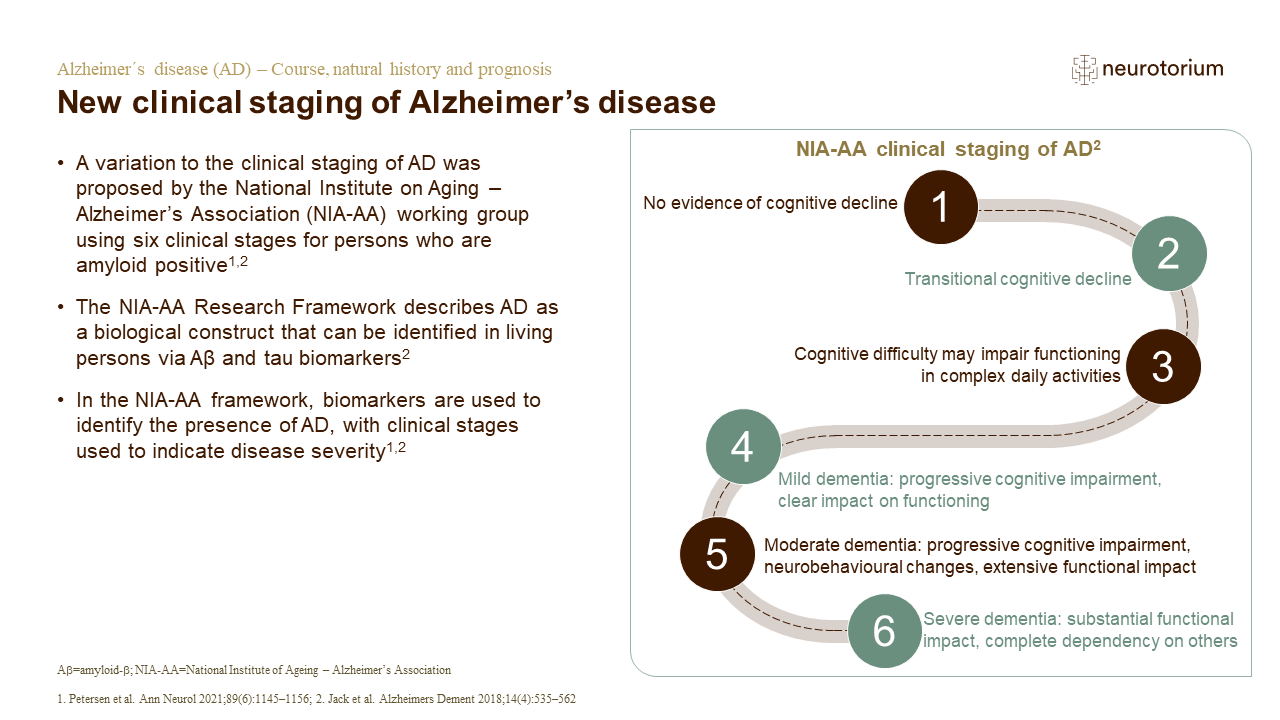
Disease stage can be based on aetiology, clinical history, anatomical distribution of pathology, or biological features.3 Clinically determined stages to categorize AD lack specificity, however they do provide prognostically relevant information.3 Numerical clinical staging can be applied to individuals in the Alzheimer’s continuum, consisting of 6 distinct stages.2 In Stage 1, cognitive performance of individuals is within the expected range and is comparable to normative data of the investigator’s choice, with or without adjustment for factors such as age, sex, education etc.2 At this point, there is no evidence of cognitive decline or a new onset of concerning neurobehavioural symptoms; based on individual report, report of an observer, or through longitudinal cognitive testing if available.2
In Stage 2, the individual continues to perform normally on objective cognitive tests, with no functional impact on daily activities, but do experience a transitional cognitive decline – a decline from the previous level of functioning, which may involve any cognitive domain.2 The individual may also present mild neurobehavioural changes such as changes in mood, anxiety, or motivation, which should have a clearly defined recent onset, with persistence that cannot be explained by life events.2
Stage 3 is characterized by performance on objective cognitive tests which is within the impaired/abnormal range.2 During this stage, there is evidence of a decline from baseline.2 Additionally, the individual may show cognitive presentations that are not primarily amnestic.2 In Stage 3, the individual is able to independently perform daily activities, but cognitive difficulty may cause mild functional impact on more complex daily activities.2
The transition to Stage 4 occurs when mild dementia is present, defined by a substantial progressive cognitive impairment which affects several cognitive domains, and may exist with neurobehavioural disturbance.2 Individuals with mild dementia experience a clear functional impact on daily life, affecting several activities and requiring occasional assistance.2
At Stage 5, the individual is experiencing moderate dementia, involving progressive cognitive impairment or neurobehavioural changes.2 The individuals are no longer independent and require frequent assistance with daily activities.2
Stage 6 denotes severe dementia, at which point progressive cognitive impairment or neurobehavioural changes continue and clinical interview may not be possible.2 Individuals with severe dementia are fully dependent on others due to severe functional impact on daily life.2