

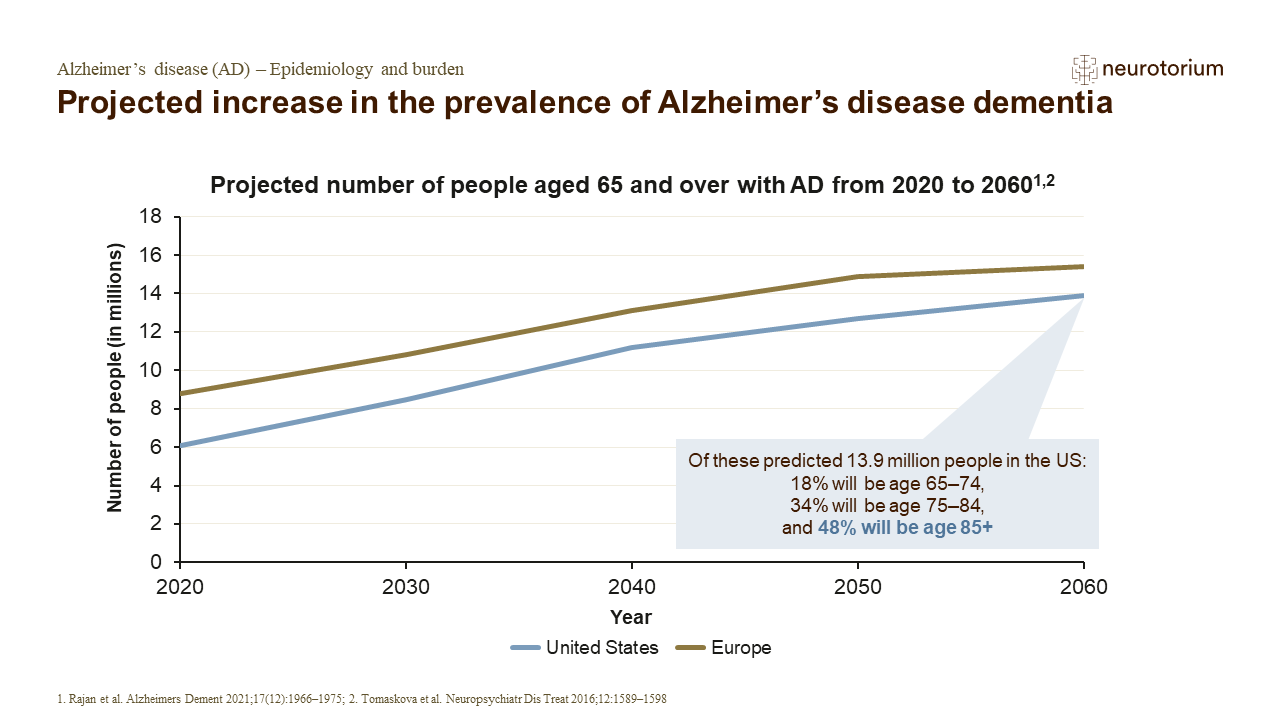
In 2011, the largest ever demographic generation in the US, known as the baby-boom generation, started to reach age 65.3 As a result of this generation, the number of Americans aged 85 and above is expected to dramatically increase over the coming years.4 Additionally, the older adult population in the US is predicted to increase relative to the population aged ≤64 years – a shift referred to as population aging. This is due to a projected decline in fertility, coupled with mortality improvements in older aged individuals.3 With fewer births each year, a larger proportion of the American population will be made up of older adults.3 Since aging is a key risk factor for AD, the number of new and existing cases of AD dementia in the US will increase.1,3 By 2025, it is predicted that the number of individuals aged ≥65 years with AD dementia in the US will reach 7.2 million, which is a 7% increase from 6.7 million affected individuals in 2023.1 Without the development of medical breakthroughs to prevent, slow, or cure AD, this value is predicted to increase to 13.9 million by 2060.1
Prediction of AD prevalence in the EU was conducted using a system dynamics model, which simulated population growth of the EU and the number of patients with AD.2 The model simulated up to 70 years, finding that the number of people with AD will increase from 2020 to 2060, and will then decrease from 2060 to 2080 due to changes in EU population size and structure.2 This trend was also seen when limiting prediction to the population aged above 80 years.2
4. U.S. Census Bureau. 2017 National Population Projections Tables. Available at: https://www.census.gov/data/tables/2017/demo/popproj/2017-summary-tables.html. Accessed 22 September 2023.