

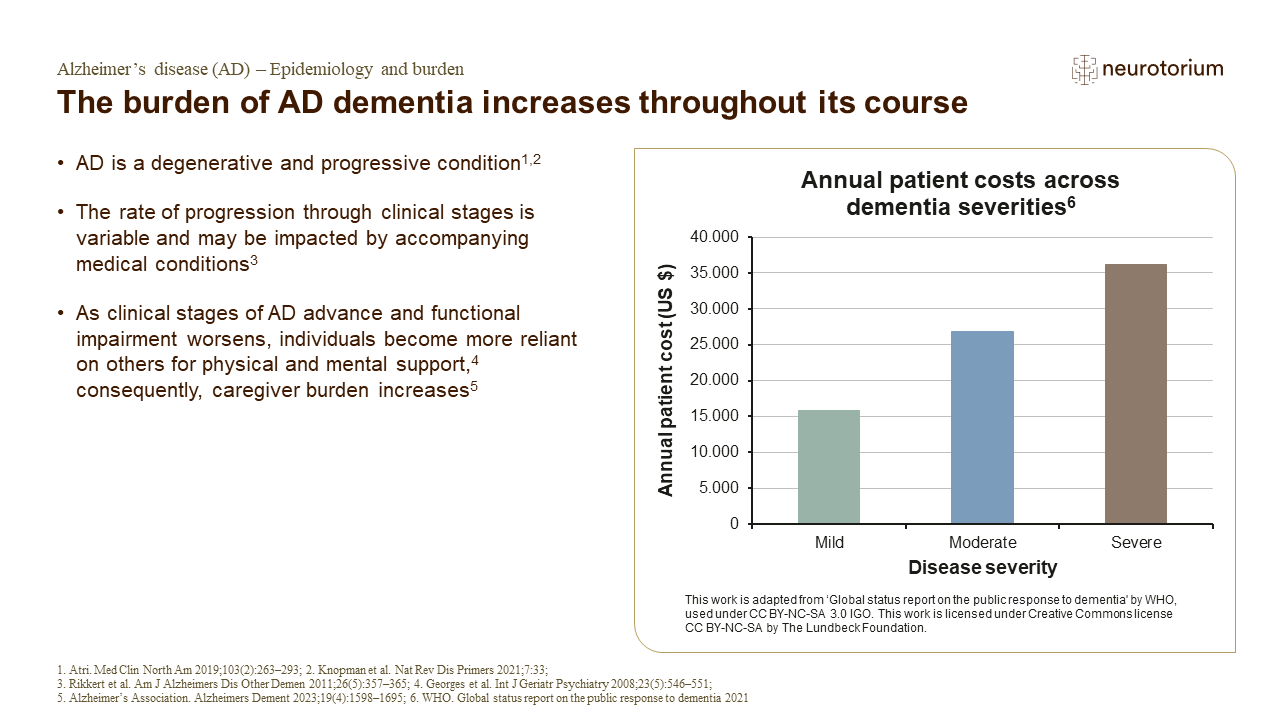
Global function denotes the overall function of an individual and includes cognitive functions, behaviour, and ability to perform activities of daily living (ADLs).7 As AD progresses, the impact on the three domains reduces global function, and increased caregiver burden.8-11 During the early stages of AD, patients may become forgetful, start losing the concept of time, and encounter difficulty learning new information.8 At this stage, changes in cognitive function are described as MCI and do not tend to affect the patient until there is an impact in functioning.5 As cognitive decline increases, people living with AD are unable to recognize themselves and others, at which point caregiver burden increases.11 As a result, many caregivers admit that they start grieving the loss during the course of disease.11
At the start of AD progression, there is little impact on behaviour and social life, allowing some patients to live their life without any external help.8 However if the patient is aware of their symptoms, their quality of life, caregiver quality of life, and financial burden may be impacted.8 As AD progresses, behavioural and psychological symptoms of dementia (BPSD) may develop, including anxiety, depressive moods, aggression, delusions, wandering, and behaviours that are incompatible with the patient’s cultural background.8 The severity of symptoms can differ at different stages of the disease, but tend to become more prominent and restrictive during the middle stages of disease.8,10 In a prospective clinic-based study, the BPSD with moderate to severe impact on caregivers were delirium, hallucinations, agitation/aggression, depression/dysphoria, anxiety, apathy, disinhibition, irritability, and abnormal motor behaviour.10
As a result of cognitive decline and BPSD, patients may begin to lose independence carrying out acts of daily living, such as dressing, and going to the bathroom.8 The presence of BPSD, including motor aggressiveness, and impaired acts of daily living have been associated with increased caregiver burden.9 Changes in cognition, behaviour, and functional autonomy result in increased caregiver burden, owing to increased dependence on others, increased financial burden, and an impact on the relationship between the patient and caregiver.5
In 2019, the global cost of dementia was estimated to be 1.3 trillion US dollars, with 74% of the costs occurring in high-income countries.6 Despite this, the majority of patients with dementia (61%) live in low- and middle-income countries.6 One factor contributing to this disparity may be the lower direct costs in low-income countries due to a lack of available diagnostic and care services.6 In high-income countries, the costs of long-term institutional care make up a substantial proportion of both direct (non-medical) social costs (approximately 50%) and total social costs (approximately 25%) of dementia, however these resources are limited in low- and middle-income countries.6 By 2030, it is expected that the global costs of dementia will increase to 1.7 trillion US dollars.6
References:
1. Atri A. The Alzheimer’s disease clinical spectrum: diagnosis and management. Med Clin North Am 2019; 103 (2): 263–293.
2. Knopman DS, Amieva H, Petersen RC, et al. Alzheimer disease. Nat Rev Dis Primers 2021; 7 (1): 33.
6. WHO. Global status report on the public response to dementia 2021. Available at: https://www.who.int/publications/i/item/9789240033245. Accessed 21 July 2023.