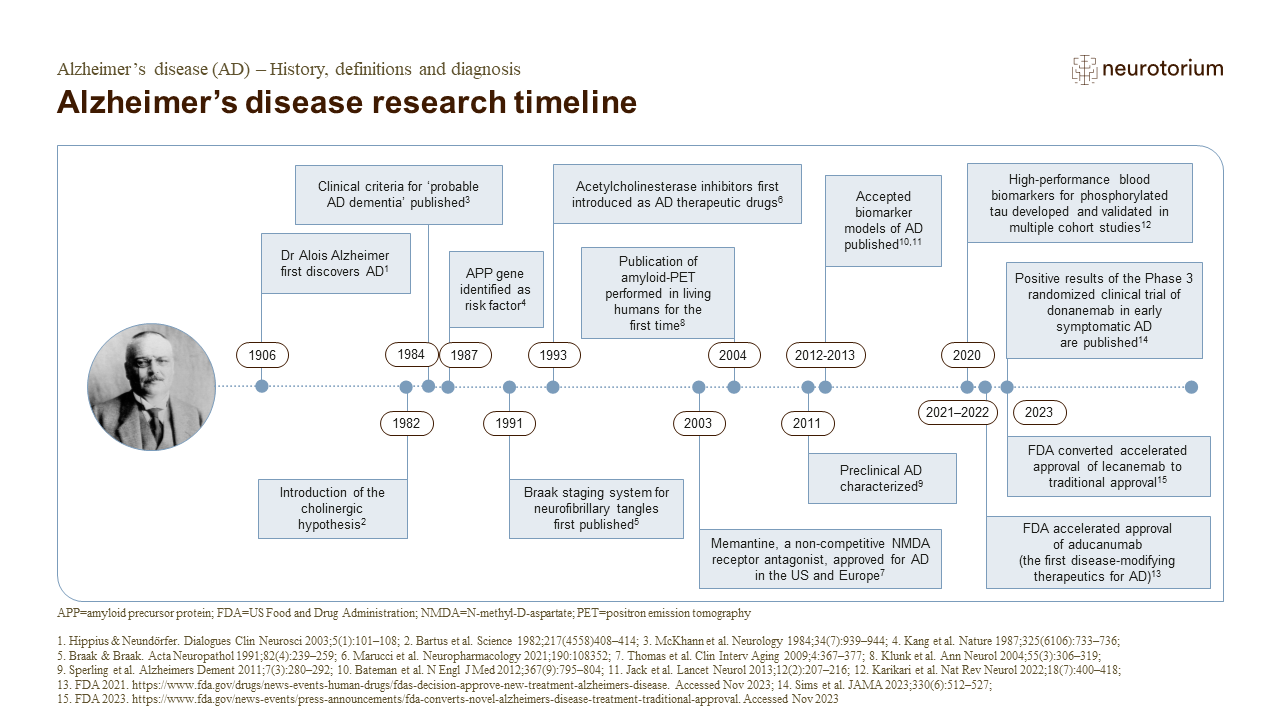
Diagnosis of AD has developed from a pathological approach to a more clinical and exclusionary approach.1,3 NIA-AA Criteria published in 2011, combined with a clinical and biological approach developed by the International Working Group (IWG), allowed for the emergence of a clinical diagnosis.3,16,17 Subsequent efforts by the National Institute on Aging and the Alzheimer’s Association working groups incorporated biomarkers, working towards a purely biological categorization of AD.18,19 The Braak staging system, developed in 1991, provides the ability to differentiate multiple disease phases based on the anatomical distribution of changes in neuropathology.5,20 More recently, blood phosphorylated tau (p-tau)181, p-tau217, and p-tau231 biomarkers reflecting brain tau and amyloid-b (Ab) pathology have been developed.12 The availability of blood-based biomarkers provides potential benefit over CSF or PET biomarkers owing to a less invasive, and more flexible, time- and cost-saving approach.12 Blood-based biomarkers allow for improved AD pre-screening, more definitive and differential diagnosis, and use in population-based and epidemiological studies.12 In 2021, the FDA accelerated the approval of aducanumab for treatment of AD, making it the first novel therapy approved for AD since 2003 and the first treatment to target underlying pathophysiology of AD – Ab plaques.13 In 2023, the FDA granted traditional approval to lecanemab as another treatment option to target the underlying disease process of AD, rather than solely treating symptoms.15 Considerable advancements in AD research have been made over the years, working towards a reality of early identification and multimodal treatment of patients with AD.21 In July 2023, positive results of a Phase 3 randomized clinical trial of donanemab in early symptomatic AD were published.14 In addition, there are currently several disease-modifying treatments being investigated, such as agents targeting amyloid accumulation, tau pathology, and others.22
References:
1.Hippius H, Neundörfer G. The discovery of Alzheimer’s disease. Dialogues Clin Neurosci 2003; 5 (1): 101–108.
2.Bartus RT, Dean RL 3rd, Beer B, Lippa AS. The cholinergic hypothesis of geriatric memory dysfunction. Science 1982; 217 (4558): 408–414.
3.McKhann G, Drachman D, Folstein M, et al. Clinical diagnosis of Alzheimer’s disease: report of the NINCDS-ADRDA Work Group under the auspices of Department of Health and Human Services Task Force on Alzheimer’s Disease. Neurology 1984; 34 (7): 939–944.
4.Kang J, Lemaire HG, Unterbeck A, et al. The precursor of Alzheimer’s disease amyloid A4 protein resembles a cell-surface receptor. Nature 1987; 325 (6106): 733–736.
5.Braak H, Braak E. Neuropathological stageing of Alzheimer-related changes. Acta Neuropathol 1991; 82 (4): 239–259.
6.Marucci G, Buccioni M, Ben DD, Lambertucci C, Volpini R, Amenta F. Efficacy of acetylcholinesterase inhibitors in Alzheimer’s disease. Neuropharmacology 2021; 190: 108352.
7.Thomas SJ, Grossberg GT. Memantine: a review of studies into its safety and efficacy in treating Alzheimer’s disease and other dementias. Clin Interv Aging 2009; 4: 367–377.
8.Klunk WE, Engler H, Nordberg A, et al. Imaging brain amyloid in Alzheimer’s disease with Pittsburgh Compound-B. Ann Neurol 2004; 55 (3): 306–319.
9.Sperling RA, Aisen PS, Beckett LA, et al. Toward defining the preclinical stages of Alzheimer’s disease: recommendations from the National Institute on Aging-Alzheimer’s Association workgroups on diagnostic guidelines for Alzheimer’s disease. Alzheimers Dement 2011; 7 (3): 280–292.
10.Bateman RJ, Xiong C, Benzinger TLS, et al; Dominantly Inherited Alzheimer Network. Clinical and biomarker changes in dominantly inherited Alzheimer’s disease. N Engl J Med 2012; 367 (9): 795–804.
11.Jack CR Jr, Knopman DS, Jagust WJ, et al. Tracking pathophysiological processes in Alzheimer’s disease: an updated hypothetical model of dynamic biomarkers. Lancet Neurol 2013; 12 (2): 207–216.
12.Karikari TK, Ashton NJ, Brinkmalm G, et al. Blood phospho-tau in Alzheimer disease: analysis, interpretation, and clinical utility. Nat Rev Neurol 2022; 18 (7): 400–418.
13.FDA. FDA’s decision to approve new treatment for Alzheimer’s Disease. 6 July 2021. Available at: https://www.fda.gov/drugs/news-events-human-drugs/fdas-decision-approve-new-treatment-alzheimers-disease. Accessed 15 November 2023.
14.Sims JR, Zimmer JA, Evans CD, et al; TRAILBLAZER-ALZ 2 Investigators. Donanemab in early symptomatic Alzheimer disease: The TRAILBLAZER-ALZ 2 randomized clinical trial. JAMA 2023; 330 (6): 512–527.
15.FDA. FDA Converts Novel Alzheimer’s Disease Treatment to Traditional Approval. 6 July 2023. Available at: https://www.fda.gov/news-events/press-announcements/fda-converts-novel-alzheimers-disease-treatment-traditional-approval. Accessed 15 November 2023.
16.Dubois B, Feldman HH, Jacova C, et al. Research criteria for the diagnosis of Alzheimer’s disease: revising the NINCDS-ADRDA criteria. Lancet Neurol 2007; 6 (8): 734–746.
17.Dubois B, Feldman HH, Jacova C, et al. Revising the definition of Alzheimer’s disease: a new lexicon. Lancet Neurol 2010; 9 (11): 1118–1127.
18.McKhann GM, Knopman DS, Chertkow H, et al. The diagnosis of dementia due to Alzheimer’s disease: recommendations from the National Institute on Aging-Alzheimer’s Association workgroups on diagnostic guidelines for Alzheimer’s disease. Alzheimers Dement 2011; 7 (3): 263–269.
19.Knopman DS, Petersen RC, Jack CR Jr. A brief history of “Alzheimer disease”: multiple meanings separated by a common name. Neurology 2019; 92 (22): 1053–1059.
20.Therriault J, Zimmer ER, Benedet AL, et al. Staging of Alzheimer’s disease: past, present, and future perspectives. Trends Mol Med 2022; 28 (9): 726–741.
21.Scheltens P, De Strooper B, Kivipelto M, et al. Alzheimer’s disease. Lancet 2021; 397 (10284): 1577–1590.
22.Cummings J, Zhou Y, Lee G, et al. Alzheimer’s disease drug development pipeline: 2023. Alzheimers Dement (N Y) 2023; 9 (2): e12385.