

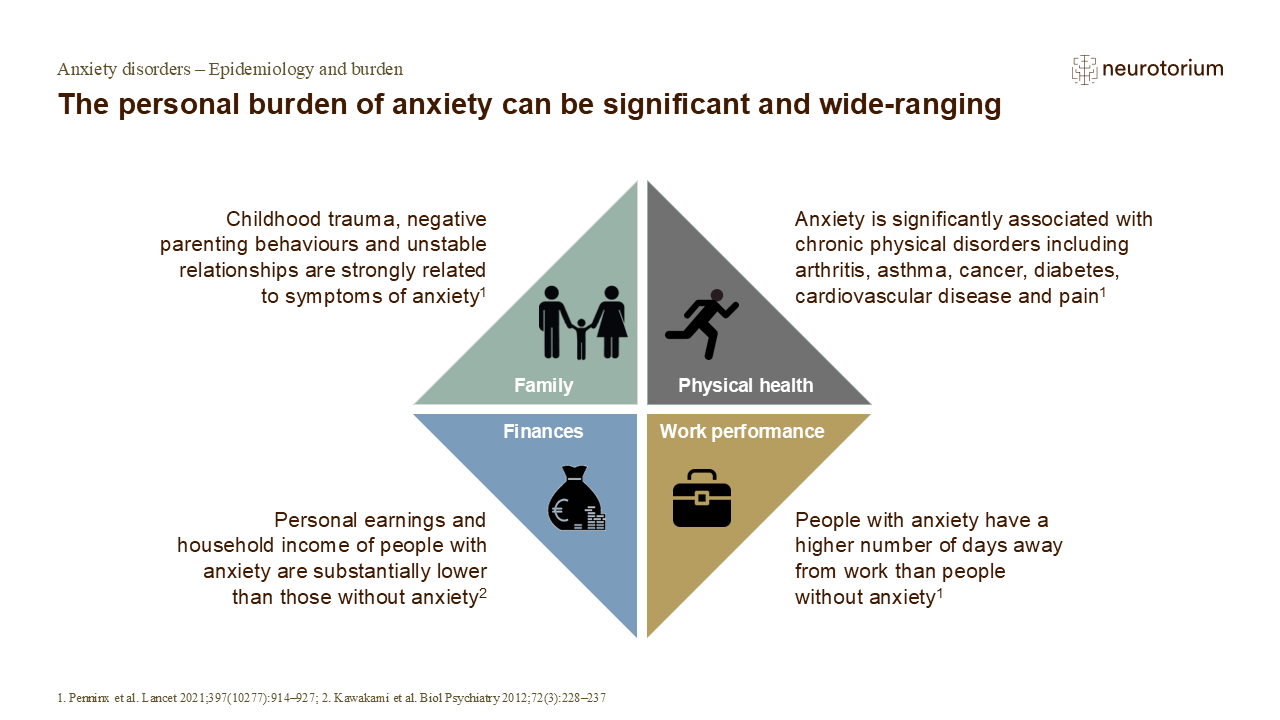
Anxiety disorders are highly disabling in part due to the combination of their early age of onset, high prevalence and the diagnosis-specific associated impairments and disabilities.3 Anxiety disorders have adverse effects on further neurocognitive development that may persist throughout the person’s life or at least have an enduring impact, impeding school and academic achievement, social functioning, and social integration.3
The presence of an anxiety disorder in childhood (i.e., separation anxiety, social anxiety disorder or generalized anxiety disorder [GAD]) has been shown to be associated with impairment in at least one functioning domain (health, financial or interpersonal) in early adulthood, when compared with people with no childhood anxiety disorder.4 The poorest outcomes were observed for childhood GAD, which negatively impacts all functioning domains.4
References:
- Penninx BWJH, Pine DS, Holmes EA, Reif A. Anxiety disorders. Lancet 2021; 397 (10277): 914–927.
- Kawakami N, Abdulghani EA, Alonso J, et al. Early-life mental disorders and adult household income in the World Mental Health Surveys. Biol Psychiatry 2012; 72 (3): 228–237.
- Wittchen HU, Jacobi F, Rehm J, et al. The size and burden of mental disorders and other disorders of the brain in Europe 2010. Eur Neuropsychopharmacol 2011; 21 (9): 655–679.
- Copeland WE, Angold A, Shanahan L, Costello EJ. Longitudinal patterns of anxiety from childhood to adulthood: the Great Smoky Mountains Study. J Am Acad Child Adolesc Psychiatry 2014; 53 (1): 21–33.