

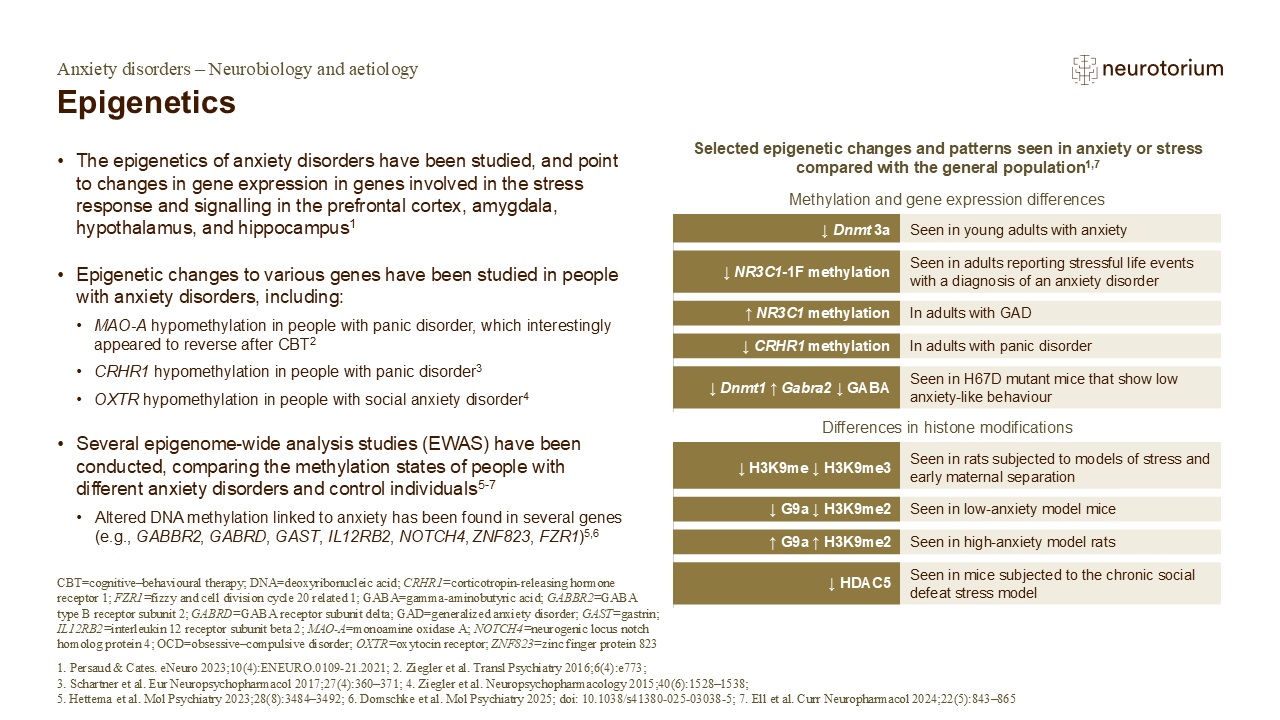
As outlined in the table on the slide, many differences in gene methylation, expression, and histone modification have been found in either people with anxiety compared with controls, or in animal models of anxiety-like behaviour.1 Happily, some of these experimental observations compliment each other, such as the decreased H3K9me2 marking in a mouse model of low anxiety paired with the increased H3K9me2 marking in a rat model of high anxiety.1
References:
- Persaud NS, Cates HM. The epigenetics of anxiety pathophysiology: a DNA methylation and histone modification focused review. eNeuro 2023; 10 (4): ENEURO.0109-21.2021.
- Ziegler C, Richter J, Mahr M, et al. MAOA gene hypomethylation in panic disorder-reversibility of an epigenetic risk pattern by psychotherapy. Transl Psychiatry 2016; 6 (4): e773.
- Schartner C, Ziegler C, Schiele MA, et al. CRHR1 promoter hypomethylation: an epigenetic readout of panic disorder? Eur Neuropsychopharmacol 2017; 27 (4): 360–371.
- Ziegler C, Dannlowski U, Bräuer D, et al. Oxytocin receptor gene methylation: converging multilevel evidence for a role in social anxiety. Neuropsychopharmacology 2015; 40 (6): 1528–1538.
- Hettema JM, van den Oord EJCG, Zhao M, et al. Methylome-wide association study of anxiety disorders. Mol Psychiatry 2023; 28 (8): 3484–3492.
- Domschke K, Schiele MA, Crespo Salvador Ó, et al. Epigenetic markers of disease risk and psychotherapy response in anxiety disorders – a longitudinal analysis of the DNA methylome. Mol Psychiatry 2025; doi: 10.1038/s41380-025-03038-5.
- Ell MA, Schiele MA, Iovino N, Domschke K. Epigenetics of fear, anxiety and stress – focus on histone modifications. Curr Neuropharmacol 2024; 22 (5): 843–865.