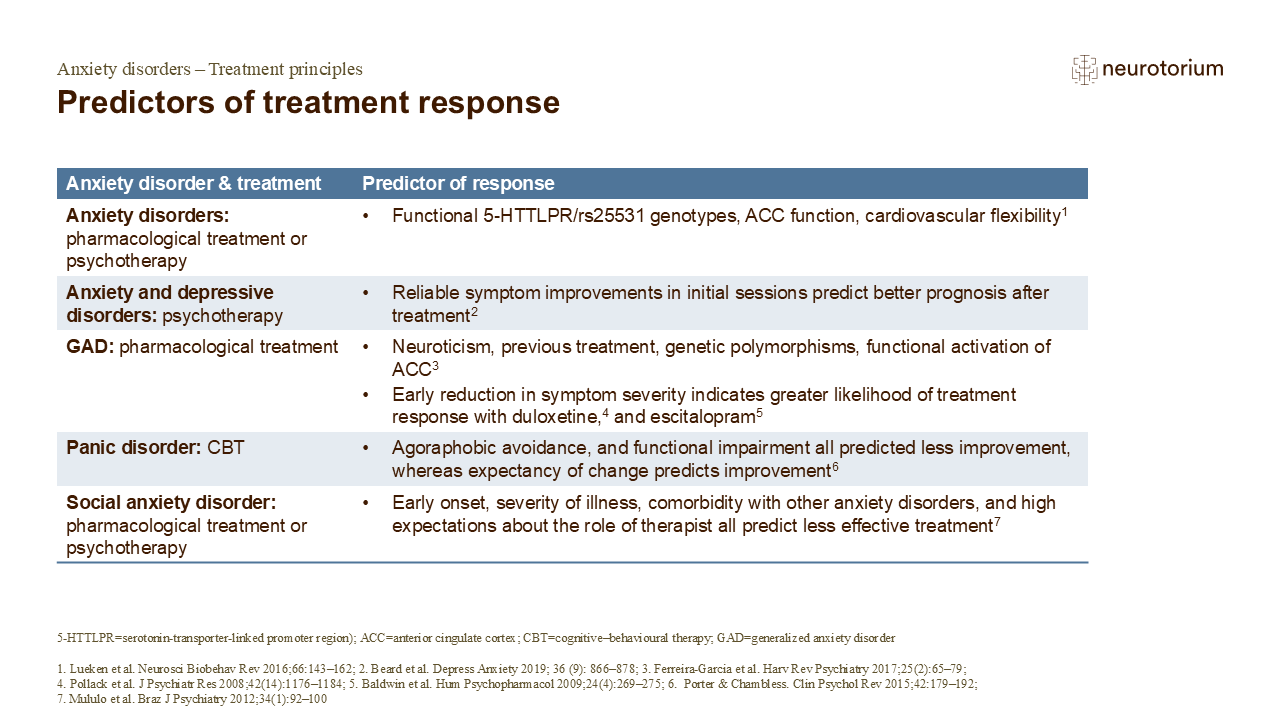
Numerous predictors of treatment response have been identified from reviews of the literature.1-7
References:
1. Lueken U, Zierhut KC, Hahn T, et al. Neurobiological markers predicting treatment response in anxiety disorders: a systematic review and implications for clinical application. Neurosci Biobehav Rev 2016; 66: 143–162.
2. Beard JIL, Delgadillo J. Early response to psychological therapy as a predictor of depression and anxiety treatment outcomes: a systematic review and meta-analysis. Depress Anxiety 2019; 36 (9): 866–878.
3. Ferreira-Garcia R, Mochcovitch M, Costa do Cabo M, et al. Predictors of Pharmacotherapy Response in Generalized Anxiety Disorder: A Systematic Review. Harv Rev Psychiatry 2017; 25 (2): 65–79.
4. Pollack MH, Kornstein SG, Spann ME, et al. Early improvement during duloxetine treatment of generalized anxiety disorder predicts response and remission at endpoint. J Psychiatr Res 2008; 42 (14): 1176–1184.
5. Baldwin DS, Stein DJ, Dolberg OT, Bandelow B. How long should a trial of escitalopram treatment be in patients with major depressive disorder, generalised anxiety disorder or social anxiety disorder? An exploration of the randomised controlled trial database. Hum Psychopharmacol 2009; 24 (4): 269–275.
6. Porter E, Chambless DL. A systematic review of predictors and moderators of improvement in cognitive–behavioral therapy for panic disorder and agoraphobia. Clin Psychol Rev 2015; 42: 179–192.
7. Mululo SC, Menezes GB, Vigne P, Fontenelle LF. A review on predictors of treatment outcome in social anxiety disorder. Braz J Psychiatry 2012; 34 (1): 92–100.