

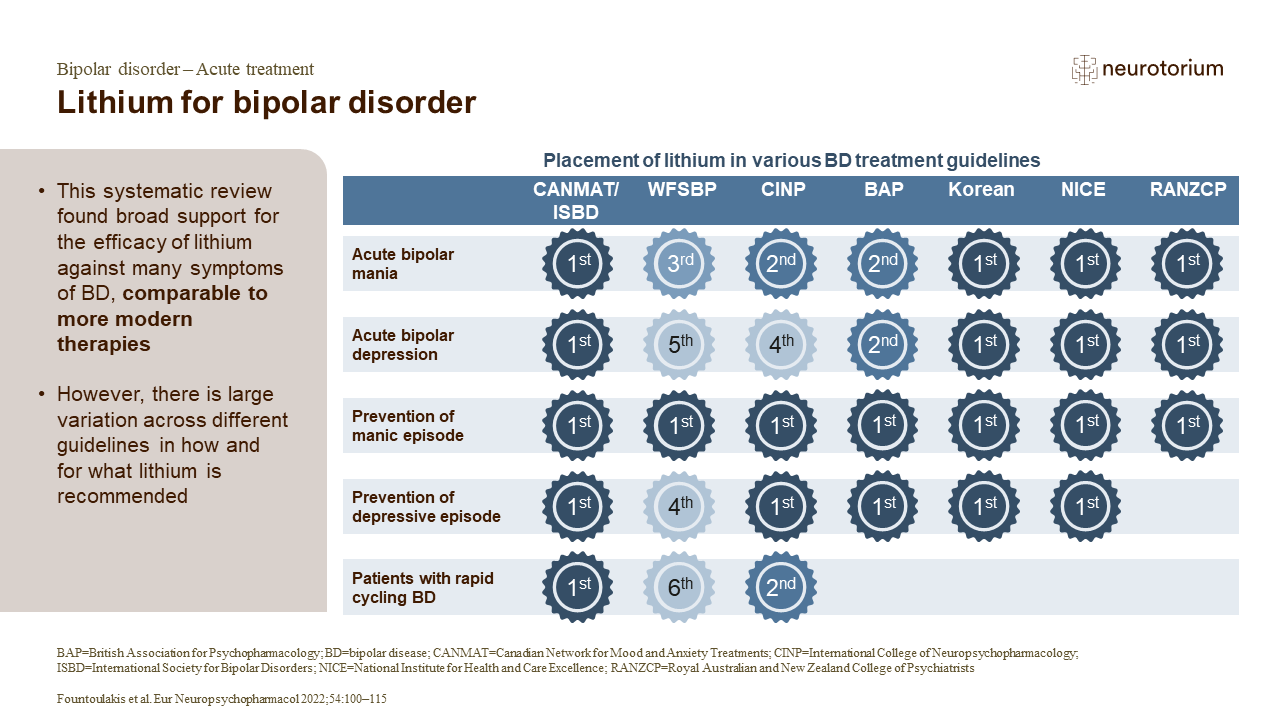
In more recent times, the prescription of lithium has decreased, partly because studies of lithium efficacy tend to be older studies, which are not as methodologically rigorous as modern clinical trials.2 Therefore, although lithium is an established treatment for bipolar disorder that has been used for many decades, there is a discrepancy across treatment guidelines about whether or not it is recommended as a first-line therapy. Beyond research standards, there are some errors in reasoning that can affect the development of guidelines and treatment consensus:3
- The ‘Woozle effect’ – (evidence by citation) whereby a source is widely cited for a repeated claim that the source does not actually support.
- Reference inflation – whereby the findings of cited studies are misrepresented.
- Belief perseverance – whereby a belief is maintained, despite new evidence to the contrary.
These errors in method and logic can occur over time, making it important for peer reviewers, researchers, authors, and readers to be ever vigilant against them.3
References:
1. Fountoulakis KN, Tohen M, Zarate CA Jr. Lithium treatment of bipolar disorder in adults: a systematic review of randomized trials and meta-analyses. Eur Neuropsychopharmacol 2022; 54: 100–115.
2. Won E, Kim YK. An oldie but goodie: lithium in the treatment of bipolar disorder through neuroprotective and neurotrophic mechanisms. Int J Mol Sci 2017; 18 (12): 2679.
3. Kelly T. Lithium and the Woozle effect. Bipolar Disord 2019; 21 (4): 302–308.