

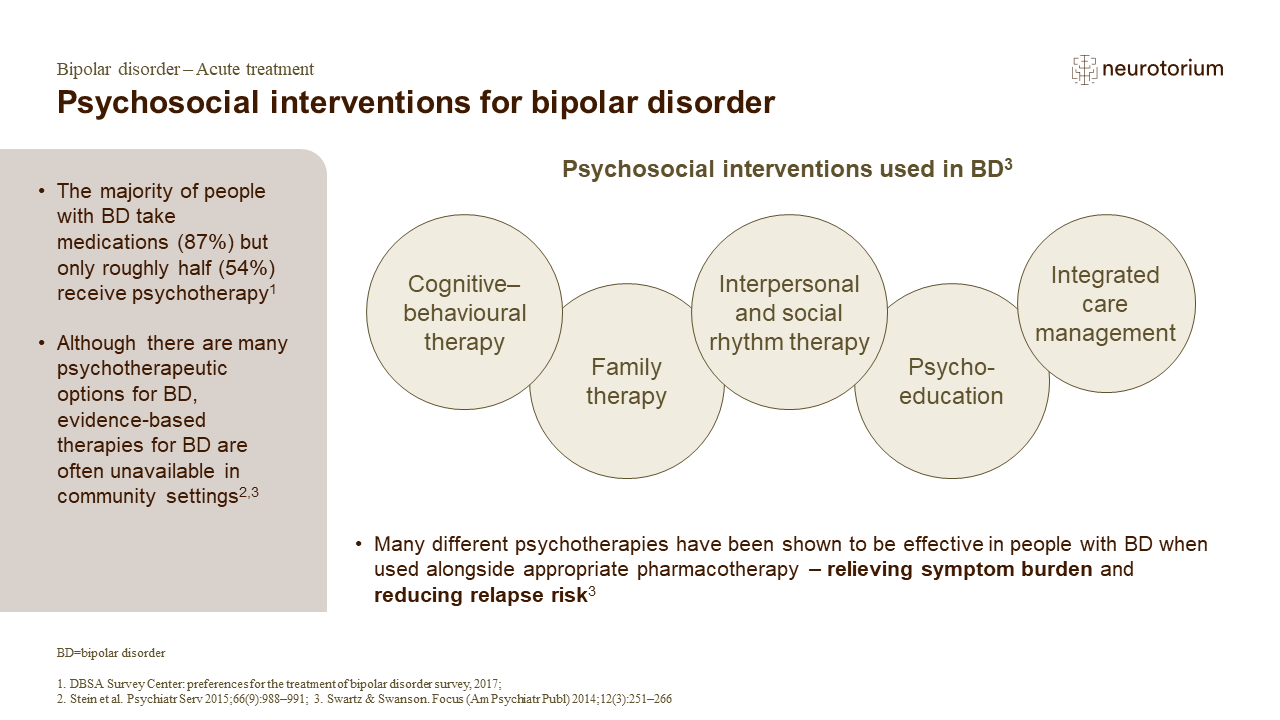
The Depression and Bipolar Support Alliance (DBSA) surveyed 2,969 people with bipolar disorder or their family or caregivers about treatment.1 Whilst the majority of respondents (87%) received pharmacotherapy, roughly half were receiving psychotherapy; indeed, only 10% of people with bipolar disorder were being helped through support groups.1 Regarding treatment options, approximately half of patients less than 30 years old preferred cognitive–behavioural approaches delivered individually, whilst the majority of caregivers preferred the idea of caregiver support/education sessions.1
References:
1. Depression and Bipolar Support Alliance Survey Center. Preferences for the Treatment of Bipolar Disorder Survey, Summary Report; May, 2017. Available at: https://www.dbsalliance.org/wp-content/uploads/2019/02/DBSA_Survey_Center_BPD_Treatment_Preferences_FINAL.pdf. Accessed February 2024.
2. Stein BD, Celedonia KL, Swartz HA, et al. Implementing a web-based intervention to train community clinicians in an evidence-based psychotherapy: a pilot study. Psychiatr Serv 2015; 66 (9): 988–991.
3. Swartz HA, Swanson J. Psychotherapy for bipolar disorder in adults: a review of the evidence. Focus (Am Psychiatr Publ) 2014; 12 (3): 251–266.