

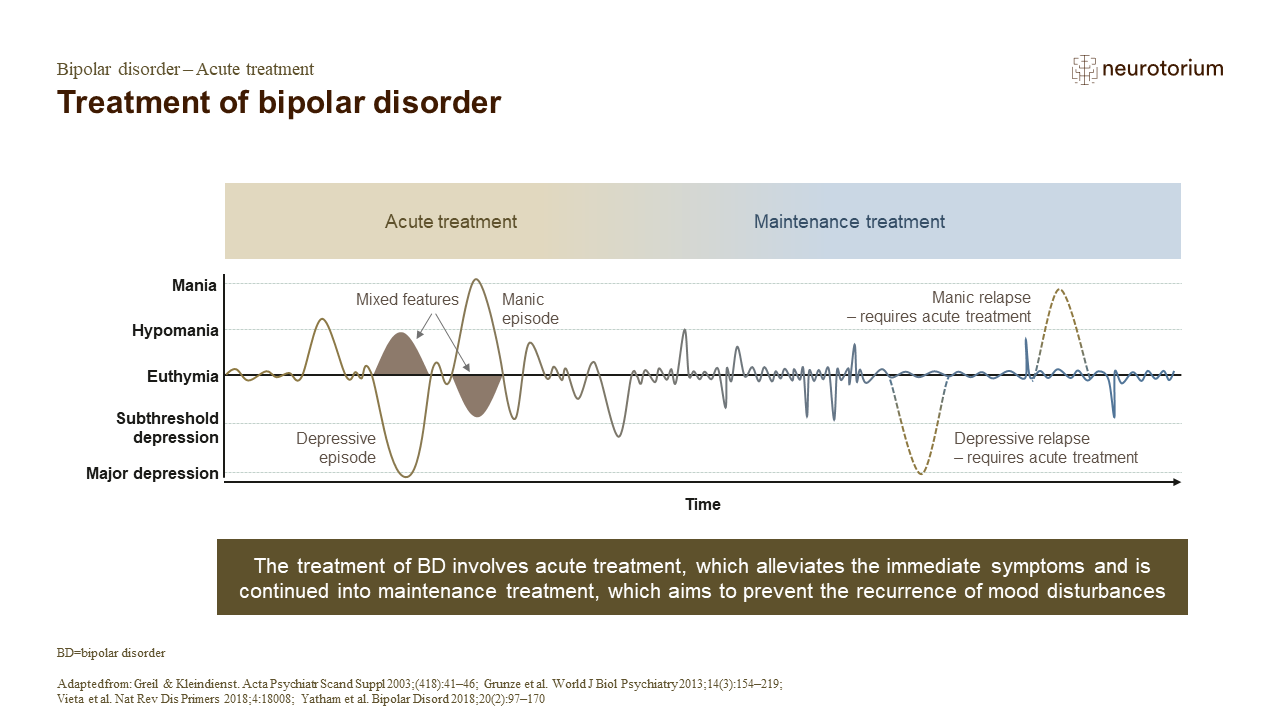
Bipolar disorder describes a complex group of serious chronic psychiatric disorders.5 Bipolar disorder has a substantial impact on the patient, through impact on functioning and quality of life, and also in terms of morbidity and mortality.5 It is therefore critical that people are treated appropriately, in a timely fashion, to avoid wherever possible the negative impacts that the symptoms of bipolar disorder can have.5
References:
1. Greil W, Kleindienst N. Concepts in the treatment of bipolar disorder. Acta Psychiatr Scand Suppl 2003; (418): 41–46.
2. Grunze H, Vieta E, Goodwin GM, et al.; WFSBP Task Force on Treatment Guidelines for Bipolar Disorders. The World Federation of Societies of Biological Psychiatry (WFSBP) guidelines for the biological treatment of bipolar disorders: update 2012 on the long-term treatment of bipolar disorder. World J Biol Psychiatry 2013; 14 (3): 154–219.
3. Vieta E, Berk M, Schulze TG, et al. Bipolar disorders. Nat Rev Dis Primers 2018; 4: 18008.
4. Yatham LN, Kennedy SH, Parikh SV, et al. Canadian Network for Mood and Anxiety Treatments (CANMAT) and International Society for Bipolar Disorders (ISBD) 2018 guidelines for the management of patients with bipolar disorder. Bipolar Disord 2018; 20 (2): 97–170.
5. McIntyre RS, Berk M, Brietzke E, et al. Bipolar disorders. Lancet 2020; 396 (10265): 1841–1856.