

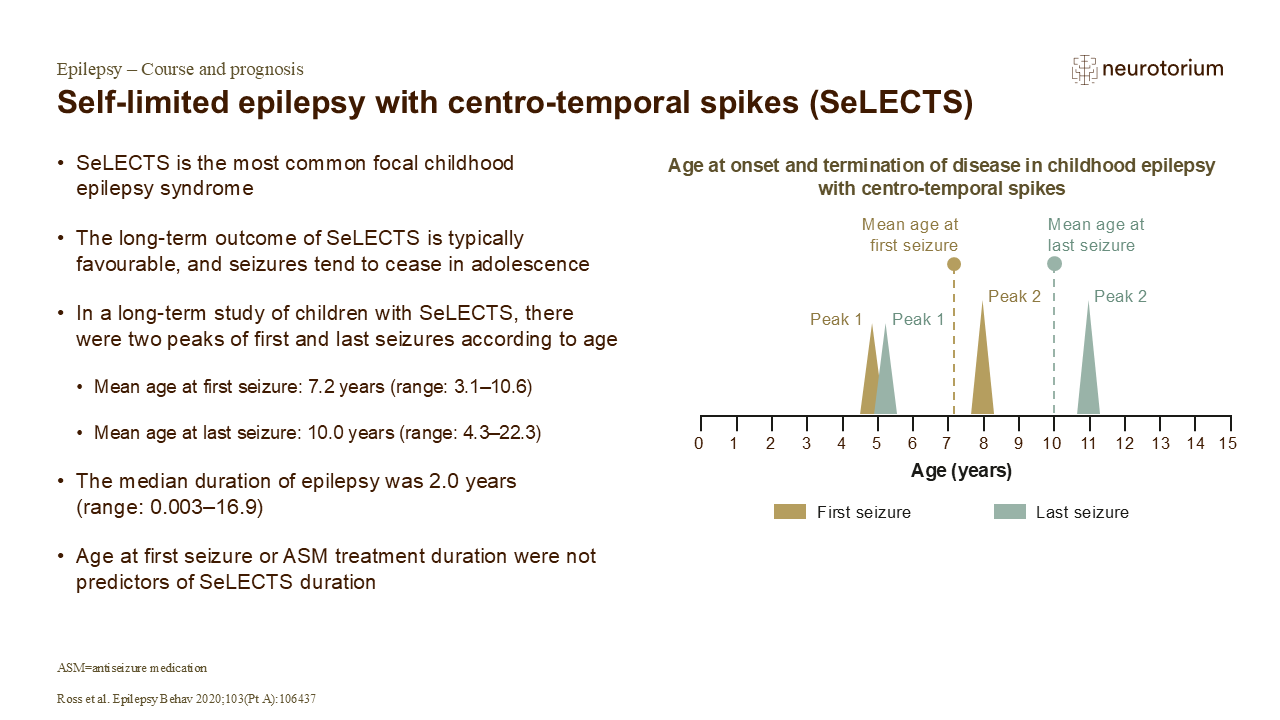
A prospective, longitudinal US cohort study evaluated the neuropsychiatric profiles and the seizure course of children diagnosed with self-limited epilepsy with centro-temporal spikes (SeLECTS).1 The study followed 60 children for a mean period of 16 years from epilepsy diagnosis (defined as ≥2 unprovoked seizures on separate days) through to disease resolution.1
Prior to receiving a SeLECTS diagnosis, 17 of the children had a neuropsychiatric concern, most commonly attention deficit hyperactivity disorder (ADHD) and/or a learning difficulty.1 Of the 55 children for whom longitudinal follow-up was available, 17 reported at least one new diagnosis without a related pre-morbid concern.1 Mood disorders were the most common postmorbid diagnosis.1 The development of a new psychiatric diagnosis was shown to be predicted by the presence of a premorbid neuropsychiatric concern; no such relationship was observed for age at epilepsy onset, duration of exposure to antiseizure medication (ASM), duration of epilepsy or seizure count.1
There was a bimodal trend in the distribution of age at first and last seizure, with peaks near 5 and 8 years for first seizure, and 5 and 11 years for last seizure, respectively.1 A quarter (15 out of 60) of the children experienced no further seizures after study enrollment.1 Approximately 70% (42 out of 60) of children received ASM treatment for at least one month, with a median treatment length of 2.13 years after their last seizure; 16 children were trialled on more than one ASM.1
Neither age at first seizure nor treatment duration were predictive of epilepsy duration; however, having a neuropsychiatric concern prior to SeLECTS diagnosis was associated with a longer disease duration and a higher total number of seizures (p=0.02 for both).1 The length of time spent free from seizures was a reliable predictor of remission, with 37 children achieving final remission after 12 months of being seizure free, and 51 children achieving final remission after 24 months of being seizure free; in other words, each additional month spent seizure free reduced the risk of a subsequent seizure by ~6.5% (p<1e-10), regardless of whether the child was receiving ASM treatment or not.1
Reference: