

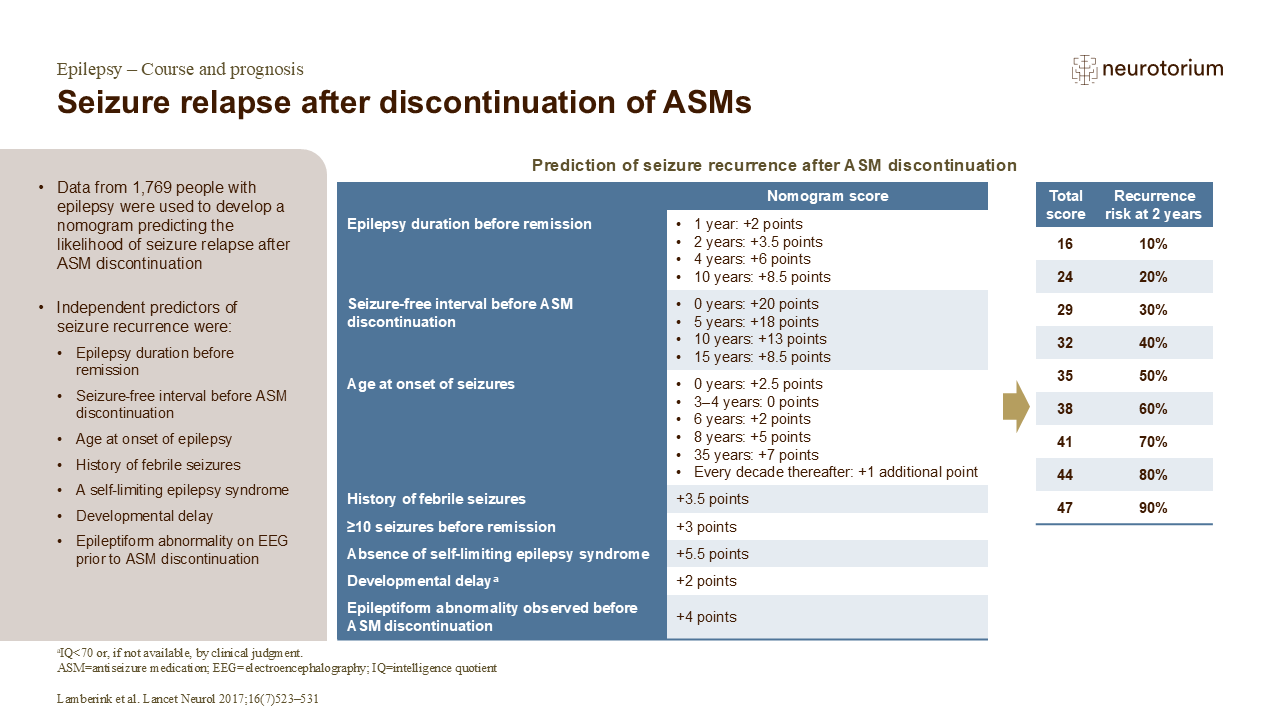
Using data from a meta-analysis of 1,769 patients with epilepsy, Lamberink et al. have developed individualized prediction models for the likelihood of seizure recurrence, and for the likelihood of long-term seizure freedom, after antiseizure medication (ASM) withdrawal; the model for predicting the likelihood of seizure recurrence is outlined on the slide.1 In either model, specific values for the respective predictors are assigned a specific number of points, which when added up to a total score then have a corresponding likelihood of the outcome evaluated by the model.1 Plotting the predicted outcome probabilities against the observed proportions showed good calibration for both models, which can therefore be used directly in clinical practice to calculate the chance of both outcome measures at specific timepoints for each individual patient.1
Outcome predictors used by both models include epilepsy duration before remission, the length of time a person spent seizure free before ASM discontinuation, number of seizures before remission, and the presence of an epileptiform abnormality on electroencephalogram before ASM discontinuation.1 Other factors were an important predictor for only one of the outcomes, e.g., age at onset of epilepsy was an important predictor for seizure recurrence, but not for long-term freedom from seizures.1
The authors were careful to point out that in addition to the likelihood of the outcome, many more considerations are present in the decision to discontinue ASM in seizure free patients, and clinicians should be aware of the way they present these prediction models to patients, to avoid steering patients towards a specific choice.1
Reference: