

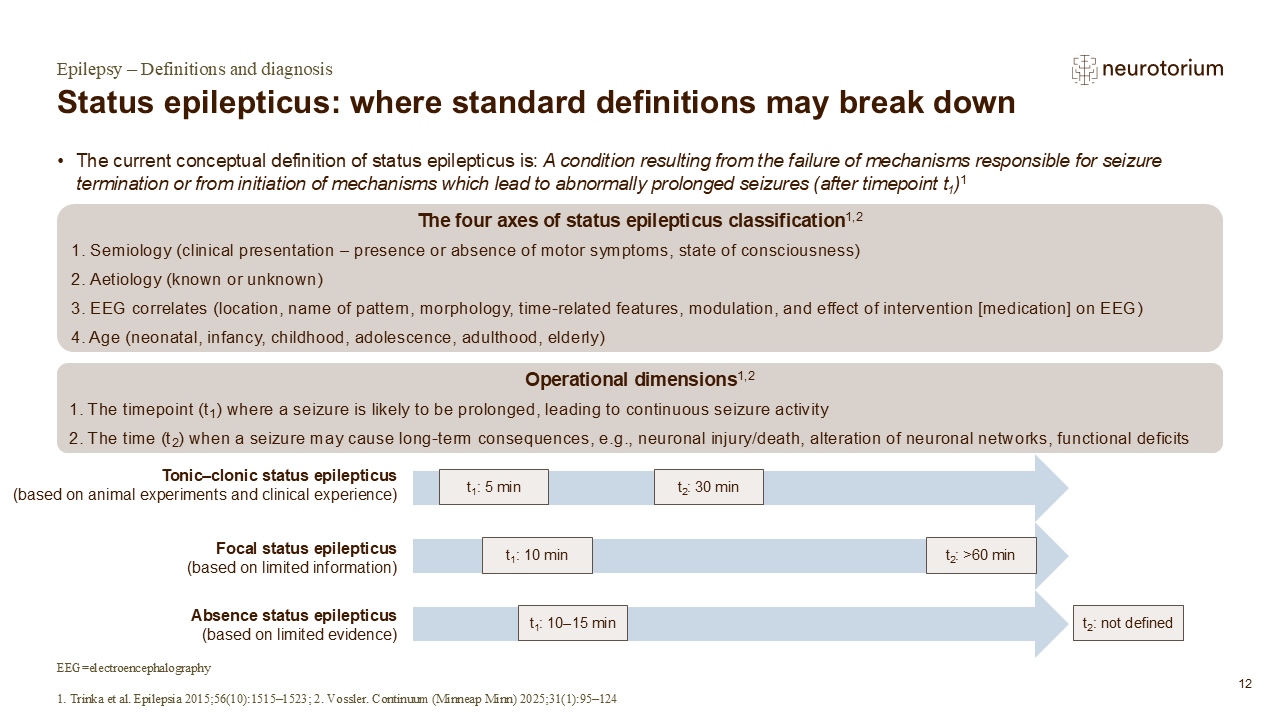
Under ideal circumstances every patient should be categorized for each of the four axes, although this may not always be possible.1 At the initial presentation, age and semiology will typically be apparent, whereas the aetiology may take time to determine.1 EEG will likely not be available at the time of presentation.1
Forms of status epilepticus with prominent motor symptoms and impairment of consciousness are considered to be convulsive status epilepticus, and otherwise they are considered as non-convulsive status epilepticus.1
References:
1. Trinka E, Cock H, Hesdorffer D, et al. A definition and classification of status epilepticus – report of the ILAE Task Force on Classification of Status Epilepticus. Epilepsia 2015; 56 (10): 1515‒1523.
2. Vossler DG. First seizures, acute repetitive seizures, and status epilepticus. Continuum (Minneap Minn) 2025; 31 (1): 95‒124.